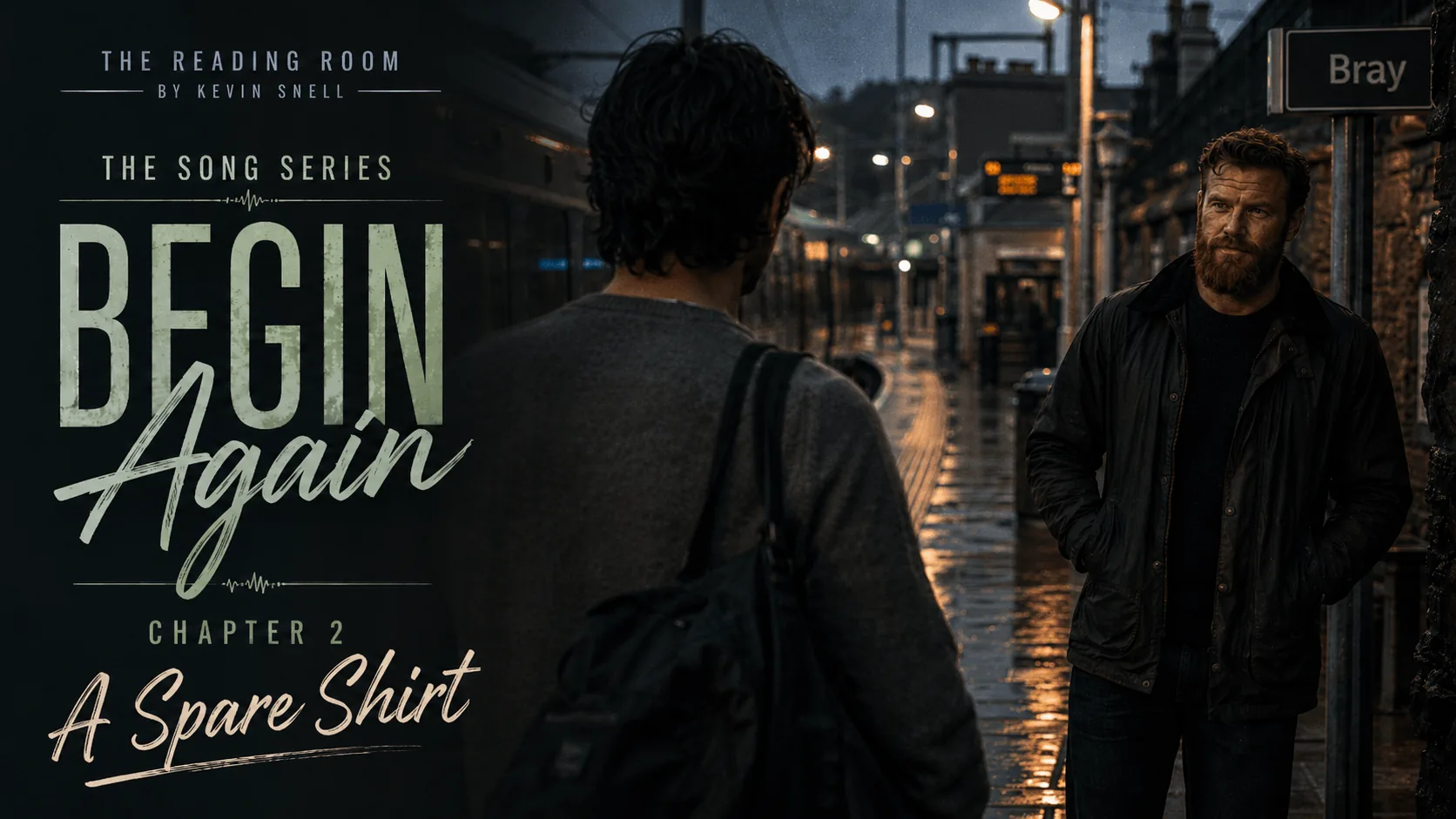
The bag had been under the bed for three months. It came out with a grey seam of dust along one side, and Evan stood in the cold of the flat and hit it twice with the flat of his hand. The dust went up into the light and came down again on everything.
A boarding pass sat in the side pocket. Dublin to Chicago, never used, a flight Nolan had booked for the two of them the summer before last and then hadn’t wanted to take. Evan took it out and held it, and then he put it on the bed, and then he carried it to the bin in the kitchen and came back.
The bag took four minutes. A shirt, laid in flat, and a second in case the first was wrong. Socks, the good jeans. His charger, after he’d already zipped the bag once.
The T-shirt took twenty. He slept in one, so it went in, and then it came out again, because packing something to sleep in was a position on what would be happening in that bed and he wasn’t ready to hold a position in his own flat on a Saturday morning with the heating clicking. He stood over the bag with it in his fist and had the argument out loud, in the empty room, both sides, and lost.
He dressed last. A jumper hung there that he wore when he wanted to be looked at. He took it down, held it, put it back. Then he pulled Wednesday’s grey one over his head instead, unwashed since, and left the other lying on the bed with the sleeves out.
He’d packed for two nights. Nobody had said a word to him about two nights.
He watched himself do it. That was what would have made a psychiatrist put down her pen. Nothing was carrying him along that he couldn’t see. It was all visible, item by item, and he kept on doing it. When he was finished he stopped in the doorway of his own bedroom over a bag that was too heavy, knowing exactly what it meant. He shouldered it and left.
On the stairs he built the sentence.
It’s just a spare shirt. Light, mild, thrown away, half a shrug in it. Or the flatter version, if the flat one was needed. Ah, it’s nothing, I always overpack. Or the one with the self-deprecation, the strongest of the three, polished on the walk up Camden Street with the rain not quite starting, I’ve never in my life travelled light, ask anyone, and he liked that one, he liked the ask anyone, it opened out and it gave the other person somewhere to go and it said nothing at all.
He put it away where he could reach it.
The DART came in at Pearse. He got on with the bag between his boots, and the city ran out under the grey. Everything on either side of him was the backs of things, the houses and the yards with the good sides all turned away—and then Booterstown, and then the sea arrived on his left without any announcement at all.
It was flat and it was the colour of the sky and it ran out to nothing.
Nolan had a way of agreeing to a journey. Of course. Then, when. Then, mildly, from a doorway, here’s the thing—and what followed was never a refusal. It was an itemisation. Evan’s want, priced line by line, and the invoice presented so reasonably that objecting to it would have been the unreasonable act. Nolan hadn’t refused him anything in four years, and Evan had come out of those years able to recite every single thing he’d ever asked for.
The train held the water on its left and the light came off it and a man in Bray had told him to bring a bag.
He got hard on the seat somewhere around Blackrock and had to put the bag on his lap, and it wasn’t the beard, or the hands, or the size of him. It was being told. A man had given him an instruction on a towpath and he’d gone home and he’d done it and he was sitting on the coastline on a Saturday with the evidence between his knees.
The train wasn’t for Bray. The train went on to Greystones and it went through Bray on its way and it wouldn’t care in the slightest if he stayed on it. He checked the display. He checked it again after Dún Laoghaire, and again after Dalkey, and his hand stayed on the strap of the bag the whole way down, and there he was, the whole shape of him, laid out on a plastic seat.
He’d never once believed that the thing he wanted would still be there when he arrived.
It was forty minutes. He’d have done four hours.
Cian was leaning on the wall outside the station with his hands in his pockets, and Evan had a few seconds of him through the glass before he was seen himself.
He’d expected the gear. Some part of him had spent three days putting the man in a harness and a hard hat and had built the whole Saturday around a beard with sawdust in it, and there was no harness. A waxed jacket, a dark jumper under it. Boots that had been cleaned, actually cleaned, this morning, by hand. A beard that was dry and brushed, darker at the jaw than it was in Dublin. He’d shaved his neck. There was a clean line under the beard where the razor had gone.
He’d got ready. He’d stood in a bathroom in Bray and got ready for this.
Evan stood inside the doors with his bag and looked at him and let himself have it for three seconds, because there was glass between them and no obligation to be a person.
Then he pushed out into the cold, and Cian turned his head and saw him.
His shoulders came down, the whole line of him dropping half an inch, and his hands left his pockets, and he was walking. He came off that wall and across the forecourt, three strides in before anything at all had crossed his face. What crossed it then wasn’t a smile. Or it was, but the smile was the last part of it and the least of it, and by then Evan couldn’t swallow.
In four years nobody had once been pleased to see him arrive.
The burn climbed his throat. Then his ears, then his face. It was cold on that forecourt with rain coming, and he couldn’t blame a single bit of it on the weather. Cian walked up and stood in front of him and didn’t look away from it.
His eyes found the bag.
Here it came. Evan had the sentence and the sentence was good, it was the ask anyone version, it was warm and it was nothing and it would land and it would put the bag away for good, and he had it up and ready in his mouth with the shape of the first syllable already made.
Cian didn’t say anything about the bag.
He didn’t reach for it or acknowledge it. And he wasn’t pleased with himself. Evan had been braced for pleased since Camden Street. The absence held a beat, and Evan let it be a door Cian had left open. Then Cian was looking at his face instead and the moment was gone and the sentence was still sitting there with nowhere on God’s earth to go.
“You’re wet,” Cian said. “Come on out of that.”
And Evan heard himself say, “I packed for two nights.”
Cian stopped.
He’d already started walking, and he didn’t turn around. He stood with his back half to the road.
“Grand,” he said.
Nothing else came. They went east.
The wind came up Quinsboro Road to meet them, full of the sea before there was any sea. Then the road ran out and gave it to them at once—the promenade, the rail, the water the colour of the sky, the pebbles going down grey and wet to the edge of it.
“That’s the Head,” Cian said, and put his chin towards the south, where the land came up out of the sea in a great green shoulder with the top of it in cloud. “You can walk it. Takes an hour if you’re not messing. It’s a swamp in this weather and people go up in runners and then they’re on the news.”
“And Dublin’s back that way.”
“Dublin’s back that way.” He didn’t turn to look at it. “You’ll not see it today.”
He stopped at the rail and put a hand on it, and he turned his back on the water, inland, west, over the roofs.
“I’m up there,” he said. “Two streets in behind the Dargle. You’d walk it from the station in ten minutes and you’d not know you were doing it.”
He gave it to Evan for nothing. Evan would be walking it. Some version of the next while had Evan coming off that train and doing that walk without being met. Neither of them went near it. Evan stood at the rail with his ears burning in the cold, holding directions to a place he hadn’t been invited to yet.
The gulls sat on the water facing into the wind, all of them pointed the same way, and not one of them going anywhere either.
They walked south. Cian told him nothing about the town, not when the promenade was built or who’d built it or what had been there before. He told him the chipper was gone, the good one, and the one there now was a disgrace, and that a fella had come down in the summer and set up a stall selling ice cream at four euro a cone. “Sure, we’re all being robbed,” he said, the same as he’d said it about the coffee in the mountains, and the whole town was in it, and it was worth more than a plaque.
They crossed at the lights and the wind hit them broadside coming off the water and Cian’s hand arrived on Evan’s hip.
It arrived the way it had arrived on the towpath—without ceremony and without asking—and it put him where it wanted him. On the front of him this time, not the back, the whole arm across Evan’s body to do it. A car was turning, and the hand had its reason. The car turned and cleared and the account was closed and they made the far kerb and the hand had not moved.
Evan didn’t move away.
It came out of nowhere and it was the only decision he made all afternoon and nobody saw him make it. He walked south on a public promenade in the town where this man lived, with a hand on his hip and half a foot of height leaning down into his ear, and every person coming north past them saw it, and Cian didn’t check a single face. He was saying something about the tide and the pipe that came out under the stones and Evan couldn’t have repeated one word of it. The beard was at his temple. His body had emptied out of everywhere else and gone to a patch of hip the size of a hand.
“—which is why you’d not swim it,” Cian said. “You listening to me at all?”
“No.”
“No,” Cian agreed, and the hand tightened once, and they went on.
The café was up off the seafront with steamed windows and Evan ordered the big breakfast.
He did it fast, before he could arrange it. The menu ran to a soup, a sandwich, and an all-day fry with an extra egg and an extra sausage. He heard himself order the fry. Then he sat in a hot room with his coat on the back of the chair and waited.
It was a practised wait. He kept the laugh loaded so he could get there first.
Cian ordered a fry as well, a pot of tea, a slice of coffee cake. He took his jacket off and hung it up, and asked Evan whether he’d been on the Head yet.
That was all. That was the verdict.
The food came, enormous and good, and Evan ate all of it. About halfway down Cian pointed at his plate with a fork and said, “Are you going to eat all them chips?”
“Do you want a chip?”
“I do.”
“Then take a chip.”
“I’m asking you,” Cian said, “because they’re your chips,” and he took one, and ate it, and nothing followed. Evan sat there with a fork in his hand and his eyes stinging over a plate of chips in a café in Bray.
The cake came with two forks. Cian hadn’t asked for two forks. He’d ordered it at the counter before he sat down.
“So why here?” Evan said. “Bray. Was it the yard?”
Cian pushed the plate to the middle of the table.
“Enniskerry’s twenty minutes,” he said. “Dublin’s on the train if I want it, which I don’t, but it’s there. The sea’s out the door.” He turned his mug a quarter turn on the table and left it. “And it was what I could afford on my own when I needed to be on my own.”
He didn’t change his voice for the last one. He said it flat and useful, the fourth item in a list of four, and he picked up his fork and had a bit of the cake.
Evan went looking for the hook.
He did it before he could stop himself. He searched the sentence for the fold in it, the barb that would be produced in six months as evidence that Evan had been told and had chosen not to listen. There wasn’t one. He searched it again anyway, and searching it cost him, because the habit wasn’t Cian’s and never had been.
He put his fork down.
“That’s a lot of things going right at once,” he said.
“It is,” Cian said. “That happens.” And he ate his half of the cake.
The rain came in at the window while they were on the tea, and it came in properly, straight off the water. The glass greyed over and the promenade emptied in under a minute. Cian watched it come, and then his own hands on the table.
“There’s a thing I’ll tell you,” he said, “and it’s not a good story, and I’d rather you had it from me than found out I’d been sitting on it.”
“Okay.”
“Fintan wants to sell me twenty percent.”
He said it and then he picked his mug up and drank out of it, and left it standing in the middle of the table.
“Of the company.”
“Of the company. He’s sixty-one. He’s a bad back and a daughter in Perth and he wants out in stages, and the stages start with me.” Cian turned the mug again. “He’s not doing me a favour. He’s doing himself one. If I go, he’s a business he can’t run and can’t sell.”
“And you want it.”
“I want it so bad I’ve not slept properly in a month.” He said that in the same flat voice, and then he stopped, and his jaw closed once and stayed closed. “And I’d have to borrow it. All of it. Against nothing, because I’ve nothing, because I’m a man with a van and a flat I rent.”
“What’s the number?”
Cian told him.
And there it was, on the table between them, in a café in Bray with the rain going sideways past the window, and it was less than Evan’s portfolio moved in an ordinary month.
It assembled itself. It was up and out of him and in his throat before he’d had any part in it, and it was so simple, and it would take nothing, and it wasn’t even generous, it wasn’t even a gift, it was a rounding error and the man across the table hadn’t slept in a month.
I could—
He closed his mouth on it.
“What are you actually afraid of?” he said instead. “Not the money. The other thing.”
Cian looked up.
“That I’ll not climb,” he said. “That I’ll be forty-five and I’ll be answering emails about hedges and I’ll have a lad up the tree doing the only part of it I ever wanted.”
“So you’d be Fintan.”
“So I’d be Fintan.”
The rain kept at the window. Evan asked him about the insurance, and Cian told him. He asked what happened if a lad went off a rope on his watch, and Cian’s hands went flat on the table answering that one. He asked whether there was a version where he took ten instead of twenty. Cian had asked. Fintan had said no, and Cian didn’t know why. They worked it for twenty minutes, and every question was a place where Evan could have put the sentence down and didn’t.
He was proud of himself.
He let himself have it. He sat in a warm café with his tea going cold and marked it down as growth, and it did not occur to him even once that he’d kept his mouth shut for exactly the same reason he’d kept it shut about the jumper and the bag and the size of his lunch. The only difference this time was that the silence had happened to be right.
“That’s the rain in for the day,” Cian said.
He said it looking out the window and he let it sit there, and then he turned back and put both forearms on the table.
“So. There’s another hour of the seafront in it if you want it, though you’ll be soaked and there’s nothing down there worth being soaked for. There’s the train back up, and you’d be home before dark.” He didn’t blink. “Or there’s mine.”
And there it was, the road out, laid on the table beside the teapot. The rain was right there. It’s lashing. There’s no point in walking. Sure, we may as well. They were all true. And each of them was a way to arrive at that flat without ever once having wanted to be in it, and he could hear himself saying them, mild and reasonable, half a shrug in it, and he could see the whole rest of the day happening to him.
He’d been letting things happen to him for four years.
“Yours,” he said.
Cian didn’t smile at that. His jaw set. His eyes dropped to the table and came back up, and by then it was finished. He stood, put his jacket on, took his wallet out.
“I’ve it,” Evan said.
“You’ve not.” Cian counted his own out on the table to the euro and put it under the sugar. He made no speech about it. He didn’t look at Evan while he did it and he didn’t look up after, and it was the cleanest thing Evan had ever watched anybody do.
They went out into it.
The flat was two rooms and a galley and it was warm, and the first thing in it was a clothes rack.
It stood in front of the radiator with the whole week hanging off it. Base layers, black, five of them. Two pairs of thick socks. A long-sleeved thing with a hole worn through at the elbow, kept anyway. The radiator ran flat out underneath the lot of it, losing. The air in the room held the smell of damp cloth drying—his work coming home with him and staying the night.
A flask stood on the counter with the cap off. One good pan on the hob and nothing else, no rack of them, no set, just the one, black and heavy and used. Two mugs on the draining board, and one of them had a chip out of the rim and a cartoon horse on it, and nobody living on his own had bought it.
And on the table, beside the laptop, there was a stack of paper with a biro sitting on top of it.
Evan went over and looked at it without touching it, because he couldn’t not. Invoices. Actual paper invoices, gone through by hand, ticks in the margins, three of them turned face down and squared off in a separate pile. A man had sat at that table on a Thursday night after being up a tree since seven and sat over his post.
There was a chestnut in Roundwood with a limb hanging over the front of a roof, and somebody had written to Evan about it three times, and Evan had read all three. He didn’t know the man’s name.
Cian came through from the hall with a towel and stopped in the doorway, and he put a hand on the frame of it and left it there, and he didn’t come any further into the room.
He looked at Evan for as long as he wanted to. He wasn’t hiding it and he wasn’t hurrying it, and he hadn’t opened his mouth, and Evan stood dripping on a stranger’s carpet and was looked at.
“You’re soaked through,” he said.
“So are you.”
“I am.” He held out the towel. “Bathroom’s there. The grey thing goes on the rack.”
Evan took it. His hair was dripping and the grey jumper was black at the shoulders and his bag was at his feet with two nights in it, and he stood in a warm room holding a towel and didn’t go to the bathroom.
“Do you want me naked?”
It came out with nothing in front of it. No shrug, no half-laugh, no ah look, none of the machinery. It landed in the middle of the room and sat there. The heat did what it always did, up the throat and into the ears, and he stood in it and let it happen.
Cian didn’t blink.
“I do,” he said. “Get dry first.”
He said it and went past him into the galley and put the kettle on. Evan held the towel in his fist, his heart hammering, and he was harder than he’d been on the train.
He took the bag in with him, and in a stranger’s bathroom he turned the whole of it out on the floor for the T-shirt, both shirts out, the socks out, the charger out onto the tiles, all of it upended for one T-shirt.
He came out in it and briefs with his hair wrecked, the bag over his shoulder and the wet clothes in his fist. He put them on the rack himself, the grey jumper and the jeans, in among the base layers. Nobody had told him to. He wanted to have done it.
And Cian was leaning against the counter with his arms folded, and he looked.
There was none of that business of looking and then finding something else to look at. His eyes took Evan’s legs, and his chest through the T-shirt, and the front of his briefs, which had nothing to hide and wasn’t hiding it. He took his time and he didn’t disguise a second of it. Evan stood in a stranger’s living room in his underwear at four in the afternoon with nowhere in the world to put his hands.
“Come here,” Cian said.
Evan went.
“Right.” Cian pushed off the counter. He was close, rain and wax on him and the ghost of two-stroke, and his eyes crossed Evan’s face and settled. “Before anything. This is the boring bit and we’re doing it standing up, before either of us takes anything else off.”
“Okay.”
“I’m clean. Tested eleven weeks ago and there’s been nobody since. You’ve my word on that and you’ll have the paper if you want it.”
“I’m clean. Three months. There’s been nobody since either.”
“Grand.” He didn’t dress it up and he didn’t dwell in it, and it was gone as fast as a rope rating and it weighed about as much. “Second thing. What I said on the towpath stands. In bed I’ll not be asking you every time. I’ll not be checking in on you and I’ll not be looking for a yes off you before I put a hand anywhere, because if I have to do that then neither of us is going to enjoy the evening.”
“I know.”
“So the word is stop.”
Evan’s mouth had dried out.
“Stop,” Cian said. “That’s the whole of it. You say stop and I stop, whatever’s happening, wherever it’s happening. You don’t have to give me a reason. You don’t have to be sure or right. You just have to say it.” He put a hand flat on Evan’s chest, over the T-shirt, over the breastbone, and left it there. “If you say it and then change your mind after, that’s fine and we’ll start again. If you say it and I’ve to get up and put the kettle on and drive you to the train, that’s fine too.”
“Yeah.”
“Third thing.” A beat. “I’m not going inside you tonight.”
“Cian—”
“I’m not.” His hand hadn’t moved off Evan’s chest. “I’ve known you since Wednesday and you’d say yes to anything I put to you this evening and we both know it.” He was completely matter-of-fact. “So not tonight. There’ll be plenty.”
And it landed in him and went straight to his cock, and it made no sense at all, and it made every sense in the world, because there wasn’t a man alive who’d ever told him in advance what was going to happen to him.
Nolan had never told him anything in advance. You found out afterwards. You always found out afterwards.
“That’s the deal,” Cian said. “Yes?”
“Yes.”
“Good.”
He took Evan’s face in one hand and walked him backwards into the bedroom door and kissed him.
It didn’t start careful. There was no version of it that began at the beginning, because they’d already done the beginning on a towpath in the dark with a bell going somewhere behind them, and this one came straight in at the level they’d left off at and went past it. The door took Evan’s shoulders and Cian took his jaw, thumb up under the bone of it, tilting his head where he wanted it, and the beard was nothing at all now to what it was in the cold. It was hot and it was rough and it dragged, and it burned along his top lip and up under his chin and Evan pushed his face further into it.
His heels came up off the floor. He was against a door with a man half a foot over him and his head was tipped back and his throat was out and there was a hand at his hip pinning him and there was nowhere at all to go, and he got a fist in the beard and pulled, and Cian growled into his mouth, low, and Evan felt it in his teeth.
And he pressed forward, and Evan got the whole answer of him through the denim, hard and heavy against his stomach.
Evan got a hand down and felt the length of it. Cian let him. He stood there and let him, and breathed out through his nose.
“Bed,” he said.
The bag had come off his shoulder somewhere inside the bedroom door and it was still there, open where it landed.
Cian got the T-shirt off over Evan’s head one-handed and dropped it, and Evan’s arms came up across his chest.
He didn’t decide to do it. It was done before he was in the room with it, both forearms crossed over his ribs, over the hair on his chest, over a mole under his left rib he’d had since he was nine, over all of it, and the window was behind him with the grey going out of the afternoon and there wasn’t a lamp on in the flat and there was nothing in that room to hide behind and nobody had offered him a thing.
Cian stopped.
There was no you’re grand out of him and no hand coming up to take the arms down. He didn’t step back and he didn’t look away, and there was no light to turn off, because it was daylight, and it was on Evan’s chest, and nothing anybody did was going to change that.
He stood there and he looked at him.
The rain kept on at the window. The radiator ticked in the other room. Evan stood in a bedroom in Bray with his arms across himself, a large man half a metre away not moving and not speaking. The seconds went by, and more of them. Nothing came to save him.
He put his arms down.
Cian came in and put his mouth on him. On his throat, and along the shoulder, and down over the collarbone and the middle of his chest with the beard going ahead of it and dragging, and Evan’s hands came up and got nothing and dropped, and he went backwards onto the bed with a man following him down.
The briefs were wet at the front and had been for an hour.
“Sorry,” Evan said.
Cian’s hand came down and closed over him through the cotton.
It didn’t move. It closed over him and it didn’t do a thing, no work in it, no squeeze, nothing, just a hand shut around him with all that weight behind it, and it stayed, and Cian propped himself on his other elbow and looked at his face from six inches away.
“For what?”
“I don’t—” His hips had gone up into the hand without consulting him. “It’s not—I’m sorry, I always—”
“Evan.” The hand stayed exactly where it was. “Tell me what you want instead.”
And the room went very quiet and very hot and there was a hand on his cock and a voice above it and the man attached to both of them was going nowhere.
He couldn’t get it out. He got a breath out. Then a sound, and the sound was awful, thin and unmade, nothing he’d have let anybody hear. Cian didn’t move his hand. He didn’t help him, and he didn’t fill the silence.
“Use your mouth,” Evan said.
It came out low. It came out lower than his voice actually was, and it wasn’t a question and there wasn’t a joke in front of it or behind it, and the second it was out of him his cock jumped under the hand.
Cian’s breath left him.
Evan heard it. He’d carry that. He’d have it on the train home and in the shower on Monday and in a meeting on Tuesday afternoon while somebody talked about engagement metrics. Not the hand. The breath. The man’s whole chest emptying because Evan had said three words to him.
He went down.
He took the briefs off and put them somewhere and got both hands on the inside of Evan’s thighs and pushed them apart and held them there. The hands stayed, big and scarred and hard at the base of every finger, one thumb over an old white scar on his knee and the other pressed up high where the leg met the hip, and they never once left him.
Which left Evan’s hands with nothing.
One went to the sheet and got a fistful and let it go. The other went flat on his own stomach and came off again, unsure he was allowed to touch himself, and he reached back and found the headboard and it was too far and the angle was wrong and it did nothing. He brought the hand down and put it on the back of his own neck, and each one was a hand looking for something to stand behind, and there wasn’t anything, no drink to hold, no joke to make, no wardrobe, no phone, no room in the world to be smoothed over.
There was a mouth on him and a beard on the inside of his thigh and grey daylight on his face and a man looking up the length of him.
That was the worst of it. He was being watched. He’d been watched for an hour on a promenade and watched in a doorway in his underwear and now he was being watched while he was taken apart, and it wasn’t kind and it wasn’t tender, it was somebody keeping an eye on a job, and Evan could not close his eyes. Every time he did, they opened again to check whether he was still being looked at. He was, every time.
The beard scoured. It went where the mouth went and it went along the crease of him and up the inside of the leg and it was going to leave a mark and Evan wanted it to.
Cian was still in his jeans. He hadn’t taken a thing off. He was straining against the fly of them, obvious, and he hadn’t touched himself once or so much as shifted his hips to make it easier, and he was breathing through it in a way you could hear—long, deliberate, worked at, like a man carrying a load down a hill.
Once, and only once, the hand on his left thigh clamped. It was hard enough to bruise and there was nothing decided about it, and then it opened again, one finger at a time, on purpose, and settled back to what it had been.
A man had put a bruise into his leg by accident and taken the grip back finger by finger, and Evan’s breath broke.
He could hear it breaking. He could hear the noise coming up underneath it, the noise, the one with a history, and he got his forearm up over his mouth and bit down on it.
Everything stopped.
The mouth came off him. So did the hands on his thighs. The whole afternoon stopped dead and Evan lay there wet and rigid and exposed to the cold air of the room with a man kneeling between his legs and not one part of either of them touching, and his own arm across his own face.
“Tell me.”
Two words, and nothing else was coming.
Evan lay there. He could hear the kettle ticking as it cooled in the other room, and his heart, and nothing else.
He took the arm off his mouth himself. Cian didn’t touch it. He hadn’t reached for it once.
“He used to laugh at the noises I make,” Evan said.
He said it to the ceiling. He said it flat, without any weight on it, the way you’d read a line off a form. Then he lay there and heard it going around the room. It was out. It was out of him and in the air of a flat in Bray and it could not be got back.
Cian held his eyes on him a long moment.
“Let me hear you, then,” he said.
And put his mouth back on him.
Evan came with his eyes open and his fist in the sheet and a sound coming out of him that he hadn’t made in front of another human being since he was twenty-six, and he was looking at Cian while he did it, and Cian was looking at him, and he didn’t close his eyes, and his arm stayed down on the bed where it was.
Afterwards the room was nearly dark.
Cian got up and went out, and Evan heard the tap running. He lay on his back in a bed he’d never been in, in a town he’d been in twice, wrecked, his chest going, the last of the grey light in the window. He didn’t know what was supposed to happen now. In his experience what happened now was that the other person turned cold, and got up, and had somewhere to be.
Cian came back with a glass of water and a flannel, warm, wrung out.
He put the glass on the floor beside the bed where Evan could reach it and he sat on the edge of the mattress and he cleaned him up. Stomach, and chest, and the mess in the hair below his navel. He did it thoroughly, without hurry, without a single word about it, and then he turned the flannel over and did it again.
Evan lay there and let a man wash him and couldn’t have spoken.
Then he sat up, and reached out, and took the flannel out of Cian’s hand.
He put it on the floor. And Cian let him.
It took a second and it changed the evening. Cian let go of the flannel. He said nothing. He took nothing back. The man who had run every second of that afternoon lay back on his own bed and put an arm behind his head and gave Evan the next move.
Evan got the jeans open.
Cian was uncut and thick and heavy and curved to the left, and Evan got both hands on him and heard the breath go out of the man above him and didn’t care about anything else in the world.
He got his mouth on him.
He couldn’t take much of it and he didn’t try to and nobody in that room treated it as a failure. He used a hand. His thumb worked the foreskin back and went over the head with his tongue and Cian’s hips came up off the bed and his hand came down and got into Evan’s hair, and pulled, and Evan went where he was pulled.
“Slower.”
Evan slowed.
“There. Do that.”
He did that. The voice above him had roughened, half its edges gone, nothing invulnerable left in it. It kept coming, short and low and useful, and each instruction told Evan exactly how to wreck him.
“Christ. Evan—”
The thigh under Evan’s forearm was shaking.
He came with his fist in Evan’s hair and his back off the mattress and a sound that came up out of the floor of him, and Evan stayed where he was and took it, and Cian’s palm came down and flattened on the back of his neck and held him there, and neither of them moved for a long time.
The kettle went on in the other room.
Cian had got up and put it on without saying anything, and Evan lay in the bed and listened to a man moving around a galley in the dark, opening a press, running a tap. He came back in with a jumper and dropped it on the bed. Green, thick, smelling of the rack and the radiator and him.
“Yours is destroyed,” he said. “Put that on.”
Evan pulled it over his head and it came down past his hips and the sleeves swallowed his hands and the warmth of it went straight through him.
Cian sat down on the edge of the bed and started unlacing his boots, which he hadn’t taken off at any point in the entire afternoon.
And the last train was out there. It was out there in the dark on the far side of the Dargle, and it was coming. It would go north up the coast in the rain with its lights on and its doors open, back to a one-bedroom flat in Portobello with a clean floor and a jumper on the bed that he’d rejected. Cian did not mention it.
He didn’t look at a clock and he didn’t ask. His back stayed to Evan, pulling a lace out of a boot, and the kettle came up to the boil in the kitchen and clicked off, and he said nothing at all about the last train.
“I don’t want the last train,” Evan said.
Cian stilled with the boot in his hand.
Then he pulled it off and dropped it on the floor.
“There’s an immersion,” he said. “It’s slow. If you want a shower in the morning you’d want to say it to me tonight.”
Then he went out to make the tea.
Evan sat in another man’s jumper in the dark with his knees up, and at the end of the bed his bag lay where it had come off his shoulder, the mouth of it wide, both shirts still rucked from the bathroom floor and the charger sitting loose on top, none of it folded and none of it packed.
After all the worry, nobody had asked him a single question about it all day.