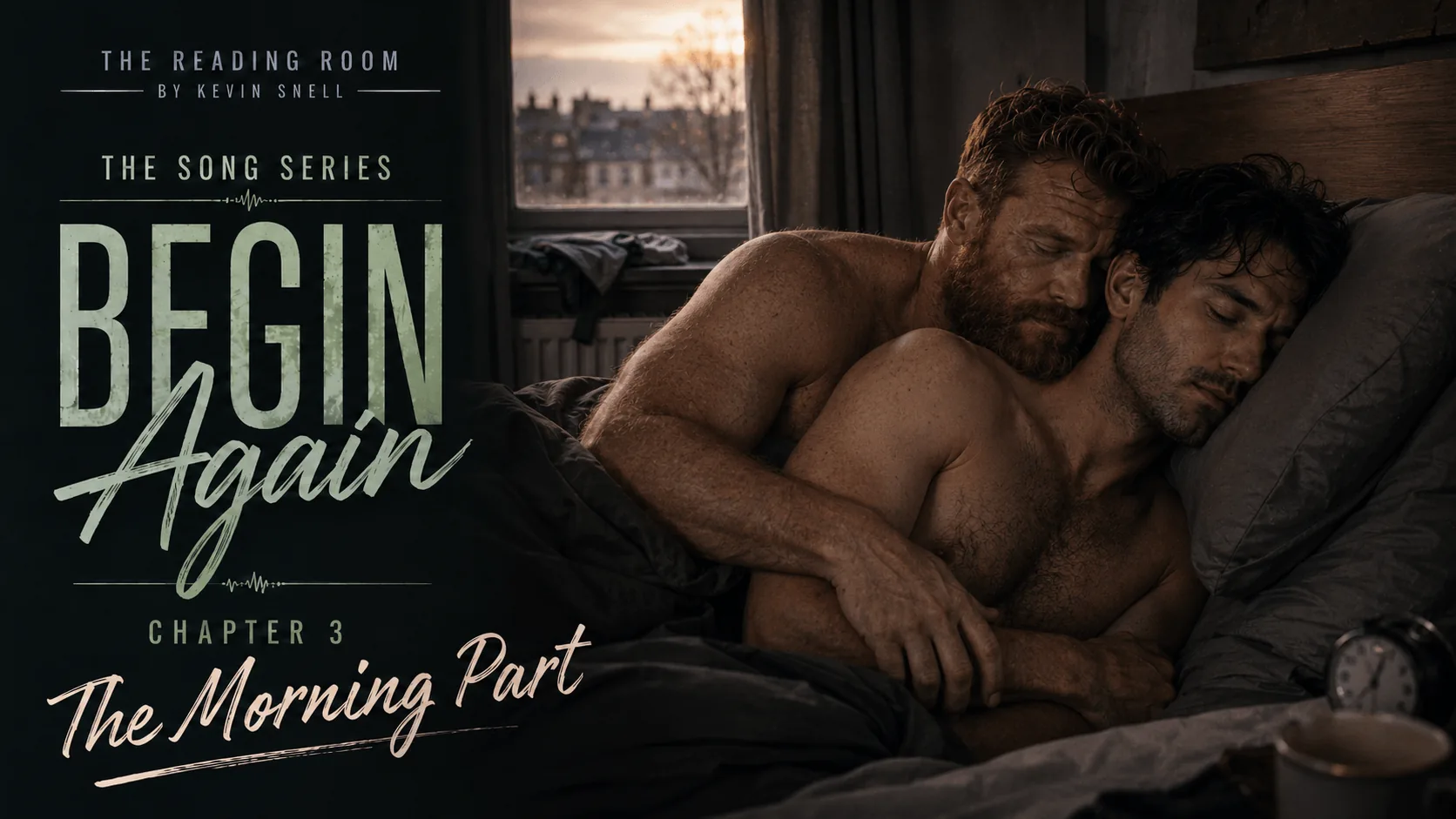
He woke in the dark under a weight.
The arm lay across his waist with the whole mass of the man behind it, and it didn’t adjust when Evan moved and it didn’t check on him. He lay inside the weight of it, and the weight went on being only weight, and behind it a chest rose and fell against his back on its own slow schedule, asleep, unbothered, going nowhere.
The ceiling was wrong. The radiator ticking somewhere in the wall was wrong, and the light around the curtain was the orange of a street he didn’t know, and behind him, against the base of his spine, Cian was hard in his sleep. Evan lay still. It was Sunday in Bray. Nobody had got up.
The room came clear in pieces. Base layers hung from the rack, with his own grey jumper among them where he’d put it himself. The boots stood by the door, the lace still hanging out of the second. The alarm clock wasn’t a phone. Its tick only reached him when he listened for it, and he lay there listening. At the end of the bed, the bag still gaped open, both shirts half out and the charger where it had landed on the carpet. Nothing had gone back in. He wasn’t packing any of it yet.
And his mouth had nothing to rehearse. For four years he’d woken and put the words in order before his feet hit the floor. This morning nobody in the flat was going to ask him to account for himself, and there were no words.
One thing in the room was familiar now—the smell of wax and cut timber and the ghost of two-stroke off the gear on the rack, one night old and already known. Evan breathed it and settled another notch into the mattress. The arm across his waist rose and fell against his stomach as Cian breathed behind him, slow, unbothered, going nowhere.
He pushed back into the arm half an inch, to see what it would do.
It stayed where it was.
Cian woke the whole way at once. He didn’t swim up out of it or need a second to place the room or the man in his bed. One breath he was asleep and the next his hand had moved on Evan’s stomach and his voice came out full of gravel an inch from Evan’s ear.
“Did you sleep?”
“Yeah,” Evan said, and kissed him before he could answer any other way.
Cian caught the kiss and took it over. One hand came up behind Evan’s neck and held there. His mouth tasted of sleep, his beard flattened down one side where the pillow had held it, and the kiss went long enough for Evan to stop bracing for what came after. The beard worked against his jaw the full length of it. It burned in a line from his chin to under his ear, and Evan pushed his face into the burn instead of away from it, and Cian kept the weight of the kiss exactly where it was until Evan’s mouth went loose.
The radiator ticked. The street light went off outside somewhere and the dark went one shade greyer around the curtain.
Evan’s hand went down under the duvet and found him.
Cian’s cock was heavy in his hand, warm from sleep, thick and uncut with the curve of it going left into his palm, and Evan held it and went still. He’d found him, and moving his hand was a second act, and the gap between the two had to be crossed out loud or not at all.
His throat shut on the first attempt. The second came against Cian’s shoulder, low and plain.
“I want to suck you.”
Cian drew one breath before he answered, his stomach lifting against Evan’s wrist.
“Go on, so,” Cian said. “Hands on my thighs.”
And the second half landed harder than the first. Cian had told him exactly where to put his hands, and Evan’s body answered before his head had any opinion at all. He’d spent last night with his hands trying the sheet and his own stomach and the headboard and the back of his own neck, and nobody had offered him anywhere to put them. This morning he had four words, and he could have wept at how simple they made it, and he didn’t, and he went down.
The light was coming up grey around the curtain by then, enough to be seen by. Cian pushed the duvet off, put a pillow behind his head, and watched. Last night Evan had only had to be looked at. This morning every choice his mouth made was visible. He kept his hands where they’d been put. The open hand settled on the back of his head without gripping or steering. It moved with him.
He took more than he could manage, the old arithmetic running under everything—be good at this and you get kept. His eyes streamed, his throat fought him, and he went down again anyway, until the open hand on his head closed into a fist.
Cian held him off. The fist in his hair kept him an inch clear, no more.
“What are you at?”
Evan dragged air past his wet mouth until his voice came back.
“I want to be good at it.”
“You’re grand at it.” Cian’s voice stayed flat. “That throat of yours is no use to me raw. What I’m after is the sound you make when it’s too much and you take it anyway. Give me that and leave the rest.”
And he opened the fist back into a hand and put Evan down again. Evan gave him the sound. Cian’s breath deepened above him, but the instructions stayed level. When Evan rushed, Cian flattened a hand on his shoulder. “Easy. Stay there.” And Evan stayed there.
He found the pace Cian wanted when he stopped trying to take more. Cian’s palm followed the back of his neck without bearing down, and when Evan’s hair fell forward, Cian moved it off his forehead and kept it there. Cian’s eyes stayed on Evan’s face. The muscles low in Evan’s stomach tightened under the look.
“Look up.”
He looked up. It cost him. He’d have sworn he couldn’t hold Cian’s eyes with his mouth full. He did it anyway, eyes streaming, jaw aching, while Cian looked down the length of himself and never looked away from Evan’s face.
“Good man,” Cian said, and the two words went through Evan harder than filth would have.
The thigh under Evan’s left hand went tight and stayed tight—the only change Cian gave him. Muscle hardened under his palm while Cian’s voice stayed level. Evan pressed his hand flat to it and gave the sound again without being asked. Cian’s breath came out through his nose, long. When he said the next word, it came out rough in the middle.
“Enough.”
He came off him slow and sat back on his heels, mouth wet, breathing, and they looked at each other across the grey light.
Cian didn’t come. The thigh under Evan’s palm eased before Cian moved. Then a forearm came under Evan’s arm and hauled him up the bed in one clean movement, turning him onto his stomach. The pull moved him before he could brace against it. Cian shoved the duvet towards the foot of the bed. A hand settled between Evan’s shoulder blades, firm enough to keep him there. Evan breathed under it and didn’t test it.
“I’m going to put my mouth on you.”
The words came in the same flat working voice as rope ratings and ground anchors.
“Yes,” Evan said into the pillow.
Then the beard dragged down the small of his back, and Cian’s hands opened his thighs. His tongue pressed against Evan’s hole and worked over it slowly. It was the same beard that’d been cold against his mouth on a towpath on Wednesday and hot on the inside of his thigh in the dark last night, and now it was here, dragging, deliberate, and the noise Evan made into the pillow was nothing he’d have owned to in daylight and it was daylight and he made it again. He ground down into the mattress. His mouth made syllables he couldn’t have repeated. Nobody laughed. The noise came again. Cian stayed where he was and kept going. More followed it, sounds Evan had kept out of every room for four years.
The drawer opened and shut. A cap clicked. Cian reached for the bottle without looking, and Evan ground his hips into the mattress before the first touch came.
Cian worked one finger into him, slow, with more patience than Evan could stand. The finger stretched him open while Cian stayed steady above him, hard against Evan’s hip and in no hurry to mention it.
“Fuck me.” It came out of Evan broken and face-down. “Cian. You can. I want you to fuck me. Now, I mean it, I want—”
The finger stilled. Neither of them moved.
“You want it. You want to hear yourself ask for it.” Cian took one breath. “Say it again.”
Evan said it again, slower, with Cian’s finger still inside him. This time he heard every word land in his own voice. Hearing it was worse than saying it and better than anything.
“Wednesday,” Cian said.
“Cian—”
“I said Wednesday.”
Cian said nothing else. The finger moved again at the same unhurried pace, and his tongue returned to Evan’s hole and worked over it again.
Evan’s thighs shook against the sheet. Cian crooked the finger and hit the same place again, then again on the same slow count, and Evan bit down into the pillow and heard himself through it, muffled, strangled, with half of it trapped in the pillow.
The finger stopped.
“None of that, now.”
It stayed still until Evan turned his face out of the pillow, cheek to the cotton, mouth clear. He gave the room the whole noise, and Cian resumed on the same beat. After that Evan didn’t try to hide again. His feet flexed against the sheet, his thighs tightened, and Cian’s next pass pulled his stomach tight. Cian kept the pace unchanged.
He came with his face turned out of the pillow and his eyes shut and the noise going into the room where anyone could have it, both arms down, one fist in the sheet, and it went on longer than it had any right to and Cian worked him through it, then stopped when Evan’s body recoiled from the next touch.
He lay there while the radiator ticked, until he could draw a full breath again.
A mouth landed between his shoulder blades, brief, and was gone. The flannel came warm and quick. Cian folded it over the radiator rail.
“That noise,” Cian said. “I’m keeping that.”
He was still hard when Evan sat up. For four years, that’d meant Evan’s turn. He reached for him.
Cian put a hand over Evan’s and pressed it flat to the mattress, firm enough to stop him and no harder. Evan’s fingers flattened one by one beneath the warmth and weight. His pulse beat against Cian’s palm.
“But you didn’t—”
“I didn’t.” He held the hand down one beat longer, then took his own away. “It’ll keep till Wednesday.”
Evan left his hand where Cian had put it. The urge to reach again stayed in his wrist. Cian had already turned towards the rack.
“That’s three days.”
“It is.”
Cian got up still hard. Yesterday’s jeans dragged over his hips without hurry. He fastened them and pulled a thermal over his head. Evan watched from the sheets. His mouth opened once. Nothing came out. His hands stayed in his lap.
Cian faced him with the green jumper in one hand.
“You’ll freeze.”
The jumper crossed the room. Evan caught it against his chest, the wool still warm from the radiator. He pulled it on, the sleeves dropping past his knuckles. Cian watched until he tugged the hem down. Evan didn’t ask about the look.
“Up. Porridge doesn’t watch itself.”
The watch strap clicked at Cian’s wrist, and his phone disappeared into a pocket. Evan stayed sitting in the sheets with the jumper pulled over his bare skin.
Cian left for the kitchen still hard and dealt with none of it. A cupboard opened first. A pot landed on the hob.
Evan stayed in the warm bed through the cupboard, the pot, the tap, the spoon against metal, and the kettle. Then he got up. The floor was cold. His jeans were over the chair where he’d left them the night before. He pulled them on under the jumper, found his socks in one boot by the door, and sat on the edge of the bed to put them on while the kitchen kept up its unhurried noise.
The kitchen was a galley and Cian filled most of it. Evan stopped in the doorway with the jeans still cold against his legs. Oats were already in the pan, the pot too large for one, and nobody had asked him a question about it. A bowl arrived in front of him, and a spoon followed it, handle turned his way. Cian pulled the second chair out one-handed and said nothing about it. Tea came next. Cian set the mug down, gave it a quarter turn on the table, and went back to the pan to scrape it and stand the wooden spoon in the pot.
They ate with their mouths half full and worked through the week as if it were already shared.
“What’s on for you?” Evan said.
“Hedge work Monday. Greystones.” Cian said it into his bowl. “Money and nothing else. Then the real one, Tuesday into Wednesday. Beech above Enniskerry.”
“What’s wrong with it?”
“Root plate’s gone. The storm before last lifted it, and the ground’s been letting go ever since.”
“Meaning it falls.”
“Meaning we decide where.”
Evan put his spoon down. “What’s a root plate?”
Cian looked at him long enough that Evan nearly withdrew the question, then turned one hand palm-up over the table with the fingers spread. “That. The whole disc of it, roots and soil in one mass. Ground goes soft enough, the wind gets a purchase on the crown, and the disc hinges.” He tilted the hand. “Once it’s hinged it doesn’t settle back. It only waits.”
“Waits for what?”
“For nothing kind. Weather isn’t the question, if that’s what you’re asking. Physics is, and physics doesn’t mind what day it is.” He picked his spoon back up. “So we mind for it. Tuesday we rig her, Wednesday we bring her down in pieces the size we choose.”
The phone buzzed twice on the counter. Cian read the screen and answered with one thumb between spoonfuls. The name at the top was Fintan.
“Problem?”
“Traffic lads have us down for Thursday. We booked Wednesday.” He set the phone face down and went back to his bowl, standing, hip against the counter, and ate three spoonfuls before he finished the thought. “Fintan’ll ring them at nine. They’ll find Wednesday. They only like to be rung.”
Evan laughed, and Cian looked across the galley at him, the pan behind him.
“I’m finished early Wednesday, once she’s down and the road’s open. Come Wednesday, so.”
“I can meet you in Bray.”
“D’you mean Bray?” He looked over. “Or d’you want to see the job?”
Evan’s spoon stopped halfway to his mouth.
“Okay,” he said. “Enniskerry.”
It came out fast. He didn’t take it back.
“Right.” Cian put his own bowl down and ate standing. He gave the directions in the same flat, useful tone he’d used in the bedroom and on the towpath. “You get the L15 from the station and you meet me in the village, at the green. You don’t come up to the site. If I bring you near it after, you stand where you’re put and you wear what you’re given, and if the lead tells you to move, you move first and ask me after. That’s all of it.”
The rules were about the tree and the men working under it, rules that existed so that everybody went home. Not one of them corrected Evan. He turned the spoon once through the porridge, ate another mouthful, warm under the ribs, and said nothing.
“You’ve a question,” Cian said, not looking up.
“What do I wear?”
“Warm. Waterproof. Boots if you own boots.” He scraped the pan. “Nothing you’d mind mud on. It’s a field with a tree in it, not a gallery opening.”
“I’ll manage my expectations.”
“Do,” Cian said, and the corner of his mouth moved, then stopped short of a smile.
Cian crouched at the door and threaded the lace back through the second boot, eyelet by eyelet, then doubled the knot at the top.
After breakfast, Evan took off the green jumper and folded it on the bed. He carried one of the shirts from the bag into the bathroom and pulled it on in front of the mirror. The mark ran along his jaw and down under it, red-brown and unambiguous. He turned his face one way, then the other, checking what the collar would cover. Behind him, Cian’s boots crossed the kitchen floor. A drawer opened. The tap ran.
The collar would cover it. He’d worn collars up for lesser reasons and called it style.
He left the collar down and the mark uncovered, and said nothing to anybody, including himself.
Bray Daly on a Sunday was wind and wet concrete and a scatter of people with nowhere urgent to be. The sea came over the wall in sound only. Cian carried the green jumper Evan had folded on the bed through the gate and onto the northbound platform.
“Bring it back Wednesday.”
He put it in on top of the shirt still in the bag, pulled the zip over it, and handed the bag back.
The train showed on the board, and the wind came up the platform off the sea and took the announcement away with it. Cian kissed him.
He did it in the open, on the platform of the town where he’d been born, with a straight back and both hands on Evan, without looking first. Evan looked for both of them. Mid-kiss, his eyes went over Cian’s shoulder and counted the doors, the bench, the man in the high-vis jacket by the timetable. Cian’s eyes stayed shut, and neither hand loosened. When they broke, the man in the high-vis lifted a hand from the railing, and Cian answered with two fingers off Evan’s shoulder. Nothing happened.
“Wednesday,” Cian said at the carriage door, and put him on the train with a flat hand between his shoulder blades, exactly where it’d been in bed. Then he stood on the platform with his hands back in his pockets while the doors closed. He didn’t wave. He was still standing there when the platform slid away.
On the train, the morning still crowded his chest.
The sea ran along on the right going north, the same water that’d run on his left yesterday. Wet back gardens went by, a trampoline with its net gone, a rotary line turning slowly with nothing on it, because it was Sunday and November and nobody in Ireland was drying anything outdoors. At the end of one garden a man stood looking at the train as if it owed him something. Dalkey came and went. Dún Laoghaire came and went. Evan had his hand inside the bag, flat on the wool of the jumper. It was ridiculous. He left it there.
He missed him.
Across the aisle a girl slept against the glass with her headphones still going, a tin whistle of sound leaking out of them. A man two seats up ate a breakfast roll out of foil without dropping a crumb. The fields gave way to the backs of houses and the houses thickened toward the city, and a heron stood in the shallows at Booterstown doing nothing, the same as every heron he’d ever seen. Through all of it, Evan’s hand stayed on the wool.
The old objections came back fully formed and reasonable. It was too soon; he’d known Cian five days. The voice was familiar, and he let it stand in the aisle unanswered past Blackrock. Somewhere before Pearse it got off without him seeing which station took it.
Aoife was at the corner table by the canal window with a pot of tea already ruined and a story visibly queued behind her teeth, and she was into it before his coat was off.
“You will not believe,” she said, “what your man Colm is after doing with the shared calendar. Sit down. He’s only gone and scheduled the quarterly review inside the all-hands. Inside it, Ev. Two hundred people got a notification that the meeting they were in had a meeting in it.”
“A turducken.”
“A turducken of wasted time, and when Sinead pointed it out he said, and I’m quoting him directly—”
The waiter arrived and wanted to know about food, and she ordered without looking at the menu or pausing the story, and Evan ordered the same thing to save time, and she got Colm’s quote out with the voice and everything, the flat Cork lilt Colm used when he was certain the room had made the mistake, and Evan was laughing before the tea had gone around.
Then Aoife’s eyes settled on his jaw, and the story stopped.
“That’s a rash,” she said.
“It’s not a rash.”
“It’s a Wicklow rash.” She poured his cup, delighted with herself. “And was he grand, so? Your Wicklow tree man?”
“He’s an arborist.”
The correction came before he could soften it—flat and fast, with no joke on either end. The table went quiet. Aoife stopped with the pot in her hand. He reached for something funny and found nothing. Neither of them covered it.
“Right,” Aoife said slowly. “An arborist.”
“It’s a real job. There’s exams.”
“I’d say there are.” She poured, watching him over the pot. “And what does an arborist charge to leave a man unable to say two civil words about him?”
“I said words.”
“You said a correction, Evan. At speed.” She set the pot down. “I’ve known you since you couldn’t grow that jaw. Do you want to tell me about him or do you want me to keep taking the mick?”
“Both,” he said, and meant that too. Aoife laughed properly. By the time the fresh pot arrived, she asked the question again, quieter.
“It’s not been a week, Ev.”
“I know how long it’s been.”
“So.” She turned her cup on its saucer. “What is he when he’s not up a tree? One of these fellas who tells you what’s what?”
“He says what he’s going to do.” The sentence made Cian sound simple, and he wasn’t. “Before he does it. He says it, and then he does it, and if I said stop—” He stopped himself, and started over, lower. “The stop’s mine. He made sure I had it before anything else happened. And he made me say things back to him so he’d know I meant them, and he listens harder than anyone I’ve ever—”
He gave up and picked up his cup, and the heat came up his throat and found his ears and finished in his face, the full climb, and Aoife watched it happen with an old friend’s mercy, meaning none.
“And what do you actually like about him?” she said. “Besides the obvious, which is all over your jaw.”
“He made porridge.”
She waited.
“He didn’t ask did I want any. It was there. And he gave me safety rules for Wednesday, for the site—where I stand, what I wear, who I listen to.” The explanation came out badly and in the wrong order, but he kept going. “None of it was about me. D’you know what I mean? The rules. They were about the tree.”
“You’re telling me you fancy a man because of his hard-hat policy?”
“Yeah,” Evan said, and meant it so plainly that she put her cup down.
“God,” she said, to the window, to the canal, to nobody. “The bar. Where we’ve had to put the bar.” But her voice softened under the words, and she didn’t take them back.
She didn’t laugh. The look she gave him carried four years of dinners where he’d gone quieter, funnier in the bad way, and thinner around the edges of himself. She opened her mouth, then picked up her cup instead.
“You’d usually have three jokes in front of all this,” she said. “That’s the part I’m noting. Not the jaw.”
“I know.”
“You’ve come back from Bray with no jokes, Evan.”
“I know,” he said again, and picked up his cup, and let it be true in front of a witness.
The food arrived and gave them both somewhere to look. Looking down at her plate, she said, “They offered me Cork.”
Evan put his fork down. “The office Cork? Move-there Cork?”
“Head of the whole circus. Colm reporting to me, which is nearly worth the relocation on its own.” Her voice stayed light. Her fork stopped against the plate. “I’ve to answer by Friday.”
“And you’ve been sitting on that since Thursday while I talked about a tree man?”
“You didn’t talk about him. That’s how I knew it mattered.” She topped up both cups with both hands around the pot. “Say something useful now.”
“Do you want it?”
“I want Colm reporting to me. I’d relocate to an oil rig for that.”
“That’s not what I asked.”
“No,” she said. “It isn’t.”
She lifted the pot lid, looked inside, and set it back. Her cup turned half a circle under her fingers. Her hands had nowhere useful to go.
She ate for a bit. He waited.
“Head of the whole operation, Ev. My own office with my own name on the door, and my mam two hours closer, which is a pro or a con depending on the week you catch her in.” She moved food around her plate. “And the money’s stupid. I’d be embarrassed to say it out loud in front of the waiter.”
“And Dublin?”
“Dublin’s fifteen years of people.” She said it to her plate. “You don’t rebuild that at this age. You get colleagues, and colleagues are grand, and then one Friday you look up and every person who’d collect you from a hospital is a motorway away in Dublin.”
The waiter took Aoife’s plate and asked about dessert. She ordered two coffees without consulting him. Neither changed the subject while he cleared the empty dishes around Evan’s plate.
“I’d drive it.”
“I know you would.” The answer came as fast as his correction had. Aoife looked down at her plate.
She lined up the salt and pepper. She’d done it in restaurants for ten years, usually before telling him a decision was still open.
“You’ve gone tidy,” he said. “You go tidy when it’s already decided.”
She looked at the salt, then at him. “One weekend with a man who pays attention and you come back insufferable.”
“Friday, you said.”
“Friday.” She put the pepper back where it’d been. “I’ll ring you Thursday night, so. You can be the witness when I say it out loud.”
“I’ll answer.”
“I know you will.”
The coffees arrived. She stirred sugar into hers, the sugar she’d claim she never took, and tapped the spoon twice on the rim and set it in the saucer. Then she picked it back up and pointed it at him.
“And when do I get to inspect this arborist?”
“Not yet.”
“Not yet.” She tried the words out and put the spoon down. “Grand. But I’m on the list.”
“You’re on the list.”
When they split the bill she took one chip off his plate and ate it.
She drained her coffee, stood, and wound her scarf twice around before he’d got his coat off the chair, the same sequence as every lunch they’d ever finished.
The message arrived while he was walking the canal home with the low sun already going and the bag on his shoulder.
Don’t make the collection into a whole production.
His thumb stopped over the screen. He read it twice. He’d been mid-stride and the stride didn’t finish, and a runner came up behind him and had to go around, and said something, and Evan didn’t hear what. A swan came up the middle of the water doing nothing at all. The cold found the gap at his collar and sat in it, and he stood on the towpath with the phone in his hand, and the canal went on doing what canals do.
His thumbs typed the apology before he chose it. Sorry, I should have sor—
He stopped, read the line, and deleted it to the last letter, and put the phone in his pocket and walked, and at the lock gates he took it back out, and the thumbs went again, warmer this time, safer. Hope you’re well.
He stood over it a long while. Three words, and they cost more to delete than the apology had, because warmth had been how he stayed safe for four years, and taking it off the message was taking a coat off in the cold. A barge came through the lock while he stood there, the whole slow theatre of it, gates and water and a woman in a wool hat working the beam, and she raised a hand to him because he was standing there watching, and he raised one back with the phone still in it. By the time the water had levelled he’d deleted the warm message. He walked the last stretch with the phone away and his hand around it in his pocket, past the bins and the bikes and a window with a dog in it that barked every day he passed, and on his own doorstep, key in the other hand, he took the phone out and typed the true thing, stripped of warmth and apology.
From his own doorstep, he sent a day and a time. Next Sunday afternoon. It’ll be ready.
The thumbs-up came back before he had his coat off, and it closed the conversation the same as it’d closed every conversation for four years. He put the phone face-down on the kitchen counter. He washed a cup he didn’t need washed, and dried it, and put it away, and wiped down a counter that was clean.
The storage-cupboard door was eight feet away, with the box Nolan meant behind it. Evan did not open the cupboard. It stayed shut for the rest of the evening.
Dark came early and entirely. Nolan’s three years still occupied the flat—the good pan he’d left because it was scratched, the second toothbrush glass Evan had never thrown out, the gap on the shelf where the records had been. He cooked badly on purpose, pasta and a jar, and ate standing at the counter with a fork straight from the pot. He left the big light off. The lamp lit the counter and nothing else.
He thought about ringing Aoife and telling her to take Cork, and didn’t, because it was hers to take, and because he’d heard the answer already in how she’d said Colm reporting to me. He put the pot in the sink and ran water into it and left it, which Nolan would have narrated, and nobody narrated.
The bag stayed on the bedroom floor with the jumper in it. Twice he passed the doorway and looked in; both times it sat exactly where he’d left it, and neither time did he take the jumper out.
The phone lit while he was drying the pan.
Home safe?
Yes.
Are you sore?
Pleasantly.
Nothing came back to the joke. No laugh or punishment followed, only a long stretch of nothing. Then a voice note landed instead of text, and Evan sat on the end of his bed before he played it.
“Use more lube than you think you need. And think about Wednesday while you’re at it.”
Cian’s voice filled Evan’s flat. Evan played the note again with his eyes fixed on the skirting board.
His thumbs typed a message to Cian. Nolan messaged. He’s collecting the box Sunday—he stopped there, read it, and deleted it. Cian could hear it Wednesday, across a table, if it needed telling. Nolan wasn’t getting the rest of tonight.
He took the jumper from the bag and left the bag in the corner instead of under the bed. He’d need it again Wednesday.
It’d kept its shape all the way to Dublin, arms folded under, the fold Cian had put in it, and it opened on the bed still smelling of the flat in Bray, wax and timber and Cian beneath both.
He didn’t wear it. He put it on the pillow under his face, with nobody there to see.
The lube was in the bathroom cabinet, where it’d sat unused for longer than he was going to count. He walked through the dark flat to get it, bare feet on cold boards, past the kitchen with the pot still in the sink. In the bathroom he didn’t turn the light on. The streetlight through the frosted glass was enough to find the cabinet by, and in the mirror on its door, as it swung, the mark on his jaw crossed the glass and was gone. He took the bottle and came back through the dark with it in his hand, past the kitchen doorway, and set it on the bedside table where he could reach it without looking. He squared it to the lamp base. Then he moved it an inch closer. He undressed slowly, dropped everything on the chair, and got under nothing. The duvet stayed spread across the bed, and the air of the room was cold on him, and he let it be cold.
He lay down with the phone on his chest and played the note through once more, and made himself stay still until it finished. The radiator hummed. A car went along the road below and its lights crossed the ceiling and slid off it, and the quiet came back in behind them. Only then did his hand move.
It wasn’t Cian’s body he was thinking about. He did as he’d been told, alone in the flat while Cian was forty minutes down the train line with no way to know whether Evan obeyed.
He used more than he’d have used. Four years had taught his hand to hurry—get it done before anyone minds that you exist. His wrist sped up on the first stroke, and he took his hand away entirely and lay breathing until the urge to finish passed. Then he started again at Cian’s pace. Twice more the speed returned to his wrist, four years of it living in the tendons. Each time he stopped, lay flat until it drained, and started over more slowly.
The café table came up behind his eyes, the question about a lad coming off a rope, the two hands going flat on the wood before the answer, and his own hand slowed further without being told. The chip followed, taken and eaten with nothing after it. His hips lifted off the bed at that—at a chip—and he stayed slow. His free hand found the wool by his face and closed on it, and the radiator hummed on through the dark, and the cold of the room lay along his back while the rest of him ran hot, and he stayed slow through that too.
Then he remembered the hand between his shoulder blades—the flat span, the exact weight that’d meant stay. His spine bowed off the mattress as though the hand were there. His own hand slowed until it barely moved. The far side of the bed stayed cold. He kept his face in the wool. He played the voice note once more with his eyes shut. His spine lifted before Cian reached the second sentence.
The train, the clock, and everybody else’s schedule had fallen away. He came slowly, his fingers tightening with each pulse, and the noise went into an empty flat with nobody to keep it. He made it anyway. Afterwards he lay still with one hand on his stomach, let the sweat cool, and didn’t reach for anything.
The ceiling stayed the same, and the radiator hummed. Evan lay with the jumper under his cheek until his heart and breath slowed. Another car passed below, its lights crossing the ceiling in the opposite direction. He watched them go with the phone still on his chest and didn’t check himself for damage.
He drank water at the sink in the dark, the floor cold under his bare feet. In the bedroom, he straightened the duvet and lay on top of it.
Then he typed with one thumb before he could argue himself out of it.
I want you to fuck me Wednesday.
His thumb moved to the delete key and stopped there. Deleting it would cost nothing. Nobody would ever know it’d existed, and that was the entire safety of the last four years in one sentence—no evidence and no record, nothing wanted with his name over it. The message sat in the box, seven words with his name over them, and his thumb rested on the key that would make them disappear.
Then he sent it.
The whoosh cut through the quiet flat. The flat went quiet again, but Evan’s heart kept beating hard against his ribs.
The reply came before he’d finished being afraid.
Good. Come south.
He left the app open. Instead of turning the phone face-down as he had for Nolan’s thumbs-up, he set it face-up on the duvet and lay where he could see the thread.
The screen dimmed and went black. The message remained.