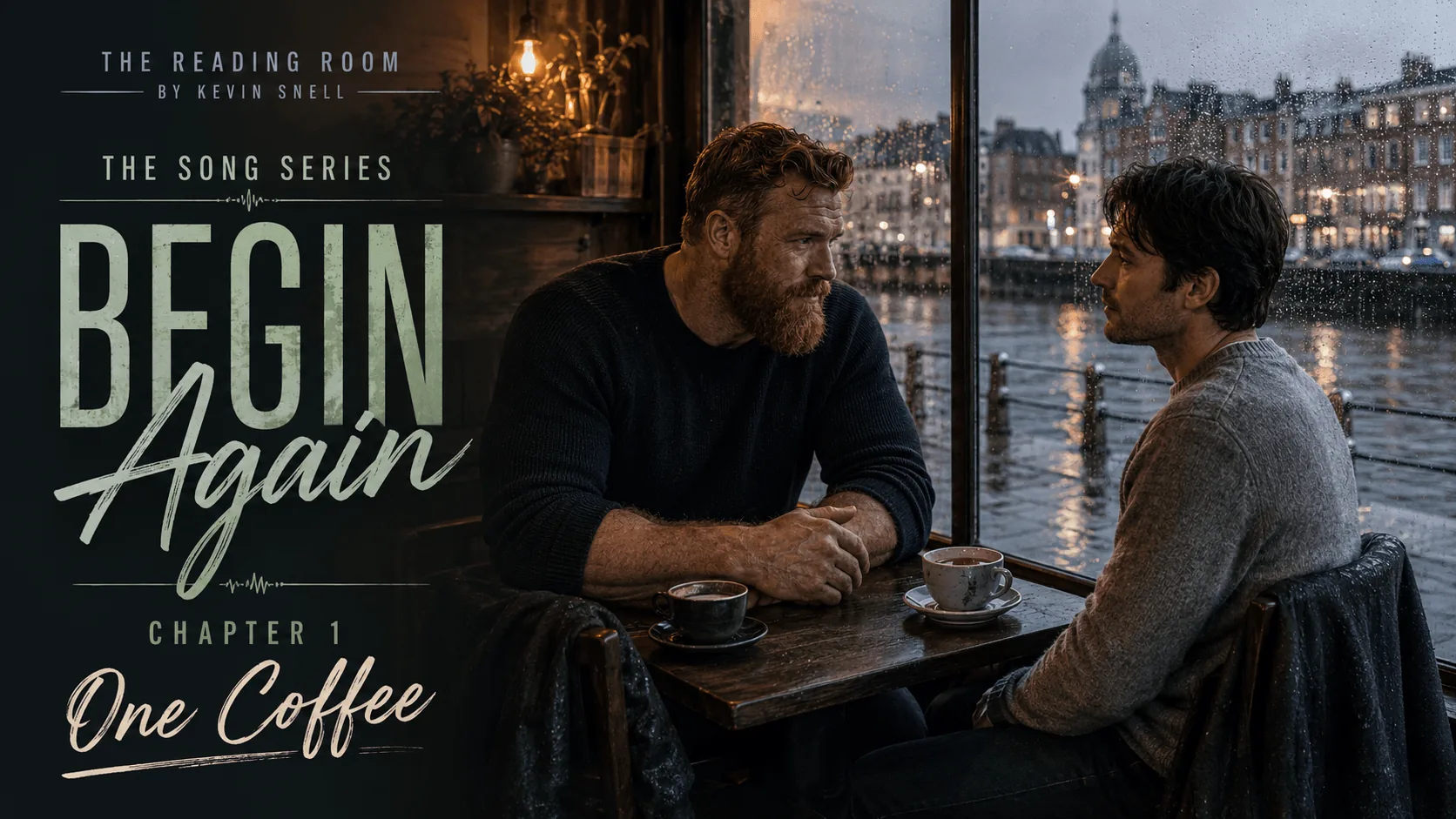
The message had been sitting at the bottom of the thread since Monday, and Evan had read it enough times that he’d stopped taking in the words.
One coffee. Half five. Give it twenty minutes and either of us can call it, no hard feelings.
His thumb rested over it without moving. Further up the screen was the line that had made him answer in the first place. One sentence, no hedge anywhere in it, and he’d written back inside a minute. I’m a top and I’d rather meet you than talk to a screen for a fortnight. No apology attached to either half of it. No wink.
It was a Wednesday. That was the whole of the case he’d built for himself all week—a Wednesday, a coffee, twenty minutes, nothing that had to survive the walk home and the ordinary things waiting on the other side of it. Nobody’s life changed on a Wednesday. You went, you were pleasant, you came home and made dinner and put a wash on.
Evan threw the phone down the length of the sofa, where he’d have to stand up to get it back.
The flat was cleaner than it had any reason to be. He’d washed two mugs and put them away, straightened the coats in the hall, run a cloth over a counter nobody was going to see, and he’d done all of it fast and badly, twice, checking the clock between jobs. Nobody was coming here. He’d made sure of that. He’d picked a café on the quays, in town, down by Temple Bar, where you could throw a pebble in any direction and hit an American. In Portobello he was the American. The girl in the shop knew his order and his accent and the fact that he lived alone now. Down on the quays in November he was just another one of them, loud and cold and in the wrong coat, and nobody in that room would turn around for him. If it went badly he could be nobody for an hour and walk home and nobody would have watched him do it. And then he had cleaned the flat.
The blue jumper was the first one on. It fit well and he’d always liked it, and he was pulling it over his head before he heard Nolan’s voice, mild and reasonable, four years back and still in the room. You look like you’re trying. Not cruel. Nolan had never been cruel in a way you could point at. He’d said it in the doorway with his glasses pushed up into his hair and his voice gone gentle, helping, and Evan had taken the jumper off then too.
He took it off now and dropped it on the bed.
The green one, then. He got it as far as his shoulders. That’s very young for you. Also mild. Also delivered from the doorway of this room, this exact room, where the bed sat under this exact window for three years while Nolan slept on the left. Evan stood in the cold air of his own bedroom with his arms half in the sleeves and his chest bare and his hair standing up with static, and he watched the whole machinery of it run. Try it on, take it off, and run a private little vote on which version of himself was allowed out of the building.
He could see it happening. Seeing it never once stopped it, not in months.
He pulled the green one off and left it on the bed with the blue one, and he took the grey jumper out of the drawer, the soft one, the one he wore when nobody was going to look at him, and he put it on.
He liked it. It was warm and it was his.
He went out the door before he could think about it again, and the cold came up off the wet pavement and took the heat out of his face, and he walked into town in the dark.
The rain was over. The roads were black and bright, throwing back the light of the shopfronts, and the bells of two cyclists came out of the dark ahead of him and went past. By half five in late November the city had already given up on the day. He went up through Portobello and across the canal and on into town, past the lit windows and the wet brick and the crowds coming the other way with their hoods up, and by the time he reached the river his ears were cold and his heart was going faster than the walk deserved.
The café sat on Aston Quay with its lights on and the Liffey running black behind him, and Evan saw him through the glass before he even reached the door.
Steam fogged the bottom half of the window. Above it there was a clear band, and through the clear band was a warm narrow room, damp coats, small tables, and a man too big for the chair he was sitting in.
That was the first thing, and it wasn’t flattery. It was a fact about the room. The chair sat narrow under him and his knees crowded the underside of the table, and his forearms took most of the top, and the whole arrangement looked temporary, as if the furniture were on loan and he would hand it back the moment he stood up. His hair was red-brown and his beard was full and gone dark at the edges with the rain, and he hadn’t bothered to do anything about it. Under a clean dark jumper his shoulders ran wide and his back filled the rest of it, and whatever put them there, it wasn’t a gym. Gyms build bodies that look like a decision. This looked like a consequence.
Then his hands, flat on the table on either side of a menu he wasn’t reading.
Evan stood out in the cold on a wet street and looked at a stranger’s hands through a gap in the steam, and his throat went hot, and then his ears. It always started that way with him, running up the sides of his neck like a fever he couldn’t argue with.
He wanted him.
It came in plain and whole and much too fast, and he stayed on the pavement for a few seconds longer than he needed to, breathing out into the cold, waiting to be someone who could open a door.
He opened the door.
Inside it was loud with the machine and thick with wet wool and half the voices in the room were American, and not one of them was listening to him. The floor near the entrance was slick, and by the time he got to the table the man was already getting up out of the narrow chair, and going up, and up.
Six three at least. Evan was five ten and had to lift his chin.
“Evan?” he said.
He’d asked. He hadn’t assumed, hadn’t spread his hands and grinned and said his name like he owned it—he asked, standing there in a café where he was the only man of that size, in front of the only man who’d walked in alone looking for him.
“Cian,” Evan said.
They shook hands. Cian’s was warm, and rough at the base of the fingers, and much larger than his, and it closed and held and let go. Evan braced for the half-second too long, the grip that stays to see what you’ll do about it. It didn’t come. Cian let go first, and that was what did the damage. The hand was there and warm and gone, and Evan sat down into the narrow chair opposite with his own hand still warm from it and nothing to do with the information.
Close up he could see more. Old scars ran across the backs of both his hands, pale, thin, healed a long time ago, and calluses sat across the base of every finger, and one knuckle carried a fresh scrape, scabbed over and going clean at the edges. His nails were short and clean. He’d washed and changed and come down here anyway, and there was nothing on him of whatever it was he’d been doing all day except what was underneath.
“You found it all right,” Cian said.
“I walked. It’s not far.”
“Grand.” He said it flat. It meant fine. “I’d have come further.”
Evan queued and came back with a coffee.
“Four euro fifty,” he said. “For that. At what point do I get a mortgage broker involved? Is there paperwork? Should I be bringing a guarantor to a café?”
He heard it land. He heard all three parts of it land, one after another, when two would have done, and his eyes went to Cian’s face.
That was the thing he did. He’d been doing it for four years and he did it now without deciding to, checking the mouth first and then the eyes, hunting for the pause. The pause was where it lived. There’d be a beat, a half-breath, the smallest hesitation before the laugh, and inside the hesitation was the whole verdict—you’ve overdone it, that was crude, that was more than the room asked for—and then Nolan would laugh anyway, kindly, and the kindness was the worst part.
Cian laughed. There was no pause in front of it.
“You should see Wicklow,” he said. “Six euro for a coffee up the mountains and they hand it to you in a paper cup the size of a shot glass. Sure, we’re all being robbed. It’s a national project.”
He turned and ordered tea at the counter. In a coffee shop. He didn’t make a joke about it and he didn’t apologise for it, and he skipped the whole business of ordering the wrong thing in the right room and needing you to find it charming. He asked for tea, and that was the whole of it, and he came back to Evan as if nothing had happened, because nothing had.
Evan wanted him to keep talking.
“How long are you in Dublin?” Cian said.
“Three years.”
“And what brought you over?”
There it was. Nobody Irish had ever failed to ask him that, and he’d never once answered it straight.
“I inherited a house,” Evan said.
Cian waited.
“A house,” he said.
“A house.”
“What class of a house?”
“The class that has a name instead of a number.” Evan picked up his coffee and put it down again without drinking any of it. “Everyone says castle. It’s not a castle. It’s a house with delusions and a roof I’m afraid of.”
He waited then, because this was the part where it happened—the recalculation, the adjustment behind the eyes while a man worked out what Evan was worth and what that made him. He’d watched it happen at three parties and one funeral and once at a bus stop.
Cian didn’t do it. He sat there with his tea in front of him and his eyes steady on Evan’s face, and he let the silence run a length that a politer man would have filled.
“That’s three jokes,” he said.
“Sorry?”
“Since I asked you. Three of them. You’re quick, I’ll give you that.” He wasn’t being cruel. He said it flat, the same as he’d say a rope was wet or a road was closed. “And you’ve told me nothing at all.”
The heat came up Evan’s throat and into his ears, and there was nowhere to put it in a bright warm room with a man looking at him.
“It’s not a fun story,” he said.
“I didn’t ask for a fun one.” Cian turned his cup a quarter turn on the table and left it. “Say it without one.”
Nobody had ever done that to him. Nolan had let him joke. Nolan had preferred it, had steered him towards it, had found him easier that way and had never once sat across from him and declined the performance.
Evan looked at the table.
“A woman I met twice left me everything she had,” he said. “My grandmother’s sister. Wicklow. The house, the land under it, and enough money that I stopped looking at the number, because every time I look at it I feel like I’m holding somebody else’s coat.” His mouth was dry. “I came over to see what it was, and I meant to stay a fortnight. I never went home.”
There. It was out on the table in the middle of a café, in plain words, with no joke standing in front of it.
Cian took that in and gave no sign at all of what he made of it.
“Whereabouts in Wicklow?”
“Outside Roundwood.”
“Derrylossary.”
It wasn’t a question. Evan had said the name of that house out loud perhaps six times in three years, and a stranger in a café had just handed it back to him across a small table without being asked.
“You know it.”
“Everyone in Wicklow knows it.” Cian said it without any edge on it at all, which made it worse. “I’m in Bray. Born there. I’ve a van in and out of Enniskerry most days of my life, and I’d say I’ve gone past your gate more times than you have.”
Evan’s coffee was going cold in front of him and he didn’t touch it.
“How many times have you been down?” Cian said.
“Three.”
“Three this year.”
“Three,” Evan said. “Altogether.”
Cian didn’t say anything to that. He turned his cup a quarter turn on the table again and looked at it, and Evan sat there in a warm café in the middle of Dublin and felt the whole size of what he’d just admitted, out loud, to a man from Bray.
“Is there land with it?” Cian said.
Evan blinked. “Twelve acres. Most of it eating itself.”
“Trees?”
“Everywhere. All wrong, I think. There’s one at the front with its arms over the roof and I’ve been pretending I can’t see it for three years.”
“That’s a limb over a slate roof in a Wicklow wind,” Cian said. “That’s not pretending. It’s a hobby.”
Evan laughed before he could stop himself, and it came out too loud for the room, and Cian looked pleased about it and unhurried about being pleased, and said nothing at all.
“And you live in Portobello,” Cian said.
“I live in Portobello.”
“In a flat.”
“In a one-bedroom flat,” Evan said, “with a shower that has opinions.”
Cian let that sit there without touching it, and something went across his face and was gone before Evan could read it, and he didn’t ask the question. He didn’t ask why a man with twelve acres and a named house was renting a one-bed in Portobello and worrying about a roof in another county. He got to it from another direction entirely.
“And what put you in Portobello?”
He had an answer for that. He’d been giving it at parties for three years and it was true and it was smooth and he could give it in his sleep. “It’s central without being the centre. Everything’s walkable, the office is a walk away, and the rent was survivable when I signed.”
Cian took a mouthful of tea. “That’s what it’s near,” he said. “What do you like about it?”
Evan opened his mouth to say something about the neighbourhood, and stopped.
“The canal after rain,” he said.
Cian waited.
“It goes completely black,” Evan said. “You get all the streetlight sitting on top of it and nothing underneath, and I like walking it at night when it’s like that. And I like the cyclists.” He heard himself and kept going anyway. “Not the cyclists. I like that they ring at people. There’s a lane, and people drift into it with their headphones on, and the cyclists ring—not angry, just this ding, ding, and the person hops out of the way and everybody carries on and nobody says anything to anybody. It’s the most Irish thing I’ve ever seen and I’ve been watching it for three years and I’m not tired of it.”
He stopped.
Cian’s mouth changed while he was talking, not much, but enough to see. Evan had watched a hundred men change their faces at him and he knew every version of it, and he’d have put money on this one being amusement, and on it not being aimed at him.
“You’ve been standing at the canal counting bicycle bells,” Cian said.
“I’ve been living my life. The bells are a bonus.”
“Right.” Cian set the tea down. “That’s Portobello, then. Not the walkability.”
“No.”
“Good,” he said, and let it go, and it stayed given.
Evan asked him about the trees.
He asked it badly. He asked about the climb and about being up there and about what it was like at the top, the whole picture he’d built in his head before he’d built anything else, and he heard it coming out of him. Cian took the picture apart, dry and precise, a correction he’d plainly made before and expected to make again.
“Most of it’s on the ground,” he said. “Rope’s wet. You’re pulling brush for four hours and feeding a chipper and you’re deaf by eleven. Half the day’s traffic management—cones, a lad with a sign, keeping the public out from under what’s coming down. Then there’s a risk assessment before anyone goes near a tree. That’s paperwork. The saws want maintaining, the site wants clearing, and you’re doing that in the dark this time of year.” He shrugged. “Climbing’s the bit in the middle. It’s not the bit that fills the day.”
“That’s less romantic than I was going for.”
“It is, yeah.”
“You could have lied.”
“I could.” He said it without any weight at all. “You’d have found out in about a week.”
“And the climbing part,” Evan said. “You just go up.”
“I sound it first.”
“You what?”
“Sound it. You take the back of the axe to it and you hit it and you listen.” Cian put his knuckles against the edge of the table and rapped it twice, and the sound came back short and solid, and he left his hand there. “That’s what you want. A tree can be a picture the whole way up and hollow as a drum where it counts, and it’ll look grand from the ground and it’ll take you down with it when it goes.” He took his hand off the table. “Ivy’s the worst of it. Ivy makes everything look well.”
“So you knock on it.”
“So I knock on it,” Cian said. “Every one. Every time.”
Evan’s mouth had gone dry. He picked up the coffee and put it down again, because a man had described knocking on a tree to find out whether it would hold him and Evan’s body had answered, and he was aware of how that sounded, and there was heat coming up his throat and his ears and no way at all to stop it in a warm narrow room with a small table between them.
The queue at the counter thinned. Somebody wiped the slick patch by the door. Evan’s coffee went cold in the cup while Cian talked about a job in Rathfarnham where the tree turned out to be holding up a wall, and Evan told him about a client who’d asked for a training module to be more fun but also legally binding, and the twenty minutes went past somewhere in the middle of it, and neither of them said a word about it.
Evan knew when it went. He didn’t look at his phone. He’d agreed to twenty minutes with an exit at the end of them and he’d been braced for that door the whole way, and it opened, and neither of them walked through it.
“Have you eaten?” Cian said.
“I’m—” Fine. It was right there. It was already shaped, already halfway out, the easy little lie that took up no room and cost nobody anything.
Evan closed his mouth. He opened it again.
“I’m starving,” he said.
Cian pushed the menu across. They read it together, and argued about whether the ham and cheese was a serious sandwich or a children’s one, and settled on two toasted sandwiches, and Cian got up to order them at the counter.
He got two steps and turned around.
“Still no mustard?” he said.
Evan looked at him.
He’d said it on Monday, in the app, buried in a stupid exchange about the worst foods in the world, in a message he’d typed on a bus and forgotten inside a minute—no mustard, I’d rather eat the jar—and this man had read it and kept it and carried it up here on a train and was standing in the aisle of a café on Aston Quay now, holding a menu, waiting for an answer.
“No mustard,” Evan said.
“Grand,” Cian said, and went to the counter.
Evan’s chest closed on something. It sat there under his breastbone, tight and warm and completely unmanageable, and he put his hands flat on the small table and breathed through it while a stranger ordered his sandwich correctly.
He didn’t want him to go.
It came in the same small words the first one had. He was going to have to sit here and eat a toasted sandwich and want a man to stay, and there was nothing in him that knew how to do that quietly.
They ate. The sandwiches were better than they had any right to be, and Cian gave him half a packet of crisps without making a production of it, and outside the window the pavement kept shining and the cyclists kept going past in the dark.
When the plates were gone Cian sat back, and the chair complained about it.
“Which way are you going?” he said.
“South. Portobello.”
“I’ll walk you.” He was already up and reaching for his coat. “There’ll be another train.”
“Yes,” Evan said.
It was out before the rest of him arrived. A whole apparatus usually ran first—is that too keen, is he only being polite, will he think you’ve nowhere to be—and it was still somewhere back at the table when his mouth had already answered. He heard the word in the air between them. It was his, and he wasn’t sure he’d decided it.
Outside, the cold came at Evan’s face like water. He’d been warm for an hour and flushed for most of it, and the damp air took hold of his ears and made him aware of them. Their breath showed.
They went south, away from the river and the crowds, up through the lit streets and the taxi ranks and the smell of chip shops, and the noise fell off them street by street until there was nothing left of it, and then the canal was there in front of them, black and flat and full of stolen streetlight.
His own canal. A few minutes from his own bed. They crossed the bridge to the south bank and Evan looked right along the towpath, west, towards home, and then turned left and went east with him instead.
The water lay on their left and the terraces on their right with their lights on and their curtains still open. Cian’s train was somewhere ahead of them in the dark. Evan was walking away from his own front door on purpose, and he knew he was doing it, and he did it anyway.
The cycle lane ran beside the path. It was busy even now, in the dark, in November—commuters coming through at speed with their lamps blazing.
Evan was on the outside, nearest the lane, and he wasn’t thinking about it.
A bell rang behind them. Then again, harder.
Cian’s hand came flat against the small of Evan’s back and moved him inwards, off the lane and onto the path, and the bike went through the space he’d been standing in with about a foot to spare and its rear light shrank away east along the water. It took no time at all. The hand was there and then it wasn’t. Cian said, “You’re grand,” in a mild voice, and took the outside for himself, and kept walking.
Evan’s back kept the print of it.
That was the thing. The hand was gone and his back didn’t know it. The heat stayed on the wool of the grey jumper and under the wool and under his skin, a broad warm shape between his spine and the seam of his side, and he walked another twenty steps with a stranger’s palm still on him.
He’d been telling this man about bicycle bells in a café an hour ago, and here was one, doing exactly what he’d said they did. Cian’s mouth might have been moving in the dark. Evan couldn’t see it, and he wasn’t going to look.
The other thing reached him late, and only because it had gone on being true for a hundred yards.
Cian had stayed there. He was walking between Evan and the lane and the lights coming through it, and he hadn’t said a word about doing it, and he showed no sign of ever moving back.
“Do you always give orders?” Evan said.
He made it a joke. He put a lift on the end of it and a smile behind it and let it sound like a joke, because he was asking the other thing, and the other thing wasn’t a question you asked plainly on a first date if you had any sense.
“When it keeps someone safe,” Cian said.
“And when it doesn’t?”
“In bed I don’t ask every time. We’d agree the rules first and then I’d stop when you told me to stop.” He looked over at him for the first time since they’d left the café. “That’s the deal. Yes?”
Evan’s heart went sideways in his chest.
“Yes,” he said.
“Good.”
He looked ahead again. His voice hadn’t lifted once through any of it, the same flat voice he’d used about the chipper and the traffic cones, as if it were another piece of practical information about how he did things, and it went into Evan like a hand under his ribs.
Not a warning. That was what got him. It was a man handing over the brake and keeping the wheel, and doing it in one sentence, on a public footpath, without breaking stride. Here are the rules. You’ll know where they are the whole time. All of it, inside the rules—they’re yours.
Nolan had never had a rule in his life. Nolan had moods, and you found out you’d walked into one after you’d walked into it.
He kept walking. That was the trick and he wasn’t sure he had it. He was hard in his jeans on a public towpath with a cold canal on his left and lit windows on his right, because a man had put a question mark on the end of it and then stood there waiting to hear him say yes.
“That’s fairly direct,” Evan said.
“It saves time.”
A barge sat moored ahead of them, dark, tied and empty for the winter, and the water slapped quietly at it as they came past.
“My last fella loved Wicklow in theory,” Cian said. “Loved the beard, loved the boots, loved telling people what I did for a living. Two years, and I did every trip north. Every one.” He said it without any heat in it at all, flat, the same voice he’d used for the wet rope and the traffic cones. “So I’ll say it now and you can do what you like with it. I’m not doing that again. If a man tells me distance goes both ways, he can prove it on a train.”
Evan went looking for the hook in it. The place where the reasonable statement folded around and became a test he was going to fail later.
He couldn’t find one. It sat there in the dark being exactly what it was.
“That’s not a threat,” Cian said. “It’s me telling you now instead of in three months.”
“I know.”
“Do you?”
“I’ve been on the other end of the other thing,” Evan said, and then, before Cian could ask him what he meant by that, “Three months. I’ve been single three months.”
“Three months is recent.” Cian glanced over. “Are you ready to be here?”
Evan’s chest emptied out.
He kept his feet going and his hands in his pockets and he could hear the water and a car somewhere over on Charlemont, and his mouth had nothing in it. Ready. It was a fair question. It was an unfair question. He was standing on a canal path in the cold with a warm print on his back and a cold answer somewhere behind his teeth, and the honest reply was a room he wasn’t going to open on a Wednesday for a man he’d known one evening.
Cian stopped walking. So Evan stopped walking.
“That came out rough,” Cian said. “I’ll say it better. I mean, would you want another date, if tonight goes well?”
It landed differently. The same question with the boot taken off it. What undid Evan wasn’t that it came out gentler. It was that Cian stopped, and looked at him, and went back and said it again properly.
“Rusty,” Evan said. “Not unavailable.”
Cian looked at him for a second in the dark.
“Fair enough,” he said. “Rusty, then.”
And he started walking again, at the same pace, and that was all.
He didn’t make a speech. His hand never came out of his pocket, his voice sat exactly where it had been, and he didn’t thank Evan for telling him. He’d taken the mildest true thing Evan had said all night and gone on down the towpath at exactly the speed he’d been going before.
Evan waited for the bill. There was always a bill. You gave a man something like that and he handled you differently afterwards, and either way you’d paid.
They walked. The barge went behind them, and then a second one, low in the water with a tarp lashed over it and a bicycle chained to the roof. The lights of the far bank lay in long broken lines on the water and came apart when anything moved. A duck complained somewhere out in the dark. Their footsteps kept level. Cian’s hands were still in his pockets and his shoulder was exactly as far from Evan’s shoulder as it had been before, and the cold came up off the canal, and the path went on under the trees, and nothing arrived.
“There’s a heron does be along here,” Cian said, after a while. “Stands on the far side about level with the lock and won’t look at you.”
“I’ve seen him.”
“That’s the same heron.”
“I assumed there were dozens.”
“There’s one,” Cian said. “He’s just good at getting around.”
“You’re telling me one heron is doing the whole canal.”
“From Portobello to the sea,” Cian said. “Working a double.”
He said it looking out at the water, and he didn’t look over to see whether it landed, and he didn’t say anything else.
It was nothing. It was a bird.
Evan took his hands out of his pockets.
Past the last of the lit windows the path went darker, with the terraces set back and the trees over them and the water close and black, and Cian slowed and turned around and faced him.
He’d left him the whole path. That was the shape of it—the canal on one side, and behind Evan the towpath running back west, dark and empty and open the whole way to his own front door, and Cian standing in front of him with his hands loose, blocking nothing, taking up the whole of Evan’s view with his shoulders and nothing else.
Evan had to tip his head back.
“I’m going to kiss you now,” Cian said.
It wasn’t a question. There was no lift at the end of it and no space left after it for Evan to be clever in, and it went through him like a hand closing.
Evan got his chin down and up again. It was all he had.
One hand came up to the back of Evan’s neck. The other settled at his waist, over the grey jumper, and the fingers there were warm through the wool and did not grip.
A breath went by. Then another, and Evan could see the damp of the beard and the cold coming off his own skin in the space between them, and then Cian kissed him.
It began controlled. That was almost the worst of it—the patience in it, a big man kissing him slowly on a public path with a hand at his neck, as if there were nothing behind him for a mile and nowhere either of them had to be. The beard scraped his mouth and his chin. It was new and it was rough and Evan’s hands came up without being sent and took a fistful of Cian’s jumper at the chest and pulled.
Cian moved. The patience went out of it. He came in close and hard and Evan’s back met nothing because there was nothing behind him, only Cian’s arm going around and the flat of his hand pressing at Evan’s spine and holding him up into it, and Evan opened his mouth and let him.
And then Cian stopped, with his mouth an inch away.
“Tell me what you want,” he said.
His voice had dropped. That was the only thing about him that had changed. He stood there with his hand spread at the base of Evan’s skull, holding the whole night still, and he waited, and he would have waited all night.
“Don’t stop.” It came out of Evan ragged and far too loud for a public path, and he heard himself say it, and he didn’t take it back. “Don’t you fucking stop.”
Their hips met once. Cian moved his thigh in against Evan’s and there it was, the whole fact of him through denim, hard and heavy and unmistakable, pressed up against Evan’s own, and Evan’s breath went out of him in a way he had no cover for.
It got out. A sound, low, up out of his chest, into Cian’s mouth.
Evan pulled back so fast the cold got in between them.
“Sorry,” he said.
Cian didn’t move. His hand was still at Evan’s waist. He was breathing hard and his beard was wet and his eyes in the streetlight went steady, and he looked at Evan with what might have been puzzlement, or might have been anything.
“For what?” he said.
Evan opened his mouth.
Nothing came up. He stood in the dark on the towpath with his heart going and his mouth open, hunting for the offence, the thing he’d done, the noise he owed a man for, and he couldn’t get an answer up out of himself into the air. Only a rule, with no reason left attached to it, running on in the dark like a lamp in an empty room.
“You don’t owe me an apology,” Cian said.
And he waited.
The distance stayed open. Cian stood there with one hand at Evan’s waist and the whole cold canal beside them, waiting. He didn’t take the distance and he didn’t fill it. He let it stay where it was.
Evan closed it.
He came up and got a hand into the wet beard and kissed him, and it was his, all of it, the second one, and Cian made a low sound against his mouth that Evan felt in his own chest.
It went on. Then Cian brought it down—slowed it, gentled it, ended it, with a last press of his mouth and his forehead coming down against Evan’s for a moment.
He was still hard. So was Evan. Neither of them was doing anything about it, in the dark, on a public path, ten feet from the water.
“Come to Bray on Saturday,” Cian said.
Not a question with a door in it. Not if you’re free or no pressure or any of the hedges men build to make a thing survivable if it’s declined. An hour of trains, each way, and he was asking for it out loud and he wasn’t apologising for the distance.
“Yes,” Evan said.
Cian took his hand off Evan’s waist. Then the one at his neck, slowly, his thumb going once along the line of Evan’s jaw on the way out, and then that hand was gone too and there was nothing on Evan anywhere. He stood back and let the cold come in between them, and he waited a second, and he didn’t reach for him again.
“Right,” he said. “I’ll get out of your way.”
He went east. Towards Charlemont, with his collar up and his hands back in his pockets, in no hurry. He didn’t look back. The path took him past the second barge and out from under the trees and into the open stretch where the lamps sat further apart, and the wet ground gave him back to himself, upside down and broken, and closed over him again behind his boots.
Evan stayed where he was on the towpath. His mouth was stinging.
It was a Wednesday. That was supposed to be the point of it. The water lay black and flat beside him and the rain smell was in his jumper along with wool and cold and the soap-and-rain of another man’s beard, and somewhere behind him a bell rang and a bike went past and he barely moved for it. The lamps took the detail off that broad back one at a time—the shoulders first, then the shape of him, then everything.
He wanted him to turn around.
Cian turned around. He was a long way off by then, a shape under a lamp with the black water going on behind him, and he didn’t come back and he didn’t raise his voice much, because the towpath was empty and he didn’t have to.
“Saturday,” he said. “Get the morning train down. And bring a bag.”
Evan’s mouth was open in the cold.
“I didn’t say anything about a bag,” he said.
“You didn’t, no.” Cian stood there in the middle of the path with his hands in his pockets, unbothered, in no rush at all. “You’ll be on that platform with one anyway. You’ll be there because I told you to be, and you’ll have thought about it the whole way down, and when you get off that train I’ll know by your face that you did.”
Evan couldn’t get a word out of himself. Not one.
“Go home, Evan,” Cian said.
And he turned back east and went, unhurried, and the dark took him a piece at a time until there was nothing left of him but the sound of his boots on the wet path, and then not even that.
Evan didn’t move.
The canal went on doing what canals do. A bike came past behind him and he barely leaned out of it. Somewhere across the water a door opened and let out music and shut again, and the cold got into his collar and under the wool and down the back of the jumper he’d chosen himself, and none of it reached him.
He was hard in his jeans on a public towpath in November. His mouth was raw from a beard. An overnight bag sat under his bed, one that hadn’t been anywhere in three months, and in Bray a man had already decided Evan was bringing it.
He did what he was told.