Search for M/M romance by any phrase you like and you’ll get the same experience. A pile arrives, alphabetized or ranked, in which “enemies to lovers,” “military,” “high heat,” “gay romance,” and “HEA” sit side by side as if they were the same kind of thing. They aren’t. One names a relationship that has to change. One names a profession and the world that comes with it. One tells you how sex appears on the page. One describes the central pairing. One promises a kind of ending. Treating them as interchangeable is how readers end up with books they didn’t want and writers end up sending the right book to the wrong shelf.
Here’s the claim that organizes everything in this guide. A trope tells you what kind of emotional movement a story promises. It doesn’t tell you the plot.
Forced proximity promises that avoidance will become impossible; friends to lovers, that established safety will have to survive new risk; hurt/comfort, that suffering will be witnessed and answered; second chance, that history will be confronted rather than erased; fated mates, an imposed connection whose emotional meaning still has to be chosen. None of those promises dictates a setting, a heat level, a voice, or a sequence of events. Two books can share forced proximity and differ in everything else that makes a book itself—moral conflict, character history, style, ending texture. The trope identifies the pressure. The writer still has to create the consequence.
That’s also why readers who search by trope aren’t asking for copied stories. They’re selecting a kind of pressure, a kind of risk, a destination they want to be carried toward. Familiarity and sameness aren’t the same thing. Execution decides whether a familiar structure feels inevitable or hollow, surprising or dead on arrival.
So this guide asks two questions of every trope it defines. What emotional movement does the label promise? And what must the characters risk, surrender, recognize, or choose for that promise to be kept? For the situational tropes, it adds a third. What ordinary method of avoidance does the situation remove?
What a trope actually promises
Readers use trope language because it works. It compresses an emotional contract into two or three words, and it lets a stranger’s book make a promise a reader can trust before chapter one. But the language grew up in public, without supervision, and the categories blur if you don’t hold them apart.
A trope isn’t a plot. “Enemies to lovers” tells you two men who oppose each other will be forced into recognition. It doesn’t tell you whether they’re rival officers, feuding chefs, or a hunter and the thing he’s hunting, and it doesn’t tell you what happens in chapter twelve.
A trope isn’t a cliché, either. A trope can become clichéd when its execution stops doing work—the misunderstanding one honest sentence would dissolve, the enemy whose enmity is only banter—but familiarity alone doesn’t make the cliché. The failure lives in the execution, not the label.
A trope isn’t a genre or a subgenre. As the Romance Writers of America defines it, genre romance requires two things—a central love story and an emotionally satisfying, optimistic ending.[1] Everything else can vary. Subgenres like paranormal romance or historical romance describe the world a romance inhabits, not the emotional movement inside it.
A trope isn’t a setting or a profession. “Military” tells you about rank, duty, and danger. It doesn’t tell you whether the romance running through that world is second chance, forbidden, or slow burn.
A trope isn’t a pairing label. M/M describes the central romantic configuration. It carries no information about what the two men will have to survive.
And a trope isn’t a heat level or an ending. “Open door” and “closed door” describe how sexual content appears on the page. HEA and HFN describe the security of the resolution. A slow-burn, closed-door HEA and a slow-burn, explicit HEA share a trope and diverge everywhere else.
Commercial systems mix these axes constantly, and they have reasons. The book industry’s BISAC subject headings put Enemies to Lovers, Fake Dating, Dark Romance, Mafia, Military, Royalty, Second Chances, Small Town, Sports, Workplace, and LGBTQ+/Gay in one Romance branch—and file Erotica/LGBTQ+/Gay under a separate branch entirely—because retail metadata exists to shelve and surface books, not to keep concepts pure.[2] Harlequin’s archived publisher-facing glossary placed tropes, subgenres, character types, craft terms, and industry language in one alphabetical resource, showing how a practical reference can combine terms that do different jobs.[3] Reader communities define terms through shared usage and openly disagree about the borders.[4]
None of that inconsistency is a reason to abandon classification. It’s the reason a guide like this has value. Romance language grew through publishing, bookselling, fandom, reviewing, and reader communities rather than through one governing body. The categories below are a practical way to separate different kinds of promise. Some labels can do more than one job, and communities don’t always draw the borders in the same place. This taxonomy is editorial, not official—and it’s decisive anyway, because a reader deserves a map even when the territory is contested.
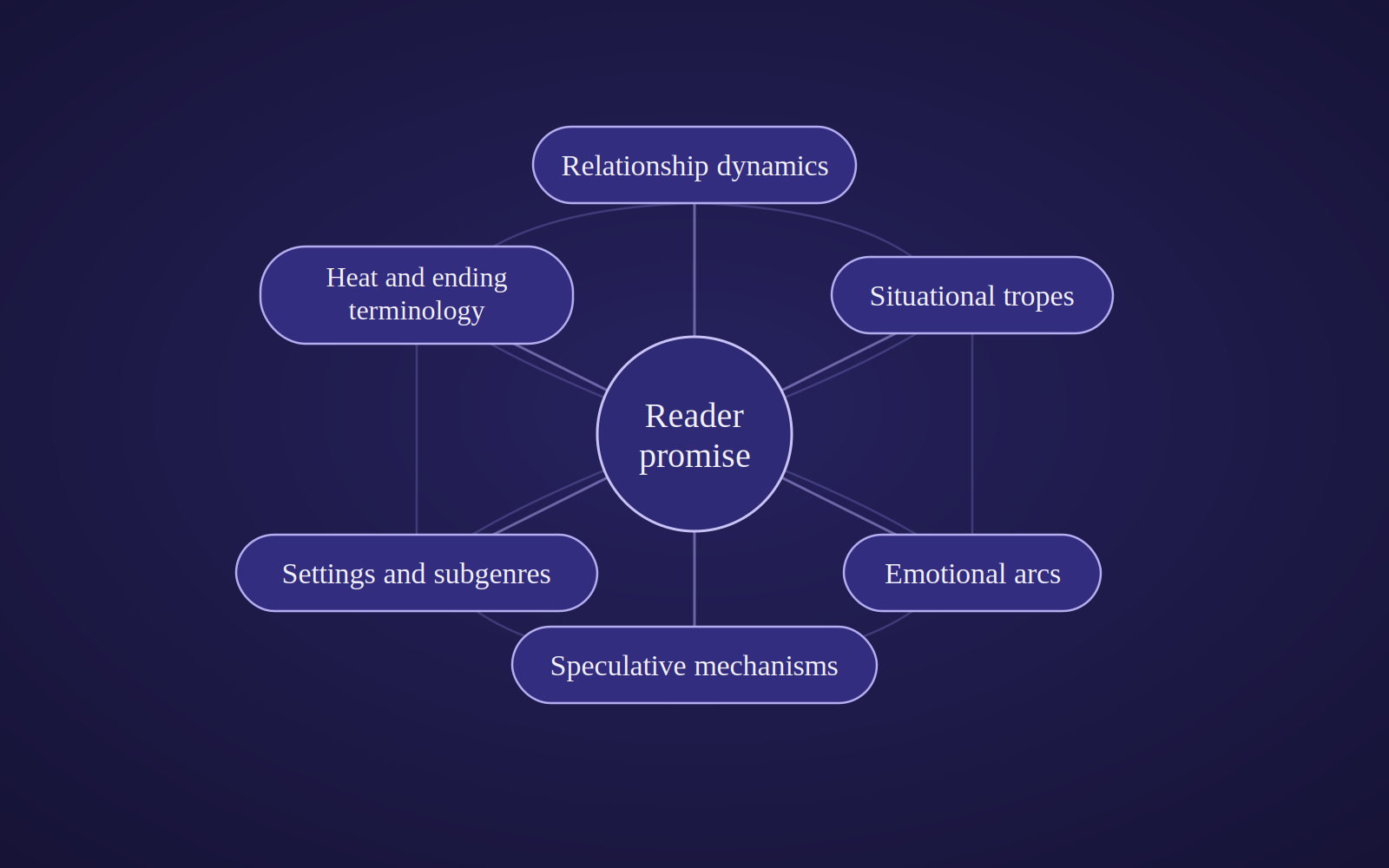
The map has six regions.
Relationship dynamics name the structure between the central characters. What existing relationship, contrast, history, or imbalance must be renegotiated?
Situational tropes—plot engines—create conditions that force contact, performance, concealment, or dependence. What ordinary exit has disappeared?
Emotional and identity arcs name the felt progression of the story. What must be witnessed, admitted, repaired, or integrated?
Speculative mechanisms explain how a connection, body, bond, or world works. What has the premise imposed, and what remains for the characters to choose?
Settings, subgenres, and professional frameworks describe where the story happens and what tradition it belongs to. What system, place, profession, or convention shapes the relationship?
Pairing, heat, consent, and ending terminology tell the reader what to expect from the packaging. What’s the reader being told about the central pairing, the sexual content, the handling of consent, or the resolution?
One book can draw from all six. That’s not a flaw in the system. It’s the system working.
Relationship dynamics
These tropes name the structure between the two men—what already exists between them and what will have to be renegotiated before anything else can happen.
- 1. Enemies to lovers.
- The promise is that hostility will be forced into moral recognition, trust, or desire. The characters must see something true in the person they’ve categorized as an enemy, and the change in judgment has to cost them something—an alliance, a self-image, a grievance they’ve built a life around. The trope fails in two directions. If “enemy” means playful irritation, there’s nothing to renegotiate and the label is decoration. If the enemy did serious harm and attraction simply erases it, the story has skipped the work the promise required. Three related terms are worth keeping distinct—rivals to lovers, redemption, forbidden love.
- 2. Rivals to lovers.
- Rivalry isn’t the same as enmity. Rivals usually want the same prize—rank, role, victory, recognition—without necessarily believing the other man is morally wrong or dangerous. The promise is that competition will become respect without making ambition disappear. The obstacle is usually ego. Can each man admire the other without experiencing admiration as defeat? Sports romance and workplace romance run on this dynamic constantly, and the best versions never ask either man to stop wanting to win.
- 3. Friends to lovers.
- An existing form of safety will be risked for a more exposed form of intimacy—that’s the promise. The obstacle isn’t unfamiliarity—these two already know each other’s coffee orders and worst years. It’s the fear of damaging something already valuable. The strongest versions make the friendship concrete enough that the potential loss feels real, because a generic friendship risks nothing when it changes. Compare it with second chance. Friends to lovers risks an existing friendship; second chance revisits a romantic relationship or possibility that ended, failed, or was never completed.
- 4. Second chance.
- History will be confronted rather than erased. The two men have loved, almost loved, or built something before, and the present story asks whether change can answer the actual reason they failed. Time apart isn’t evidence. The second chance has to test whether anything is different now—and the reader has to see the proof, not hear the claim. Second chance overlaps naturally with redemption and grovel when the failure involved harm rather than circumstance.
- 5. Grumpy/sunshine.
- Two contrasting methods of meeting the world will expose what each method protects. That framing matters, because the trope collapses fast when it’s read as one mean man and one human golden retriever. “Grumpy” shouldn’t be shorthand for cruelty, and “sunshine” shouldn’t mean childishness or a permanent shift of emotional labor onto the brighter man. Reserve is a strategy with costs. So is brightness. The dynamic becomes interesting when both men have to answer for what their method has been hiding. Grumpy/sunshine is one recognizable expression of the broader opposites-attract family, which covers any contrast doing this work.
- 6. Age gap.
- A difference in age, experience, life stage, or social power will have to be acknowledged rather than made decorative. There’s no universal numerical threshold, and communities differ on how large a difference has to be before it’s marketed explicitly.[4] The relevant question is what the difference changes—authority, resources, expectations, public perception, sexual experience, future planning, or the freedom to say no. An age gap that changes nothing is a birthday, not a trope. When the gap runs through a workplace or another power structure, it borrows obstacles from forbidden love and needs the same care with consent.
- 7. Established relationship.
- This one promises that love will be tested after formation rather than ending when the couple gets together. Marriage, domestic strain, betrayal, loss, parenthood, renegotiated desire—all of it lives here. The trope corrects a lazy assumption baked into a lot of romance marketing, that romantic movement ends with the first commitment. A marriage-in-trouble story belongs here; it also becomes second chance when the romantic relationship has ended in practice and the men are choosing whether to enter it again. The distinction is continuation versus re-entry, not legal status.
Situations that remove escape
Every trope in this category answers the same diagnostic question. What ordinary method of avoidance does this situation remove? People are good at not dealing with things. They leave rooms, delay conversations, manage distance, control the terms of contact. A plot engine works by taking one of those tools away.
- 8. Forced proximity.
- The promise is that avoidance will become impossible. The setting isn’t the engine—the constraint is. Two men who would ordinarily leave, hide, or schedule their way out of contact can’t use those exits, and whatever was already unresolved between them starts compounding. The confinement doesn’t create the conflict. It exposes the conflict that was already there. I’ve written a full essay on the deeper logic of this trope—why forced proximity works in M/M romance—and everything there applies to the variants below.
- 9. Only one bed.
- This is forced proximity concentrated into furniture. Physical space will make awareness, restraint, or desire impossible to ignore—that’s the whole promise. Its power comes from negotiated boundaries and conscious proximity—who takes which side, what counts as accidental, what either man does with the fact of the other’s breathing. Note the honest weakness. The characters can still choose the floor, a chair, another room, or the parking lot unless the story credibly removes those options. The bed becomes an engine when the story makes the alternatives unavailable, implausible, or more emotionally revealing than sharing it.
- 10. Fake dating.
- Performed intimacy will produce evidence the characters can no longer dismiss as performance. The public fiction has to solve a real problem—reputation, family pressure, access, protection, work, inheritance—or the premise is a costume. The emotional engine is the instability between rule and feeling. The arrangement has terms; the men keep exceeding them; and every exceeded term is data neither can unread. My novel The Terms of Us runs on exactly this engine—a contract precise enough to measure everything the contract can’t contain.
- 11. Marriage of convenience.
- This is fake dating’s older, heavier cousin, and it promises that a practical contract will acquire emotional meaning its terms never anticipated. Marriage creates stronger legal, social, financial, and domestic consequences than a pretend boyfriend does, which raises the stakes and shrinks the exits. The practical reason for the marriage has to be credible inside the story’s world—immigration, inheritance, insurance, protection, dynastic obligation—or the whole structure reads as a decorative shortcut to cohabitation.
- 12. Roommates.
- Domestic repetition will turn private habits into emotional evidence. Accumulated access drives it—mornings, illness, money, chores, sleep, guests, the unnoticed rituals of care. Sharing an apartment can be nothing but a setting. It becomes a plot engine when shared domestic life changes what can be hidden or avoided, when one man learns things about the other that no date would have surfaced.
- 13. Workplace romance.
- Professional roles will collide with private desire—that’s the promise. The label can describe a setting, a professional framework, or a true plot engine, and an honest book knows which one it’s writing. A coworker relationship and a supervisor/subordinate relationship aren’t the same story. The org chart changes the authority, policy, career risk, reputation, and real ability to refuse. My short story Hookup App, Same Office stacks the workplace frame with anonymity and secrecy, which is the point of stacking—each label answers a different question about the same two men.
- 14. Protector or bodyguard.
- The promise is that professional vigilance will become personal vulnerability. The protector has sanctioned access and a duty to watch; the protected man may resent surveillance, dependence, or the unequal control built into the arrangement. The romance works when safety doesn’t become ownership and protection doesn’t cancel the protected character’s agency. When it fails, it fails there—the watched man dissolves into an object of care and stops being a person who chooses.
- 15. Secret relationship.
- Intimacy will develop under the pressure of concealment. The secrecy may protect safety, livelihood, family belonging, military service, reputation, or another relationship, and the story has to distinguish understandable privacy from an arrangement that treats one partner as disposable. A man who hides you because the command would end his career is living a different story than a man who hides you because you embarrass him. In military M/M romance the concealment answers to the command—I’ve written about rank, consent, and the chain of command in military M/M romance at length, and my story Danger Close lives inside that exact pressure.
- 16. Forbidden love.
- The relationship will test a rule, an institution, a loyalty, a taboo, or a social boundary with meaningful consequences. “Forbidden” requires an actual source of prohibition—law, policy, family, faith, violence, the real risk of losing a career or a home. It shouldn’t be used because a relationship is merely inconvenient. Historical and military M/M romance earns this label more often than most, because for long stretches of history the prohibition wasn’t a plot device. It was the legal environment.
- 17. Road trip or stranded together.
- Movement or isolation will strip away ordinary identities and routines. A road trip creates a sequence of temporary spaces where neither man is on home ground; being stranded creates a fixed interruption nobody chose. Both remove familiar support systems and make departure difficult, and both fail the same way—when the delay fills pages between destinations instead of changing the emotional situation. My story Hours With No Edges works this ground—travel disruption, temporary isolation, and an encounter with a clock running inside it.
One craft note remains before leaving this category. Trope labels can tell a reader why two men must remain in contact. They can’t keep every “he” clear at the sentence level. That’s a separate discipline, and I’ve written about writing two men clearly on the page for anyone doing the line-level work.
Emotional arcs and speculative mechanisms
This section holds two different kinds of language, and the difference matters enough to state plainly. Hurt/comfort describes what the relationship does with suffering. Fated mates describes how or why the characters are connected. A book can use both. The first group names felt progressions—what must be witnessed, admitted, repaired, or integrated. The second names machinery—what a speculative premise has imposed and what it leaves for the characters to choose.
The emotional and identity arcs come first.
- 18. Hurt/comfort.
- The promise is that suffering will be witnessed and answered. The hurt may be physical, emotional, social, or traumatic; the comfort may be care, presence, protection, touch, advocacy, or the simple act of believing what another person says. The structure has a long history in fan communities, where it developed as a form of its own well beyond romance. Fanlore, the collaboratively maintained fan-history wiki, documents that lineage.[5] It becomes romantic when the act of witnessing changes the central relationship, when being seen at the worst moment turns out to be the intimacy neither man had risked.
- 19. Caretaking.
- It’s hurt/comfort’s quieter sibling, and its promise is that practical care will reveal attachment. Illness, injury, disability, loss, exhaustion, recovery, plain domestic labor—caretaking can be repeated and undramatic where hurt/comfort foregrounds a wound and its answer. The distinction is worth preserving because the two satisfy different appetites. One reader wants the crisis and the vigil. Another wants soup made without being asked, ten Tuesdays in a row.
- 20. Slow burn.
- Emotional or sexual recognition will accumulate rather than arrive all at once—accumulation is the promise. There’s no universal percentage of a book that makes a romance slow burn. Fanlore describes the trope through gradual romantic or sexual development rather than a numerical threshold.[6] The honest test is whether delay produces new knowledge, risk, and pressure. Every deferral should change something. Repetition without changing stakes isn’t a burn. It’s postponement, and readers can tell the difference by chapter six.
- 21. Mutual pining.
- Both men want the relationship; each believes action is impossible, unsafe, or unreturned. The pleasure lives in the gap between what the reader can see and what the characters can admit. The craft obligation is symmetry of credibility—each man needs a real reason not to resolve the misunderstanding immediately, or the pining curdles into contrivance. Pair it with slow burn and you have most of the genre’s ache. Pair it with secret relationship and the silence gets teeth.
- 22. Found family.
- Belonging will be built through chosen care rather than guaranteed by blood or law. This is an emotional and communal structure, not inherently a couple trope, and it’s far older and broader than romance. In M/M fiction it can carry extra weight by giving the central relationship a social world, a place of safety, or a counterweight to rejection. The failure mode is reduction, a supporting cast that exists only to cheerlead the couple. A found family that never disagrees isn’t a family. It’s an audience.
- 23. Angst with a happy ending.
- The story will permit serious emotional pain without abandoning the genre’s optimistic resolution—that’s the contract. “Angst” describes the intensity of the experience, not the outcome, and the ending label has to stay explicit precisely because many readers will walk into heavy weather only when they know the relationship comes out emotionally secured. This is packaging honesty at its most functional—the label lets the reader choose the hurt knowingly.
- 24. Redemption.
- A character who caused harm will change in action, not merely in self-description. Redemption is broader than romance, and inside romance it carries its own danger. Love may motivate change, but it can’t be the proof that change occurred. Accountability, restitution, altered choices, and the injured character’s autonomy do that work. A romance that treats being loved as the evidence of reform has confused the reward with the receipt.
- 25. Grovel.
- The man who damaged trust will recognize the harm and make a costly, concrete attempt at repair. A grovel isn’t a speech length and it isn’t a humiliation ritual. It’s repair. The apology has to name the harm accurately, skip the demand for immediate forgiveness, and be backed by behavior the reader watches. Readers who search for “grovel” are asking a precise question—will the repair be proportionate to the damage?—and the books that satisfy them answer it on the page.
- 26. Sexuality awakening.
- A character’s understanding of his desire or identity will change under emotional and sexual pressure. Use this broad label when the eventual identity isn’t yet known or when the story deliberately resists a narrower one. Use “bi awakening” or “gay awakening” only when the text supports that identity—attraction to one man doesn’t prove a universal label, and a book that pretends otherwise is flattening its own character. One historical note belongs here. The older market phrase “gay for you”—often abbreviated GFY—still circulates, but a major current M/M reader community identifies it as outdated and potentially offensive, because it can treat bisexuality as impossible and gay identity as an exception caused by one irresistible person.[4] It appears in this guide as a contested historical label, not a recommended one.
- 27. Coming out.
- Private knowledge and public life will have to be negotiated. Coming out is an identity and social arc before it’s a romance trope, and it may involve safety, family, work, law, faith, community, and selective disclosure that never fully ends. Two cautions keep the arc honest. Public disclosure isn’t a universal moral requirement a story should impose on every character, and one disclosure doesn’t end the process—men come out for the rest of their lives, one room at a time.
The speculative mechanisms come next. These explain how a connection, body, bond, or world works. They can generate a romance plot, but they can’t complete one. Destiny isn’t trust. A bond isn’t consent. Biological compatibility isn’t emotional knowledge. The strongest speculative romance knows exactly what its machinery imposed—and then makes the characters choose everything the machinery couldn’t.
- 28. Fated mates.
- The promise is that a connection has been imposed, recognized, predicted, or made inevitable—and that the characters must decide what it means. The mechanism may be biological, magical, spiritual, social, or cosmic. Fate can create contact and pressure; it can’t substitute for consent, compatibility, or the slow accumulation of actual knowledge of another person. The version worth reading asks what the characters choose after destiny has spoken. The version that fails treats the bond as the relationship, delivered whole, with nothing left for either man to do but comply.
- 29. Soul bond or magical mating bond.
- The relationship becomes perceptible or consequential through a supernatural link—one that may transmit emotion, pain, thought, health, power, location, or mortality. A soul bond isn’t always romantic, and a mating bond isn’t always identical to fated mates. Fanlore documents wide variation in soulmate conventions,[7] which is exactly why a book has to define what its own bond does. A bond that shares pain writes a different story than a bond that shares thought. The details are the story.
- 30. Omegaverse, or A/B/O.
- A speculative system of secondary sex or social roles will shape bodies, status, desire, reproduction, hierarchy, or intimacy. Omegaverse developed in early-2010s slash fandom and has since moved through fan fiction, original fiction, digital publishing, and multiple national markets.[8] Its conventions are composite and variable—a story may use alphas, betas, omegas, heats, ruts, scenting, nesting, knotting, bonding, pregnancy, social hierarchy, or only a subset. It isn’t synonymous with shifter romance and it doesn’t always involve wolves. Two accuracy notes are non-negotiable. Write A/B/O with the slashes; the unspaced form matches a racial slur used in some English-speaking contexts.[8] Never imply the genre automatically contains nonconsensual sex, dubious consent, male pregnancy, fated mates, or explicit content—it may contain any of them, which is why exact consent and content language matters more here, not less. Milena Popova’s research examines Omegaverse fan fiction as a site for thinking through power and sexual consent.[9]
- 31. Shifter romance.
- The promise is that transformation, instinct, pack or group belonging, and divided identity will shape the relationship. Wolves, big cats, bears, dragons, birds, invented creatures—the animal varies, and the label can incorporate fated mates or Omegaverse conventions without requiring either. “Shifter” names a speculative framework. The romance inside it still needs its own emotional engine, because a man who turns into a wolf is a premise, not a plot.
- 32. Vampire romance.
- Desire will be shaped by hunger, danger, immortality, secrecy, or unequal time. Vampire romance can run gothic, paranormal, erotic, horrific, comic, or urban-fantasy adjacent, and the creature alone doesn’t identify the central trope. The productive questions are structural. What does feeding mean between these two men? What does it cost to love someone who won’t age? Which of them holds power, and does the story know?
- 33. Human/nonhuman romance and alien bonding.
- Intimacy will cross a meaningful boundary of species, embodiment, language, culture, or personhood. “Monster romance,” “human/nonhuman romance,” and “alien romance” are market labels whose borders vary by community. Alien bonding is a mechanism when biology, technology, ritual, or telepathy creates the connection—but the actual romance may still be forced proximity, fated mates, or enemies to lovers wearing a different sky. My novel Claimed by the Ninth Orbit is a clean demonstration of stacked labels rather than a single trope. It stacks an M/M pairing, a science-fiction framework, an alien-bonding mechanism, a forced-proximity engine, and dark, explicit romantic packaging—five labels, five different questions, one book.
How readers and writers use trope language
Everything left to cover is language that gets shelved with tropes without being tropes—and it’s some of the most consequential language in the genre, because it’s how books get found and how expectations get honored or betrayed.
Start with settings, subgenres, and professional frameworks. These describe where a story happens, what world or institution governs it, or what market tradition it belongs to. Some can also act as plot engines, and the honest classification depends on the label’s primary function in the book at hand.
- 34. Military romance.
- The relationship will be shaped by service, duty, rank, danger, the rules of the service, or the afterlife of military experience. Military isn’t a trope by itself. Rank gap, secret relationship, forbidden love, forced proximity, reunion, protector, second chance—one of those supplies the romantic engine, and the branch of service, unit culture, and historical period change everything about what’s at stake. I’ve written a full essay on rank, consent, and the chain of command in military M/M romance for writers working this ground.
- 35. Sports romance.
- Competition, performance, team identity, public scrutiny, bodies, contracts, or career timing will shape the relationship. The frame is professional and social; the romance usually runs on rivals to lovers, teammates, a forbidden or secret relationship, or injury caretaking. Power deserves extra care here—a romance between peers on a roster and a romance between a coach and a player aren’t the same story, and consent has to be written with that authority gap in view.
- 36. Small-town romance.
- Place, history, visibility, and community will affect what the characters can hide or become. A small town concentrates witnesses. For two men, that concentration cuts both ways—it can mean surveillance and inherited judgment, or found family and a place that closes around its own. The town has to exert pressure. When it doesn’t, the label describes set dressing, decorative storefronts and familiar faces with nothing behind them.
- 37. Dark romance.
- The promise is that danger, taboo, moral ambiguity, coercive power, obsession, or transgression will be integrated into the central relationship rather than remaining external atmosphere. The term is commercially recognizable and still contested—it grew up largely through digital and self-publishing channels, and scholars examining it as a publishing category note that its definition remains an open argument.[10] Hold the boundaries anyway. Dark romance isn’t a heat level. It isn’t a synonym for mafia, captive romance, noncon, or a sad ending. A violent thriller with a conventional romance subplot isn’t automatically dark romance—the darkness has to materially shape intimacy, desire, power, or the romantic arc itself. And “dark” is never a substitute for clear content and consent language in the packaging. Readers who want this shelf want to know exactly which door they’re opening.
- 38. Paranormal romance versus urban fantasy.
- Both promise that supernatural beings, powers, or worlds will materially shape the story. The classification turns on narrative priority. Paranormal romance keeps the love story and its optimistic resolution central; urban fantasy generally centers the protagonist’s conflict with a supernatural world and may carry a romance arc without letting it organize the book. Communities and publishers draw this border differently, especially across series, so describe narrative priority rather than announcing a universal test.[4] My novel The Night Hungers shows how much one book can hold across that border—urban-fantasy architecture, paranormal desire, dark tone, bloodline magic, and a developing bond—without making the labels interchangeable.
Now comes the packaging language proper—pairing, ending, heat, and consent. These aren’t tropes at all, and the genre is healthier every time somebody says so plainly.
- 39. M/M, MM, MLM, and gay romance.
- These usually describe a central romantic configuration involving two men, though communities and individual works don’t always draw the boundary identically. M/M and MM are common publishing and reader abbreviations; MLM means men loving men in some community contexts; “gay romance” is a familiar discovery phrase that can be narrower or broader than a given book’s characters. Here’s what the pairing label doesn’t establish. It doesn’t tell you both characters are gay, cisgender, equally public, or described by identical identity language. The characters may differ in sexual orientation, gender history, public identity, or the language they use for themselves. A trans man is still a man; when a central character identifies as nonbinary rather than as a man, some communities prefer M/NB or a more exact description instead of assuming M/M.[11] This guide uses M/M romance as its consistent editorial label while acknowledging all of that adjacent usage.
- 40. HEA, HFN, and the literary ending.
- Ending labels tell the reader what degree of romantic security the book offers. HEA—happily ever after—means the relationship ends with durable emotional commitment and an optimistic future. It doesn’t require marriage, monogamy, children, wealth, or the removal of every external problem. HFN—happy for now—means the relationship has a satisfying, optimistic present even if the future stays less fully secured. It doesn’t mean the relationship is likely to fail; it means the book is honest about how far it looked. RWA’s genre-romance definition requires a central love story and an emotionally satisfying, optimistic ending,[1] and reader communities use HEA/HFN as functional shorthand for that expectation.[4] A bittersweet, unresolved, tragic, or literary ending can be artistically valid and deeply romantic—but it shouldn’t be packaged as conventional genre romance without clear language, because ending expectation is the deepest promise the genre makes.
- 41. Closed door, fade to black, open door, explicit, and high heat.
- Heat language tells the reader how sexual content appears on the page. It tells them nothing about the relationship dynamic or the plot. The working definitions run roughly like this. Closed door generally means sex occurs but isn’t shown in detail. Fade to black generally means a scene ends or transitions before explicit activity. Open door generally means sexual activity appears on the page. Explicit indicates greater anatomical or action-level detail. High heat may refer to detail, intensity, frequency, centrality, or some combination. Notice how much “generally” is doing—these definitions overlap and aren’t standardized across the field. One long-running review site maintains its own contextual sensuality scale and says outright that its standards have shifted over time,[12] which is the honest position. No universal one-to-five spice scale exists, and this guide won’t install one. One last vocabulary note remains. Harlequin’s archived publisher glossary used “clean romance” for low-heat books,[3] while a major M/M reader glossary rejects the term because it implies that on-page sex is dirty and recommends “closed door” or “fade to black” instead.[4] Use the concrete term the book actually supports—closed door, fade to black, low heat—and skip the moral freight.
- 42. Erotic romance versus erotica.
- The label tells the reader whether explicit sexual interaction serves a genre-romance arc, a broader erotic project, or both. In erotic romance, explicit sexual interaction is integral to the love story, the character growth, and the relationship’s development—remove it and the narrative breaks—while the book still delivers the central love story and optimistic resolution genre romance requires.[1] Erotica is organized primarily around erotic experience, exploration, transformation, or arousal, and it doesn’t need to end with a couple’s HEA or HFN.[4] That doesn’t mean erotica has no plot. It means the erotic movement, rather than the formation of a conventionally resolved romance, is the organizing principle. Retail metadata reflects the split—BISAC files gay erotica and gay romance under different branches entirely.[2] The two forms are neighbors, and plenty of writers work both sides of the street. The label exists so readers know which house they’re entering.
One compact clarification belongs beside the heat labels, because it’s the most common and most costly confusion in the genre’s packaging.
Consent labels aren’t heat levels. Dubcon indicates consent that’s narratively doubtful, compromised, coerced, or difficult to establish. Noncon indicates nonconsensual sexual activity. CNC—consensual non-consent—describes a negotiated erotic practice in which participants agree to role-play non-consent under defined conditions.[4] It isn’t interchangeable with noncon. Usage varies, and three lines can’t replace precise content notes. The point is classification. “Explicit” tells the reader about on-page detail; dubcon or noncon tells the reader about consent conditions. A book can be low-detail and coercive, or highly explicit and fully consensual.
That distinction matters especially in dark romance and in Omegaverse stories that use bodily compulsion or unequal social roles. It should never substitute for a book’s own concrete content notes.
So how does a writer, or a reader, actually use all of this? Stack the labels. A book isn’t one thing, and the axes don’t compete—they answer different questions. A workable classification formula runs like this.
Pairing + primary emotional promise + plot engine + subgenre or framework + heat and ending language
Two classification examples follow—generic ones, not descriptions of my books.
M/M + friends to lovers + forced proximity + military framework + open door + HEA
M/M + fated mates + alien bonding + science-fiction romance + explicit + HFN
Lead with the label that carries the book’s primary emotional promise, then add only the secondary labels that materially shape the reading experience. Six accurate labels beat one impressive one, and one accurate label beats six that were chosen for traffic. Transparent packaging isn’t the same as revealing the plot—a trope names the door, not the rooms behind it. The same logic governs how digital shelves and tags surface short fiction, a shift I examine in The Digital Renaissance of the M/M Short Story.
Good trope language doesn’t reduce a story to a checklist. It tells the truth about the door the reader is entering. The story still decides what happens after it opens.
If you want to see the labels working in finished fiction, browse Kevin Snell’s M/M and literary short fiction.
Sources
Fanlore is a collaboratively maintained fan-history resource, and Reddit sources reflect community usage. Their value here is evidence of how reader communities use language, not institutional authority.
- Romance Writers of America, “About the Romance Genre,” Romance Writers of America, accessed July 23, 2026. ↩ 1 ↩ 2 ↩ 3
- Book Industry Study Group, “BISAC Subject Headings List: Fiction,” Book Industry Study Group, accessed July 23, 2026. ↩ 1 ↩ 2
- Claire Caldwell, “From Alpha Hero to HEA: A Harlequin Romance Glossary,” Write for Harlequin, September 16, 2015, archived July 28, 2022, Internet Archive. ↩ 1 ↩ 2
- r/MM_RomanceBooks, “Glossary of Romance Terms,” Reddit community wiki, accessed July 23, 2026. ↩ 1 ↩ 2 ↩ 3 ↩ 4 ↩ 5 ↩ 6 ↩ 7 ↩ 8
- “Hurt/Comfort,” Fanlore, Organization for Transformative Works, accessed July 23, 2026. ↩
- “Slow Burn (trope),” Fanlore, Organization for Transformative Works, accessed July 23, 2026. ↩
- “Soulmates,” Fanlore, Organization for Transformative Works, accessed July 23, 2026. ↩
- “Alpha/Beta/Omega,” Fanlore, Organization for Transformative Works, accessed July 23, 2026. ↩ 1 ↩ 2
- Milena Popova, Dubcon: Fanfiction, Power, and Sexual Consent (MIT Press, 2021), https://doi.org/10.7551/mitpress/12546.001.0001. ↩
- Katie Deane, “Dark Romance: An Introduction,” Porn Studies, published online January 2, 2026, https://doi.org/10.1080/23268743.2025.2586593. ↩
- r/MM_RomanceBooks, “Acronyms,” Reddit community wiki, accessed July 23, 2026. ↩
- All About Romance, “Sensuality Rating System,” All About Romance, accessed July 23, 2026. ↩