A uniform can put two men in the same room. Rank decides what the room costs them.
I served as a Sergeant in the Army’s 82nd Airborne Division, and I was gay while I did it, in the years when policy had a written opinion about that. I’m not a spokesman for every soldier who ever wanted another man. I’m one veteran making one argument. Military M/M romance often treats the uniform itself as the problem.
The uniform is a costume. The Army is the thing wearing it. A story can get every patch, weapon, and acronym right and still feel false because none of those details tells us who outranks whom, who writes whose evaluation, or who can order whom onto a duty roster, into a field exercise, or out of a career.
A captain stops being a generic dominant hero when the story shows what he can order, whom he must answer for, and what he can lose. A secret either puts the men at real risk or exists only to give chapter nine somewhere to go. The genre keeps reaching for uniforms because uniforms photograph well.
Cloth and insignia can’t make two men afraid to be seen together. The fear comes from the Army placing every man above some soldiers and below others, watching how he treats the men above and below him, and enforcing written rules about what he does with his body and loyalty.
The tropes are not the subject here. The chain of command that gives them consequence is.
The military is a chain of command before it is an aesthetic
Romance has a whole shelf of adjacent fantasies that borrow the same wardrobe, including bodyguards, mercenaries, contractors, cops, and vaguely defined operatives who answer to no one and deploy to unnamed places. Boots and a severe haircut don’t turn those stories into military romance.
A bodyguard and his client work under a contract either man can end, even if ending it costs one man the job and the other his protection. A soldier can’t simply quit the assignment, choose different coworkers, or leave because the relationship has become inconvenient. He doesn’t choose his schedule, housing, or sometimes even his zip code.
The Army that makes those choices also evaluates, promotes, and disciplines him. When a bodyguard falls for the client, the contract may end and the client may need someone else to protect him. When a soldier falls for the wrong man, the Army gets a vote, and it has paperwork ready.
Military romance misunderstands rank most often when it treats rank as a personality type. Captains are commanding, sergeants are gruff, privates are sweet and trainable. But “Captain,” “Sergeant,” and “Private” aren’t flavors of masculinity. Those titles tell us whom he obeys, whom he can order, and what every exchange between the men means before either speaks.
Branch, component, job, unit, duty station, and era determine what he does all day, who gives him orders, and how much of his life the Army controls. A National Guard mechanic and an active-duty infantry NCO work different hours, answer to different commanders, and face different demands. The reader does not need every acronym. The reader does need to know which facts can change the men’s jobs, homes, and futures.
The same hotel room becomes a different danger every time the ranks change. Two civilians share it and wonder whether either man will act on what he wants. Two soldiers of the same rank in different units share it at a training course and also have to think about rumors and the men sleeping down the hall.
Make one of them an NCO and the other a junior enlisted soldier in the same battalion, and the room stops being a room. It becomes possible evidence of an improper relationship, whether or not anything happens in it.
Make one man an officer and the other an enlisted soldier in the same direct chain of command, and the closed door can become evidence before either man touches the other. Whether the Army would punish them depends on details this example leaves out. For the writer, the point is simpler. The bed has not changed. The men’s ranks have changed what the closed door can cost them.
Rank matters because one man can give the order and the other may pay for refusing it.
Rank changes the meaning of everything
The current relationship rules sit in the standalone Army Regulation 600-32, not in Army Regulation 600-20’s general standards-of-conduct section. AR 600-32, paragraph 2-2, governs conduct between soldiers of different grades. It doesn’t simply say that different ranks can’t date.
It says relationships between soldiers of different grades are prohibited when they compromise, or appear to compromise, supervisory authority or the chain of command, when they cause actual or perceived partiality, when they involve or appear to involve the improper use of rank for personal gain, when they are or are perceived to be exploitative or coercive, or when they create an adverse impact on discipline, authority, morale, or the mission.
On top of that general test, certain relationships are expressly prohibited, subject to limited exceptions, including dating, intimate or sexual relationships, and shared living arrangements between officers and enlisted soldiers, and between NCOs and junior enlisted soldiers.[1]
The rule is aimed at what rank can do to an order, a favor, an evaluation, or a refusal—and at relationships that look as though rank might have done it. The phrases “or appear to” and “or perceived to be” let the Army act on what a relationship looks like, not only on what the two soldiers intended. A relationship need not buy a promotion or erase a punishment to damage a unit. Everyone else still has to wonder whether the relationship changed who was promoted or punished.
Every clause on that list can become a scene. A ride home from the motor pool may feel like kindness to the two men and favoritism to the platoon. Rank, not intention, determines whether the command sees an improper favor. A room assignment is logistics until the same two names keep landing beside each other often enough to look deliberate.
A correction delivered in private instead of in formation might be protecting a young soldier’s dignity, or hiding something, and the platoon will decide which without consulting either man. A junior soldier can say no to dinner off post and still wonder whether the senior man will hold that refusal against him on the next duty roster, evaluation, or invitation. A favor that costs the senior man nothing can quietly reprice everything the junior man earns afterward, because now nobody is sure what was earned.
Consent matters, but it doesn’t answer every question a military love story raises. One error says every rank-gap relationship is predatory. The other says that since both men want it, nothing else matters. Army policy commits neither error, and neither should a novelist. In civilian romance, the question may be whether he meant yes.
In a military chain of command, the junior man may also have to wonder whether saying no will follow him into his evaluation, duty roster, leave, housing, or reputation. The senior man may never know whether the junior soldier wants him or is afraid to refuse him. The unit may call the relationship favoritism or coercion even when both men call it love, and that suspicion can change who gets trusted, promoted, corrected, or sent home.
A man who chooses to submit to his lover in bed isn’t in the same position as a soldier ordered by his squad leader. Lovers can agree on who gives orders, change the rules, or stop. A junior soldier being directed by his squad leader negotiated nothing.
The sergeant’s authority is backed by evaluations, duty assignments, discipline, and the junior soldier’s future, and it doesn’t switch off because both men are off duty and interested. A story can put both men in the same bed, but the page must show which orders the junior man chose and which ones he could not refuse.
Forbidden relationships belong in military romance, but the story must name what each man can lose, who can punish whom, and why the junior man usually has more to lose. A book that does that is already ahead of half its shelf.
What military M/M romance gets right
The strongest military romances let one man prove, day after day, that he will be there when the other needs him, even before either calls it love.
Army leadership doctrine treats trust as the condition that makes influence possible, and it identifies the source plainly. Trust doesn’t come from speeches. It comes from shared experience, from communication, from commitments met, over and over, in view of other people.[2] Strip away the doctrine language and the love story is already there. Long before either man admits what he wants, the proof is already in what he does for the other.
Care in a military unit shows itself in the work. One soldier checks the other’s equipment without making a show of it, puts food within reach after a missed meal, remembers the detail that keeps him safe, corrects him in private, and trusts him with the task that matters.
Those choices feel intimate before either man says a word because everyone can see them. If they’re peers and break no rule, the unit can watch them become necessary to each other without giving the command anything it can punish. The civilian workplace can only approximate that kind of intimacy, because it rarely puts your life in your coworker’s hands as a scheduled activity.
The genre praises restraint while frequently writing its cheap substitute. Restraint is active. A restrained character has plenty to say and show, then chooses every day what he will let anyone see, hear, or risk. Every choice to hide himself should change what he says, does, or gives up. A hero who never speaks, never wants visibly, and never reacts is absent, and no amount of jaw-clenching converts absence into depth. Military competence becomes erotic only when the work protects someone or forces the character to ignore what he wants.
In my unit, learning I was gay didn’t change who trusted me. I stayed in after the summer that became my short story Danger Close. I served two tours in Afghanistan with the 82nd, and somewhere in those years I stopped being alone with what I was. I found a family inside my own unit. Those men and women, soldiers all, decided it cost them nothing.
They had my back after someone who had paid hard for the lesson warned me that no one ever would. Nobody made a speech about it. They accepted me one ordinary day at a time. They worked beside me, kept their word, and never delivered the rejection I’d spent my whole enlistment bracing for. A single dramatic acceptance scene misses how it often happened. In a military unit, the same men may simply keep working beside you after they know.
My literary M/M military romance Rain by Midnight shows what happens when desire and military discipline occupy the same life. Its Staff Sergeant has survived by keeping every part of himself separate after watching a good soldier lose everything for being seen too clearly. A civilian undoes that separation in coffee shops, parking lots, and other public places where being seen wanting him could become evidence. The novel makes wanting and discipline share every scene because, in my experience, they shared every day.
What it gets wrong
Each shortcut removes the Army and leaves the writer an easier book.
The genre turns the uniform into an alpha costume. This is the most common failure and the most forgivable, because it’s what the market rewards. The hero has muscles, boots, a weapon, clipped speech, and no job. He has no unit obligations, no coworkers, no sergeant major breathing down his neck about a missing sensitive item, and no Army behind him at all.
The boots, weapon, and clipped speech do the work the character never does. Knowing acronyms doesn’t make masculinity credible. He becomes credible when he still has work to do after the love interest enters the room, and when falling in love makes that work harder.
The genre strips rank of consequence. The book wants the deference, the “sir,” and the delicious wrongness of a rank gap, but it erases the evaluation, favoritism, rumor, and career damage as soon as they threaten the fantasy. Rank becomes a costume too, just a verbal one. A rank-gap romance earns its place when the rank can still damage the men. If the gap never threatens either man, the book has kept the “sir” and thrown away everything that makes the word dangerous.
The genre confuses protection with possession. A good soldier watches exits, reads rooms, and spots danger. Turning that attention toward a lover can feel like devotion. Too often, the genre inflates it into surveillance, jealousy, and threat displays that would put a real soldier in front of his commander by Thursday. Tracking exits and reading a room are part of the job.
Monitoring a lover’s phone and threatening anyone who looks at him aren’t signs of competence. A soldier who can’t control his jealousy or threats is giving his commander a problem. Protection asks what the other man needs. Possession asks what the protector fears. Those are different characters, and only one of them is admirable.
The genre uses trauma as a personality. In the stock version, drinking, nightmares, and flinching at fireworks supply the veteran’s entire personality, borrowed depth, and reason to be rescued. That shortcut is lazy because most veterans don’t have PTSD, and veterans who do are still people with work, jokes, appetites, tempers, and lives beyond the diagnosis.
The VA reports that roughly 7 out of every 100 veterans will experience PTSD at some point in their lives.[3] PTSD is real, it varies, and it’s treatable, and none of that makes it a garnish. Veteran status isn’t a diagnosis. Combat exposure, moral injury, loss, ordinary difficulty readjusting, and clinical PTSD aren’t interchangeable, and a writer who treats them as one flavor of brokenness isn’t honoring veterans. He’s using veterans.
The genre treats the military as one job. Too many fictional service members are snipers, pilots, special operators, or generically “deployed,” as if the whole service were a single occupation with different hats. The military contains cooks, mechanics, clerks, medics, chaplain’s assistants, and satellite technicians, with distinct cultures layered across services, components, units, and specialties. The story doesn’t need MOS trivia.
The story must show what the character does all day, who can punish or promote him, where he sleeps, and what he can choose, because those facts decide when he can see the other man, what he can hide, and what he can lose. Two admin clerks who share an office face different risks from two men who see each other four days a month, and both stories are military romance.
The genre strips queer secrecy of its historical clock. This one I take personally, so let me be precise. Don’t Ask, Don’t Tell was in effect from February 28, 1994 until September 20, 2011. Under it, gay, lesbian, and bisexual service members couldn’t serve openly, and the Department recorded 13,472 separations under the DADT-era homosexual-conduct policy.
Some of those men and women left with discharge characterizations below fully honorable, which could affect access to veterans’ benefits and remain attached to their military records. More than a decade after repeal, the Department reviewed eligible records on its own and corrected those that still carried the damage.[4] It wasn’t social disapproval, and it wasn’t awkwardness. It was enforceable personnel policy with a filing system.
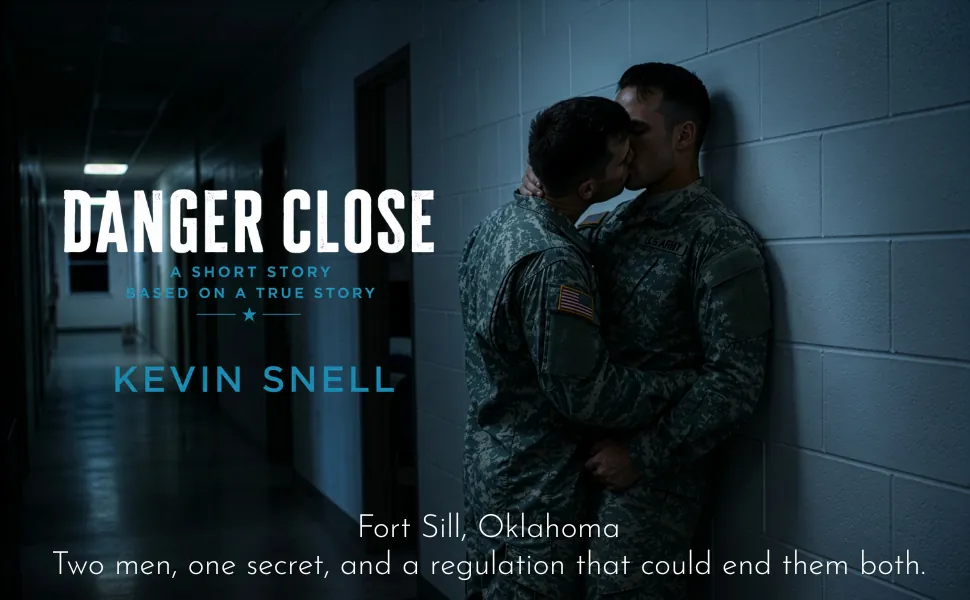
So a story set in 2000 and a story set now aren’t the same story with different phones. Danger Close is my autobiographical military short story set at Fort Sill in 2000. It begins with the words “This one is true,” and its danger is inseparable from its date. I was twenty-two that summer, certain that what I was could end me, because I’d already watched it end someone I loved.
Discovery in that world didn’t mean gossip. It meant a regulation with your name on it, a coded discharge, a changed life. That history doesn’t make Danger Close a tragedy. I got lucky, I kept serving, and I’d make the same choice again without hesitating.
But luck was the word that mattered, and a love story set in that era that can’t tell luck from safety hasn’t done its research. My experience was not every gay soldier’s experience. When a writer treats exposure under DADT as merely embarrassing, or writes a present-day service member as though DADT still governs him, the story gives its characters the wrong danger and every consequence after that becomes false.
Two facts keep the history honest. First, fear was never evidence that gay men in uniform threatened anything. When RAND studied the question ahead of repeal, reviewing the research on cohesion and surveying gay and bisexual service members along with foreign militaries and comparable institutions, it concluded that open service was likely to have little effect on recruiting, retention, unit cohesion, or performance, and that cohesion in combat units comes from shared threat and shared task rather than from everyone arriving with matching private lives.
Plenty of service members already knew gay people were serving beside them.[5] The Army had legitimate questions about whether soldiers trusted one another, treated one another fairly, obeyed authority, and did the job.
Being queer answered none of them, no matter how long policy pretended otherwise. A novel that blames queerness for breaking unit cohesion repeats the policy’s ugliest claim after RAND found little evidence that open service would harm cohesion or performance. Second, repeal didn’t end rank restrictions, privacy conflicts, bad command climates, or homophobia in every unit. Getting the era right means admitting that repeal didn’t make every unit safe.
Write the chain of command, not the costume
A writer can tell whether the Army matters by answering the questions a uniform can’t. Before the men touch, the writer should know the answers the Army would ask first about each of them. The answers aren’t a briefing for the reader. They matter because every one of them changes what a glance costs.
- What branch is this, and what era?
- Is he active duty, Reserve, National Guard, a veteran, a contractor, a dependent, a civilian employee?
- What’s his rank, and what’s his actual job?
- Who supervises whom, and who evaluates whom?
- Who controls schedules, duty assignments, leave, housing, training, discipline, or access?
- Are they in the same unit?
- Would the relationship create actual or perceived favoritism?
- What can the man with less rank or authority lose by saying no?
- What can discovery take from each man, and are those losses equal?
- What does the unit know, and what does it merely suspect?
- What must stay private because of policy, and what stays private because they’re afraid?
- What does one man do every day that proves the other can trust him?
- What part of this relationship could happen only inside this chain of command?
- If the uniforms disappeared, would the plot remain unchanged?
That last question tells you whether the Army matters. If you can remove the uniforms without changing the romance, the Army is probably decoration. Nothing on the list requires the men to obey the rules. It requires the writer to know what the rules make the men’s choices mean.
The best military M/M romance doesn’t ask the uniform to manufacture masculinity, because it doesn’t need to. It gives the men orders, duties, and careers they can’t ignore, then asks what they will risk for each other. One man’s competence can keep the other safe, and repeated acts of trust become their courtship in front of witnesses, on a schedule neither chose.
When one soldier chooses another, he changes how they work together and how every soldier around them judges the orders, favors, corrections, and risks between them. Other men’s safety may depend on those judgments. The chain of command creates the cost. The men decide whether the cost is worth paying. Write the choice.
Sources
- Headquarters, Department of the Army, Conduct Between Soldiers of Different Grades, Army Regulation 600-32 (September 16, 2024, incorporating Change 1, February 28, 2025), para. 2-2. The Army’s 2026 improper-relationships policy memorandum identifies AR 600-32 as the controlling relationship regulation alongside AR 600-20. ↩
- Headquarters, Department of the Army, Army Leadership and the Profession, Army Doctrine Publication 6-22 (July 2019). ↩
- VA National Center for PTSD, “How Common Is PTSD in Veterans?” U.S. Department of Veterans Affairs, accessed July 21, 2026. ↩
- U.S. Department of Defense, “Don’t Ask, Don’t Tell Resources,” accessed July 21, 2026. ↩
- National Defense Research Institute, Sexual Orientation and U.S. Military Personnel Policy: An Update of RAND’s 1993 Study, MG-1056-OSD (RAND Corporation, 2010), https://doi.org/10.7249/MG1056. ↩