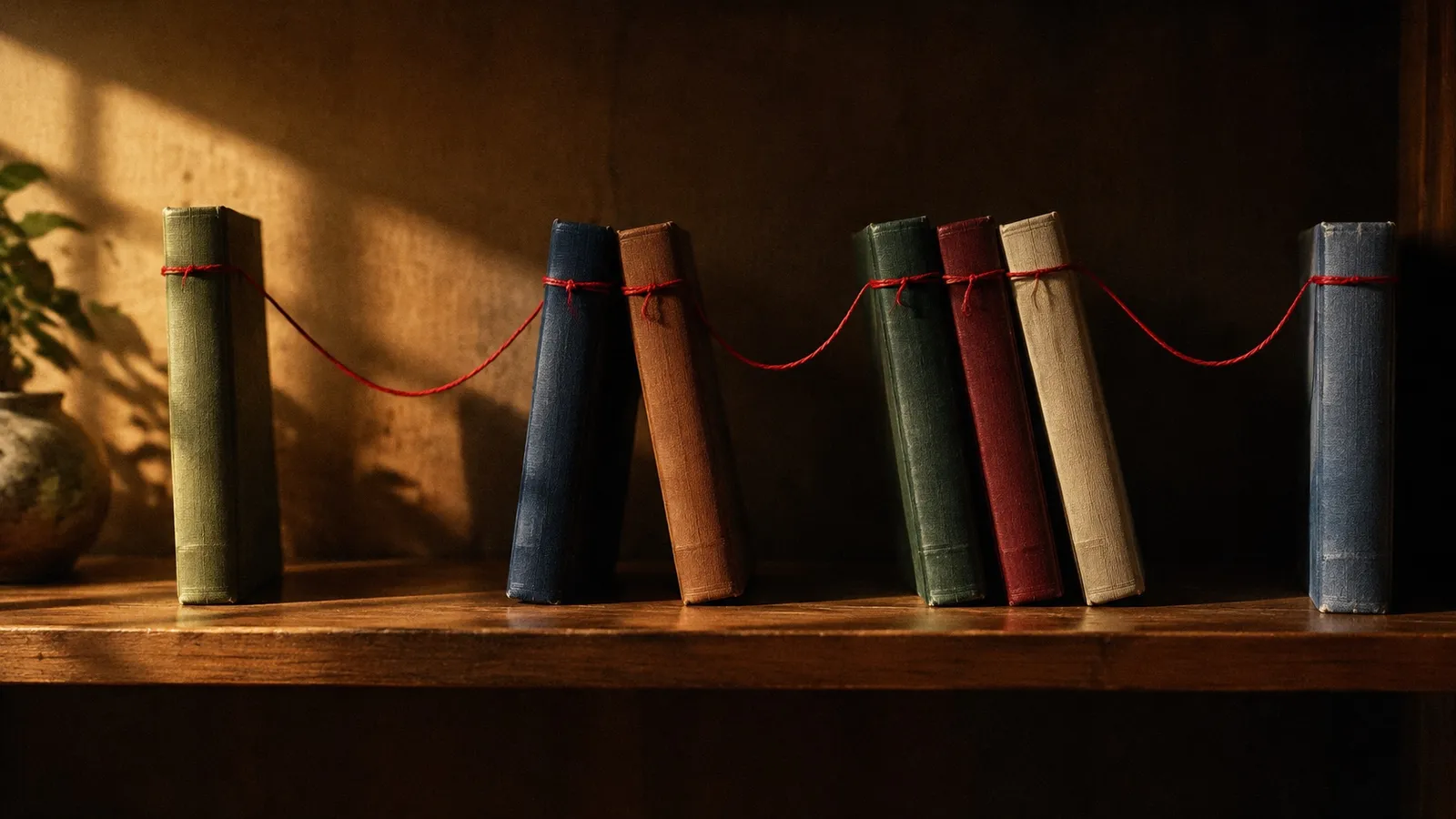
Every series makes the reader one of two promises. Start anywhere, or start at the beginning.
“Do I have to read these in order?” may be the most common question romance readers ask about a series, and the honest answer is that it depends on a structure most books don’t explain. Retailers number almost everything. A trilogy might be three separate love stories, one love story told in three parts, or three couples whose books build a larger story together. “Book Two” tells a reader where a title falls in the list. It doesn’t say whether the list is a staircase or a neighborhood.
This guide defines the structures romance readers will meet most often, from the standalone novel to the continuing-couple series and the duology. For each one it covers the promise the structure makes and the reading order it requires. Cliffhangers get their own section, and so do the trade-offs for readers and writers. My own catalog happens to include nearly every structure, so I’ll use it for examples.
The standalone novel
A standalone tells one complete story. One couple meets and reaches an ending that resolves the romance, and nothing in a later book is required to follow or enjoy it. A reader can pick it up cold and finish satisfied.
For readers, the standalone is the lowest-risk purchase in fiction. It asks for one book’s worth of commitment and pays out in full. For writers, it offers freedom. Nothing has to be set up for a sequel, and the whole book can serve its own couple. The cost is commercial. A standalone has no built-in next book, so every reader who loves it has to go looking for the author’s other work on their own. Most of my literary novels are standalones because their stories end where they need to end.
Shared worlds and interconnected standalones
An interconnected standalone gives each book its own couple and its own complete romance while sharing a setting, a friend group, a family, or a town with other books. Earlier couples come back as supporting characters, and future couples often appear before their own books. Each book ends with its couple resolved, so a reader can start anywhere, though reading in publication order gives the fullest experience.
My Saltwick Bay Romances work this way. Each book follows a different couple in the same beach town, from a former consultant whose sausage cart gets wrecked by a rival vendor to a quiet hardware man and a talkative contractor caught up in the town’s wagers, and the neighbors meddle in all of them. The Merry Misbehavior trilogy does the same with a Chicago circle of friends and one family. Freddie Bennett gets his own romance in Sleigh Me, and the third book follows his best friend and his older brother, so Freddie’s happiness becomes part of the obstacle.
“Shared universe” is the looser cousin of the interconnected standalone. The books share a world, but characters may never meet, and the connection may be a city or a magic system rather than a cast. Reading order rarely matters.
The advantage for readers is choice without penalty. The cost is mild spoiling, since a later book may show an earlier couple happily together. Romance readers usually shrug at that because the genre guarantees the ending anyway. For writers, interconnected standalones build readthrough without trapping new readers at the door. The risk is the sequel-bait side character who exists only to advertise the next book. I’ve written about avoiding characters who know they’re in a romance novel, and about how to give them lives that continue offstage, in Your Side Characters Know They’re in a Romance Novel.
The continuing-couple series
A continuing-couple series follows the same two men across several books. Each book has its own plot, but the relationship arc carries over, and the series as a whole tells the story of a love that has to survive more than one test. Reading order is strict. Start with Book Three and you’ll meet a relationship without the history that gives it weight.
The Meridian Series follows Finn and Declan across three books. The Terms of Us starts with a broke chef and a scandal-hit billionaire agreeing to a six-week fake relationship. By The Cost of Keeping Him, their public love has become something others can use against them, and the finale, What Love Demands, tests whether their life can hold both men. The Nightbound Series follows Soren and Adrian through an urban fantasy world. In the first book Soren’s desire for Adrian opens a hidden world and draws the Order, and in the second their bond is tested by an inherited Wild house.
The genre still applies to every installment. Romance Writers of America defines a romance by a central love story and an emotionally satisfying, optimistic ending,[1] and continuing-couple series honor that by giving each book an emotional resolution even when the larger arc keeps going. Early books often end happy for now, with the men together and the future uncertain. The final book delivers the happily ever after the whole series has been building toward.
It helps to separate two kinds of resolution. Book-level resolution answers the question a single installment raised, such as whether the men survive a scandal or whether one of them stays in the city. Series-level resolution answers the question the whole series asked, whether this love can last a life. A continuing-couple book can deliver the first in full and leave the second open, and readers will accept that bargain when the book’s own question gets a real answer. They resent a book that withholds both and ends mid-crisis with the relationship in pieces and the explanation saved for the sequel. That’s a cliffhanger in a romance’s clothes, a problem the section on cliffhangers takes up below.
For readers, the continuing-couple series offers depth no single book can match. A relationship gets to grow, fail, recover, and age. The cost is commitment, plus the risk that a series ends before the couple’s story does. For writers, the challenge is renewal. Every new book has to find a fresh threat to a relationship the reader already trusts, without breaking the couple up yet again.
Duologies and two-part stories
A duology is two books. Sometimes it’s two connected stories, but in romance it most often means one story split into two volumes, and then the first volume doesn’t resolve the romance. Reading order is strict, and the first book’s ending is a pause, not a conclusion.
My Halloween slasher rom-com is built this way. Halloween House Party is one story in two parts. Thirst Trap opens at a Halloween party with hundreds of guests and one killer, and Death Trap brings the conclusion, as Ethan and Adam face the killer in a haunted mansion. The first part ends on a cliffhanger, and its description says so up front, because a reader who expects a complete romance deserves to know before buying that the second half is required.
For readers, a two-part story offers a larger canvas and the pleasure of a long payoff. The cost is a wait, or a second purchase they didn’t plan on. For writers, splitting a story allows room a single volume can’t hold, but the split has to fall at an honest seam, and the marketing has to be candid.
Trilogies describe length, not structure
“Trilogy” only tells a reader there are three books. It doesn’t say how they connect. Merry Misbehavior and the Saltwick Bay Romances are trilogies of interconnected standalones. Meridian is a trilogy that follows one couple. The Ninth Orbit Series is a third kind, a trilogy in which each book pairs a different man with the same black-glass world, from a scientist who came to disprove reports of bonding in Claimed by the Ninth Orbit to Jordan Hale, who is received directly by the planet in Becoming the Ninth Orbit. The romances stand on their own, but the world’s story deepens from book to book, so publication order is the best way in.
When a series description says only “trilogy,” look for other clues. Check whether each book names a different couple and whether the blurb promises the book can be read as a standalone. Titles that share a world or a family name are another hint, and those details reveal the structure faster than the number does.
Prequels, novellas, and spin-offs
Series often grow sideways. A prequel novella may show how a couple met before Book One, a holiday novella may revisit a couple after their happily ever after, and a spin-off may launch a new series around a side character. These extras are usually optional, and the best ones say so. Readers are safest reading a novella where the author places it in the series list, since it often assumes knowledge of the main books. Writers revisiting a settled couple need a contained conflict of their own, or the novella reads as a scrapbook.
Cliffhangers, hooks, and teasers
Not every unresolved ending is the same, and romance readers react to each kind differently. A relationship cliffhanger leaves the couple apart or uncertain at the end of the book. A plot cliffhanger resolves the romance but leaves an external threat open, a pattern common in continuing series with fantasy or suspense elements. A sequel teaser resolves everything and then introduces the next couple, often in an epilogue.
Readers who come to romance for its guaranteed ending tend to accept plot cliffhangers and sequel teasers and to resent relationship cliffhangers they weren’t warned about. Serial fiction has trained audiences to wait before. Victorian readers followed novels in monthly or weekly installments, and the installment form shaped how authors built suspense at each break.[2] Modern romance readers will wait too. They want to know in advance that they’re being asked to.
Award judges think about the same question. Lambda Literary’s guidelines say that books in a series are judged individually rather than as one cohesive story.[3] Writers can borrow that standard even when no award is at stake. Each book should give the reader something complete enough to judge it on its own.
Reading order at a glance
| Structure | Same couple? | Each book a complete romance? | Reading order | Typical unresolved ending |
|---|---|---|---|---|
| Standalone | One couple | Yes | Any | None |
| Interconnected standalone | New couple each book | Yes | Any, publication order is best | Sequel teaser |
| Shared universe | New couple each book | Yes | Any | Rare |
| Continuing-couple series | Same couple | Emotional resolution each book, HEA at the end | Strict | Plot cliffhanger or open question |
| Two-part story or duology | Usually the same | Not until the final part | Strict | Relationship or plot cliffhanger |
Choosing a structure as a writer
Writers should choose a structure for the story, then let the marketing describe it accurately. A love story that resolves in one book will feel stretched if it’s forced into a continuing series. When a world keeps producing couples, interconnected standalones let it grow without making new readers do homework, and a relationship with more than one book’s worth of life in it can carry a continuing-couple series.
Whatever the choice, put the structure in the description and on the series page. “Can be read as a standalone” and “Part One of a two-part story” are short phrases that prevent a great many bad reviews.
The structure of a series is a promise about how much trust a book asks for. A standalone asks for one book. An interconnected series asks the reader to visit a place more than once. A continuing series asks the reader to stay. When the promise is clear, readers can decide what they’re willing to give, and the books get read by the people most likely to love them.
Frequently asked questions
What does interconnected standalone mean?
An interconnected standalone is a book with its own couple and complete romance that shares a setting, family, or friend group with other books in a series. Earlier couples appear as side characters, but each book resolves its own love story, so readers can start anywhere. Publication order usually gives the richest experience.
Can I read a romance series out of order?
It depends on the structure. Interconnected standalones and shared-universe books can usually be read in any order, with mild spoilers about earlier couples. Continuing-couple series, duologies, and two-part stories need to be read in order, because the relationship or the plot carries over from book to book.
What’s the difference between a series and a shared universe?
A series usually has a defined order and recurring characters, whether that’s one couple or a connected cast. A shared universe is looser. The books share a world or a set of rules, but characters may never meet, and the books rarely depend on each other.
Do romance series end on cliffhangers?
Some do. Relationship cliffhangers, where the couple ends a book apart or uncertain, are most common in two-part stories and some continuing series. Interconnected standalones usually resolve each romance and end with, at most, a teaser for the next couple. A good book description should tell readers which kind they’re buying.
What is a continuing-couple series?
A continuing-couple series follows the same romantic couple across several books. Each installment has its own plot and an emotionally satisfying ending, but the relationship keeps developing. Earlier books often end happy for now, and the final book delivers the happily ever after.
Sources
These sources inform my descriptions of genre conventions and serial reading; none is offered as a rule every series must follow.
- Romance Writers of America, “About the Romance Genre,” accessed November 25, 2026, https://rwa.memberclicks.net/about-romance-fiction. ↩
- Linda K. Hughes and Michael Lund, The Victorian Serial (University Press of Virginia, 1991), WorldCat, https://search.worldcat.org/search?q=The+Victorian+Serial+Hughes+Lund. ↩
- Lambda Literary, “Lammys Submissions,” last updated August 31, 2026, https://lambdaliterary.org/awards/lammys-submissions/. ↩