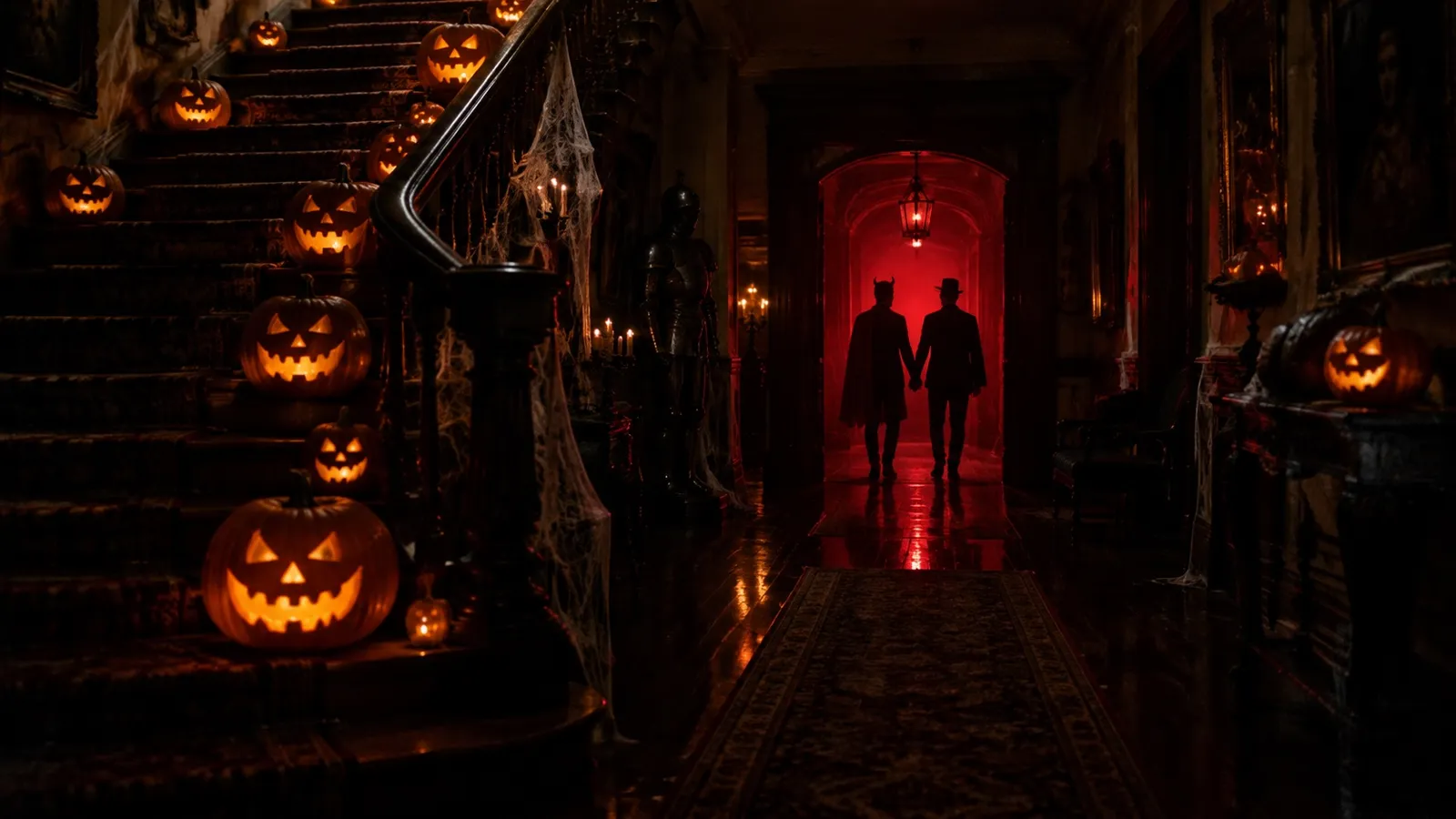
Fear speeds the heart. A horror romance asks the reader to wonder which man it’s beating for.
Horror and romance look like opposites. One genre runs on dread and the other on hope, one promises that someone won’t make it and the other promises that two people will. Readers who love both know the genres share more than they admit. Both live in the body, both depend on vulnerability, and both ask what a person wants badly enough to risk everything for. The gothic novel blended them two centuries ago, and a new wave of queer horror romance and horror comedy is blending them again.
For M/M fiction the pairing carries extra charge, because horror has a long and complicated history with queer men, often casting them as the monster. A horror romance can reverse that history by making two men the heroes who survive and get the happy ending. Fear and attraction feed each other in ways early psychology tried to measure, and survival can bond people faster than courtship. A writer still has to build romantic stakes inside a horror plot, borrow what slasher conventions offer, manage the tonal shifts and the humor, and satisfy readers who came for either genre. My own Halloween House Party books serve as the running example.
Fear and attraction share a body
Fear and desire feel different, but the body produces many of the same signals for both, including a racing pulse, fast breathing, and heightened alertness. In a classic 1962 experiment, Stanley Schachter and Jerome Singer proposed that people interpret physiological arousal by looking to their situation for an explanation, so the same pounding heart can be read as fear, anger, or excitement depending on context.[1]
Donald Dutton and Arthur Aron tested one implication in 1974. Men who crossed a high, swaying suspension bridge and were then approached by an attractive interviewer were more likely to call her afterward, and their written stories contained more sexual imagery, than men approached on a low, stable bridge.[2] The study used heterosexual men and a single setting, and researchers have debated how strong the effect is. A later meta-analysis of arousal and attraction research by Craig Foster and colleagues found support for the idea that arousal can intensify attraction, though the experiments it pooled tested heterosexual attraction, mostly among college students in laboratory settings.[3] Two men in a burning farmhouse are a long way from that lab, and I treat the research as a prompt for fiction rather than a law of desire.
For writers, the lesson isn’t that fear causes love. It’s that fear and attraction can blur in the body, and a horror romance can use the blur. A man pressed against another man in a dark closet while footsteps pass outside feels his heart hammering, and the reader is free to wonder how much of the hammering is about the footsteps.
Survival bonding
Threat also pulls people together. In studies on affiliation, Stanley Schachter found that people told they were about to receive painful shocks preferred to wait with others who faced the same experience rather than wait alone.[4] His participants were women students in the late 1950s, so the result is a starting point rather than a rule. In fiction, shared danger gives two men a reason to cooperate, and cooperation under threat can build trust fast.
Survival also reveals character with brutal efficiency. A man who stays behind to help shows the other man who he is in a way no conversation could, and a man who freezes and then forces himself forward reveals something as intimate. Every chase scene doubles as a character test. When the threat passes, the men know each other differently than they did an hour before, and the romance can build on what the danger showed. Confinement intensifies the effect, since locked doors and closed roads remove every exit. I’ve written about why that works in Why Forced Proximity Works in M/M Romance.
Romantic stakes inside a horror plot
A horror romance fails when the love story and the horror run on separate tracks. The threat should endanger the relationship as well as the men’s bodies. Danger can separate the couple at the worst moment, force one man to choose between saving the other and saving someone else, or plant a suspicion that poisons trust.
Suspicion is the slasher romance’s sharpest tool. If the killer could be anyone at the party, he could be the man the protagonist is falling for. That question turns every intimate moment into a risk and every kindness into a possible performance. The romance has to answer it, and the answer has to arrive in a way that feels earned rather than convenient. The best answer reveals something about both men, such as what the suspect was hiding instead of murder and why the other man was ready to believe the worst.
Horror readers expect deaths, and romance readers expect the couple to survive. The genre contract that serves both is simple. Supporting characters can die, sometimes spectacularly, while the central couple lives to reach the ending. Deaths should still matter. A horror romance that kills characters the reader never cared about squanders its horror, and one that kills them without consequence for the couple wastes its romance.
Slasher conventions
The film scholar Carol Clover’s study of slasher films introduced the idea of the Final Girl, the watchful survivor who sees the danger first and faces the killer at the end.[5] Clover observed that the Final Girl is often boyish in name or manner, a figure who unsettles gender categories even as the films seem to reinforce them. Queer audiences have long read her as one of their own.
A queer slasher romance can expand the convention into a final pair, two men who survive by trusting each other. It can also play with the genre’s old rules. Slasher films have often been read as punishing sex, and the meta-horror of Scream made that rule a joke characters could recite. A queer horror romance can overturn it entirely. Here, intimacy doesn’t get anyone killed, and the couple’s trust becomes what saves them.
The history behind that reversal matters. The film historian Harry Benshoff has traced how horror cinema repeatedly coded its monsters as queer, linking same-sex desire with threat and corruption.[6] When two gay men become the heroes of a horror story and survive to love each other, the genre’s old code flips. The monster is someone else, and the queer couple gets the last word.
Tonal shifts
Horror romance has to move between dread, comedy, and tenderness, sometimes within a page. The shifts work when the book establishes its range early. If chapter one contains a joke, a scare, and a moment of longing, the reader learns that the book can hold all three and won’t feel whiplash later.
Shift tone through character rather than through the narrator’s mood. A joke that cracks under fear tells the reader the danger is real. After a scare, let the body crash into something gentler. Adrenaline wears off, hands shake, and the man who held it together in the stairwell sits down on the bathroom floor and laughs until he can’t breathe, and the other man sits down beside him. That comedown is one of the genre’s best places for intimacy. Comedy also buys the writer permission. Readers who’ve laughed with two men for fifty pages will follow them into a darker room than readers who’ve only been frightened.
Humor and camp
Humor in horror romance does several jobs. It releases tension so the next scare can land, it reveals character, and it gives the men a way to flirt while they’re being hunted. Camp adds another dimension. In “Notes on ‘Camp,’” Susan Sontag described camp as a sensibility devoted to artifice and exaggeration, a love of the unnatural and the theatrical.[7] Horror comedy has always had a camp streak, and queer horror romance can embrace it, with costumes, melodrama, and dialogue that knows it’s in a slasher.
Here’s humor that deflates the scene.
Lucan screamed when the lights went out. “Relax,” Webb said. “It’s probably just the killer.” They both laughed.
Here’s humor that holds the scene up.
When the lights went out, Lucan grabbed the first thing he could reach, which turned out to be Webb’s belt. “Bold move,” Webb whispered. “In a crisis.” Neither of them let go, and when the hallway floor creaked twenty feet away, Webb’s hand closed over Lucan’s and stayed there.
The second joke keeps the danger alive and moves the romance forward in the same breath. Camp works best when it never forgets that the knife is real.
Satisfying both audiences
Readers come to horror romance from both genres, and each group expects different things. The table below maps the overlap.
| What horror readers expect | What romance readers expect | How to satisfy both |
|---|---|---|
| Real danger and rising dread | A central love story with room to breathe | Let quiet romantic scenes sit inside the threat, so the dread never fully lifts |
| Deaths with weight | The couple’s survival | Kill supporting characters the reader cares about, and protect the leads |
| A clever, frightening antagonist | An obstacle that tests the relationship | Make the antagonist exploit the couple’s trust or secrets |
| Suspense about who survives | Certainty about the ending | Shift suspense to how the couple survives and what it costs |
| Explicit violence, often | Intimacy that moves the relationship | Give sex scenes and violence different jobs, and let neither undercut the other |
Heat level deserves care. Sex scenes in a slasher can feel tonally jarring if they ignore the danger, and thrilling if they use it. The best ones change the relationship, as every intimate scene should. I’ve written about making intimate scenes matter in The Sex Was Good. The Scene Did Nothing.
A slasher rom-com in two parts
My Halloween House Party books are a slasher rom-com in the spirit of television’s Scream Queens, with the camp turned up and the romance at the center. Thirst Trap opens at a Halloween party with hundreds of guests and one killer, and Death Trap brings the conclusion as Ethan and Adam face the killer in a haunted mansion. Telling the story in two parts let the dread build across a longer arc, and the first book’s cliffhanger is disclosed up front so romance readers know the ending waits in the second.
Horror and romance work together because both genres take the body and its terrors seriously. In fiction, fear sharpens attention, danger reveals character, and survival can build trust faster than any date. The blend holds when the love story and the threat keep feeding each other, so that every step toward the monster is also a step toward the other man. Readers who came for the scares should get them in full, and so should readers who came for the kiss. The best horror romances leave readers checking the locks and smiling at the same time.
Frequently asked questions
What is horror romance?
Horror romance blends a central love story with horror elements such as a killer, a haunting, or a monster. The romance remains central and ends optimistically, while the horror supplies danger, dread, and stakes. Subgenres include slasher romance, gothic romance, paranormal horror romance, and horror comedy.
Why are fear and attraction connected?
Fear and attraction produce similar physical arousal, such as a racing heart and fast breathing. Research beginning with Schachter and Singer in 1962 suggests people interpret arousal through context, and Dutton and Aron’s 1974 bridge study found that arousal from fear could intensify attraction among the heterosexual men it studied. Shared danger also pulls people together.
Can a horror romance have a happy ending?
Yes, and it should if it’s marketed as romance. Supporting characters may die, but the central couple survives and ends together. Horror romance shifts suspense from whether the couple survives to how, and what surviving costs them.
What is a Final Girl, and how does it apply to M/M horror?
The Final Girl, a term from film scholar Carol Clover, is the watchful survivor who confronts the killer at the end of a slasher film. Queer audiences have long identified with her. M/M horror romance can expand the idea into a final pair, two men who survive by trusting each other.
What are some queer horror romance books and films?
Readers looking for queer horror with a romantic thread often start with Aiden Thomas’s young adult ghost romance Cemetery Boys and Chuck Tingle’s horror novel Bury Your Gays, which takes aim at a harmful trope. On screen, the first film in Netflix’s Fear Street trilogy, set in 1994, centers a queer romance inside a slasher. My Halloween House Party books are an M/M slasher rom-com.
Sources
These works inform my craft argument; none is offered as proof of how a fictional couple must respond to danger. The early arousal studies used limited, mostly heterosexual samples, and I treat them as suggestive.
- Stanley Schachter and Jerome Singer, “Cognitive, Social, and Physiological Determinants of Emotional State,” Psychological Review 69, no. 5 (1962): 379–99, https://doi.org/10.1037/h0046234; also indexed on PubMed, https://pubmed.ncbi.nlm.nih.gov/14497895/. ↩
- Donald G. Dutton and Arthur P. Aron, “Some Evidence for Heightened Sexual Attraction Under Conditions of High Anxiety,” Journal of Personality and Social Psychology 30, no. 4 (1974): 510–17, https://doi.org/10.1037/h0037031; also indexed on PubMed, https://pubmed.ncbi.nlm.nih.gov/4455773/. ↩
- Craig A. Foster, Betty S. Witcher, W. Keith Campbell, and Jeffrey D. Green, “Arousal and Attraction: Evidence for Automatic and Controlled Processes,” Journal of Personality and Social Psychology 74, no. 1 (1998): 86–101, https://doi.org/10.1037/0022-3514.74.1.86. ↩
- Stanley Schachter, The Psychology of Affiliation: Experimental Studies of the Sources of Gregariousness (Stanford University Press, 1959), WorldCat, https://search.worldcat.org/search?q=The+Psychology+of+Affiliation+Schachter. ↩
- Carol J. Clover, Men, Women, and Chain Saws: Gender in the Modern Horror Film (Princeton University Press, 1992), WorldCat, https://search.worldcat.org/search?q=Men+Women+and+Chain+Saws+Clover. ↩
- Harry M. Benshoff, Monsters in the Closet: Homosexuality and the Horror Film (Manchester University Press, 1997), WorldCat, https://search.worldcat.org/search?q=Monsters+in+the+Closet+Benshoff. ↩
- Susan Sontag, “Notes on ‘Camp,’” Partisan Review 31, no. 4 (1964): 515–30, WorldCat, https://search.worldcat.org/search?q=Notes+on+Camp+Sontag. ↩