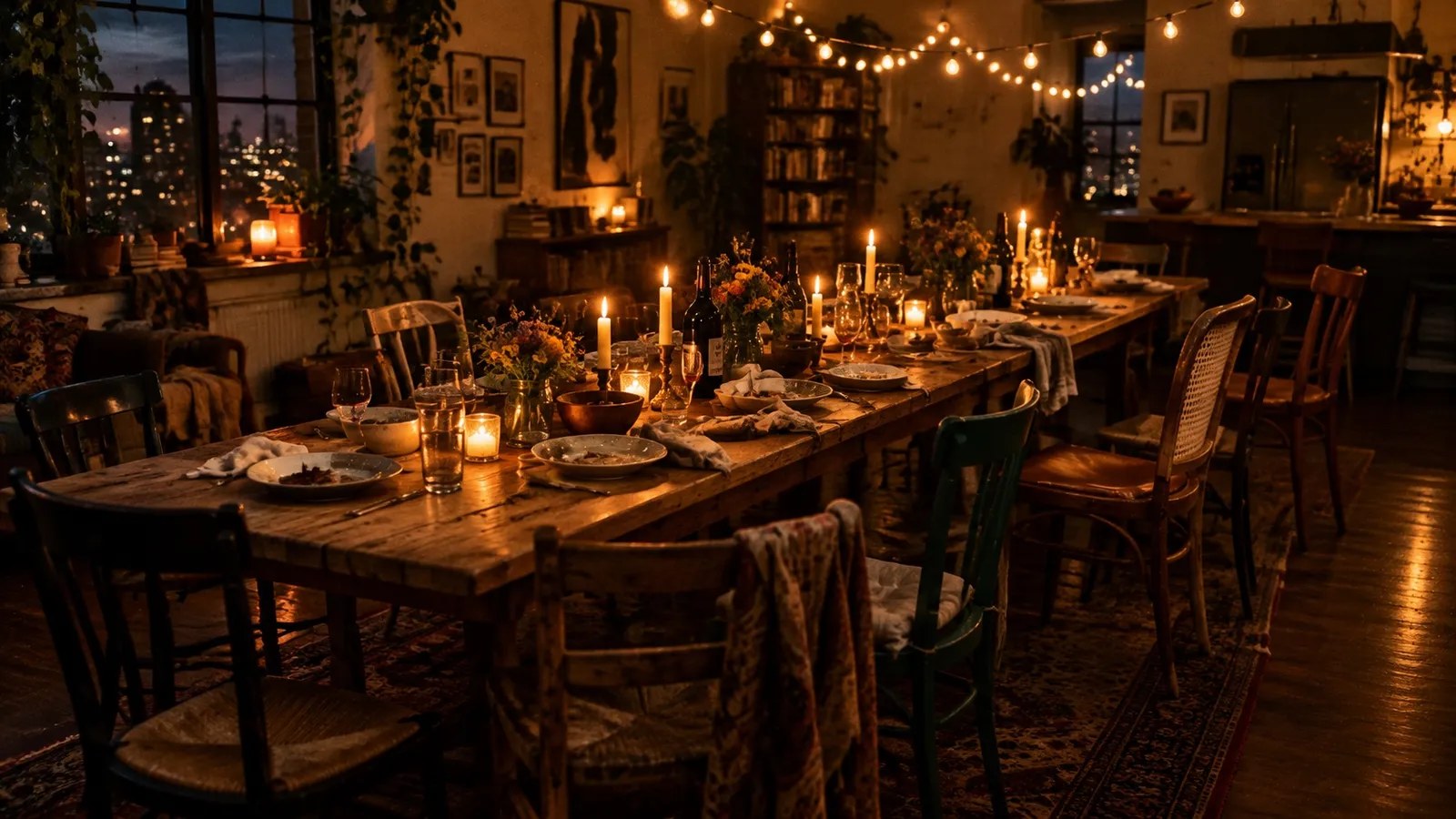
Some families are handed to you. The ones in these books get built, one Sunday dinner at a time, by people who were told they didn’t belong anywhere.
Found family is one of the most beloved tropes in fiction. Fantasy readers love the band of misfits who become a household, science fiction readers love the ship’s crew who’d die for each other, and sitcom viewers have spent decades watching friend groups function as families. In queer fiction the trope carries more weight, because it grew from something real. Many lesbians and gay men who were rejected by their families of origin built kinship from friends, lovers, and former lovers, and they called it family because nothing else described it.
In an M/M romance, found family is more than background warmth. It’s the structure that holds the couple up, the audience that witnesses their love, and a promise that belonging extends beyond the two men. It also poses a craft problem. An ensemble vivid enough to feel like family can crowd the romance off the page. Solving that problem starts with history. The ensemble in these books descends from real networks of friends who became kin, and that history explains why friendship in queer fiction often carries the weight blood relations carry elsewhere. Belonging, rejection, and loyalty run through every version, and an ensemble built from those themes can serve the two protagonists instead of crowding them. The history matters on the page because readers bring it with them. Many queer readers have built families of their own, and they can tell when a book treats chosen kin as scenery.
Where chosen family comes from
The anthropologist Kath Weston gave the idea its best-known name. In Families We Choose, based on fieldwork among lesbians and gay men in the San Francisco Bay Area in the 1980s, Weston described kinship networks built from friends, lovers, and ex-lovers that people treated as family in every practical sense.[1] These families shared holidays, cared for the sick, lent money, and showed up for the moments biological families often missed or refused.
Fiction reached the same idea from another direction. Armistead Maupin’s Tales of the City gathered a household of tenants around Anna Madrigal at 28 Barbary Lane, and decades later Maupin titled his memoir Logical Family, his term for the people we find as distinct from the biological family we’re born into.[2] In New York, the ballroom houses documented in Jennie Livingston’s Paris Is Burning gave Black and Latino queer and trans young people mothers, siblings, and a home, and the scholar Marlon M. Bailey has written about ballroom houses as a kinship system in their own right.[3]
That history makes found family more than a comfort trope in queer fiction. It’s a record of how people survived, and readers who’ve built their own chosen families recognize it at once.
Friendship as emotional infrastructure
In a romance, the found family does structural work. It gives the men somewhere to go after a fight, someone to tell them the truth, and witnesses who make the relationship real in public. The sociologist Peter Nardi has described gay men’s friendships as communities that provide support, identity, and continuity, often filling roles that families of origin didn’t.[4]
Show that infrastructure working. Decide who has whose spare key and who drives whom to the airport at five in the morning, and who gets the call when the furnace dies or the test results come back. A found family proves itself through logistics before it proves itself through speeches. When the romance hits trouble, the family’s practical presence tells the reader that neither man will face it alone.
Belonging and rejection
The emotional core of the found-family trope is belonging after rejection. A man turned away by the family he was born into finds a table where he has a seat. That arc can carry a romance’s deepest feeling, because the man who finally belongs somewhere has the most to lose if love goes wrong.
The richest version puts the romance and the found family in tension. My Christmas romance One Last Christmas Mistake turns on exactly that. Drew has spent twelve years of Christmas Eves at the Bennett family’s table as Freddie’s best friend, and his arrangement with Freddie’s older brother puts the family he chose at risk. The romance can’t succeed unless the chosen family survives it, which gives the book stakes that reach beyond the couple. The whole Merry Misbehavior trilogy builds that circle across three books.
Found family also changes with age. The friends who shared a crowded apartment at twenty-five become the people who sit in hospital waiting rooms at sixty, and a romance between older men can show a chosen family that’s lasted decades, with its old jokes and older grudges intact. That history gives a late-life romance an audience that has seen both men at their worst and still wants them happy.
Rejection shouldn’t be every character’s backstory. Some queer characters have loving families of origin and chosen families too, and a book that assumes universal rejection flattens real lives. Let some characters carry estrangement, and let others bring their mothers to Sunday dinner. My essay The Home That Isn’t looks at homecomings that everyone already knows have failed, and it pairs well with the found-family question of where home is once the old one stops working.
Loyalty and its limits
Chosen families have rules, and they fight. A group can disapprove of a new boyfriend, side with an ex, or resent a member who suddenly spends every weekend with the man he’s falling for. Those conflicts make the family real. A found family that agrees about everything reads as a fantasy of support rather than a picture of it.
Loyalty conflicts are especially useful in romance. When the found family distrusts the love interest, the protagonist has to choose between the people who held him up and the man he wants, or find a way to bring them together. The resolution can be one of the book’s warmest payoffs, the moment the family makes room at the table. Let the family be wrong sometimes, too. A group that misjudges the new boyfriend and then apologizes shows readers a family capable of growth, the same thing the romance asks of the couple.
Ensemble characterization
Ensemble casts fail when each member is reduced to one trait, the funny one, the mom friend, the grump. Give each member a want, a history, and an offstage life, and let at least one of their wants complicate the leads’ happiness. I’ve written about giving supporting characters independent stakes in Your Side Characters Know They’re in a Romance Novel, and the found-family ensemble is where that advice matters most.
| Role | Flat version | A member with a life |
|---|---|---|
| The confidant | Exists to give advice | Gives advice he can’t follow in his own failing relationship |
| The parent figure | Approves of everyone | Has one rule she won’t bend, and the romance breaks it |
| The comic relief | Jokes on cue | Uses jokes to dodge his own fear |
| The skeptic | Disapproves to create drama | Has a reason drawn from experience |
| The ex | A jealous plot device | Still part of the family, so the group has to renegotiate around him |
Introduce an ensemble through a task rather than a roll call. A moving day, a Sunday dinner, or a bar’s closing shift lets each member reveal himself through what he does. Here’s an ensemble that exists to discuss the leads.
At Sunday dinner everyone asked Mercer about Abe. June thought Abe was perfect, Ofelio thought it was moving too fast, and Tad wanted details.
Here’s one with its own weather.
Sunday dinner started late because Ofelio’s son had called from Phoenix, and Ofelio came back to the table and carved the roast without a word. June topped up his glass. By the time anyone asked Mercer about Abe, the question landed in a room that had already been reminded what losing someone looks like, and Mercer answered more truthfully than he’d planned.
The second version doesn’t talk about the romance more. It makes the room matter, so the romance moves when it enters.
Found family across a series
Series romance loves found family because the ensemble supplies future couples. Each book pairs off another member, and earlier couples return as the family’s settled core. Readers get the pleasure of watching a household grow, and each new romance draws on history they already know.
The danger is turning the family into a matchmaking queue, where every friend exists to wait for his book. Members who are only future leads stop behaving as family. Keep some members single for good, some happily partnered offstage, and some uninterested in romance at all, and let the family’s rituals continue whether or not anyone falls in love that year. A family is defined by who keeps showing up, not by who’s next in line.
Keeping the protagonists at the center
The found family should serve the love story. Every ensemble scene should change something between the leads, whether it reveals a fear, forces a choice, or gives one man a chance to see the other at his best. If an ensemble scene could be cut without losing a beat of the romance, fold it into one that matters or cut it.
Keep the point of view with the protagonists, and use ensemble members as mirrors and foils. A friend’s failing marriage can show the leads what they’re afraid of, and an older couple in the group can show them what’s possible. Resist the urge to give every member a subplot that sets up a sequel. Readers can feel when a character is auditioning for his own book.
A whole town can work as a found family too, and my Saltwick Bay Romances lean on that, with meddling neighbors and town wagers that make every couple’s business everyone’s business. The town is a family in the loud, nosy, loyal sense, and it gives each romance an audience that cares how the story ends.
Found family in queer fiction honors a history of people who built homes from friendship when other doors closed. In a romance, it gives the couple a world worth belonging to and a community that makes their love public. That public dimension matters to the story, because a love nobody witnesses can feel only half real. That world feels real when its members have lives of their own and quarrels that don’t resolve on schedule, and it stays in its place when every subplot bends back toward the two men at the center. When the family makes room at the table for both of them, the reader gets a happy ending that reaches past the couple to everyone who held them up.
Frequently asked questions
What is the found family trope?
Found family is a trope in which characters who aren’t related by blood form bonds strong enough to function as family. The group might be friends, coworkers, roommates, a crew, or a community. In queer fiction, the trope draws on real chosen-family networks that LGBTQ+ people built when families of origin rejected them or fell short.
Why is found family important in queer fiction?
Many LGBTQ+ people have built families from friends, partners, and former partners, especially when families of origin rejected them. Anthropologist Kath Weston documented these chosen families in the 1980s, and ballroom houses and other communities created kinship of their own. Found family in queer fiction reflects that history and offers readers belonging.
What are good found-family books with queer characters?
TJ Klune’s The House in the Cerulean Sea is a widely loved M/M romance built around found family. Armistead Maupin’s Tales of the City gathers a chosen household in San Francisco, and Becky Chambers’s The Long Way to a Small, Angry Planet centers a found-family crew. Romance series set in close communities often use the trope too.
How do you write found family without overshadowing the romance?
Make every ensemble scene change something between the leads, keep the point of view with the protagonists, and give supporting characters lives that intersect with the romance rather than replacing it. Use ensemble members as mirrors and foils, and avoid subplots that exist only to set up sequels.
What’s the difference between found family and chosen family?
The terms overlap. “Chosen family” usually describes real kinship networks, especially among LGBTQ+ people, built from friends and partners. “Found family” is the fiction-trope label for the same idea. Armistead Maupin’s phrase “logical family” names it too.
Sources
These works inform my argument about chosen family and craft; none is offered as proof of how a fictional ensemble must be built. The ethnographic and historical sources describe real communities, which fiction draws on for its own purposes.
- Kath Weston, Families We Choose: Lesbians, Gays, Kinship (Columbia University Press, 1991), WorldCat, https://search.worldcat.org/search?q=Families+We+Choose+Weston. ↩
- Armistead Maupin, Logical Family: A Memoir (Harper, 2017), WorldCat, https://search.worldcat.org/search?q=Logical+Family+Maupin. ↩
- Marlon M. Bailey, Butch Queens Up in Pumps: Gender, Performance, and Ballroom Culture in Detroit (University of Michigan Press, 2013), https://doi.org/10.3998/mpub.799908. ↩
- Peter M. Nardi, Gay Men’s Friendships: Invincible Communities (University of Chicago Press, 1999), WorldCat, https://search.worldcat.org/search?q=Gay+Mens+Friendships+Nardi. ↩