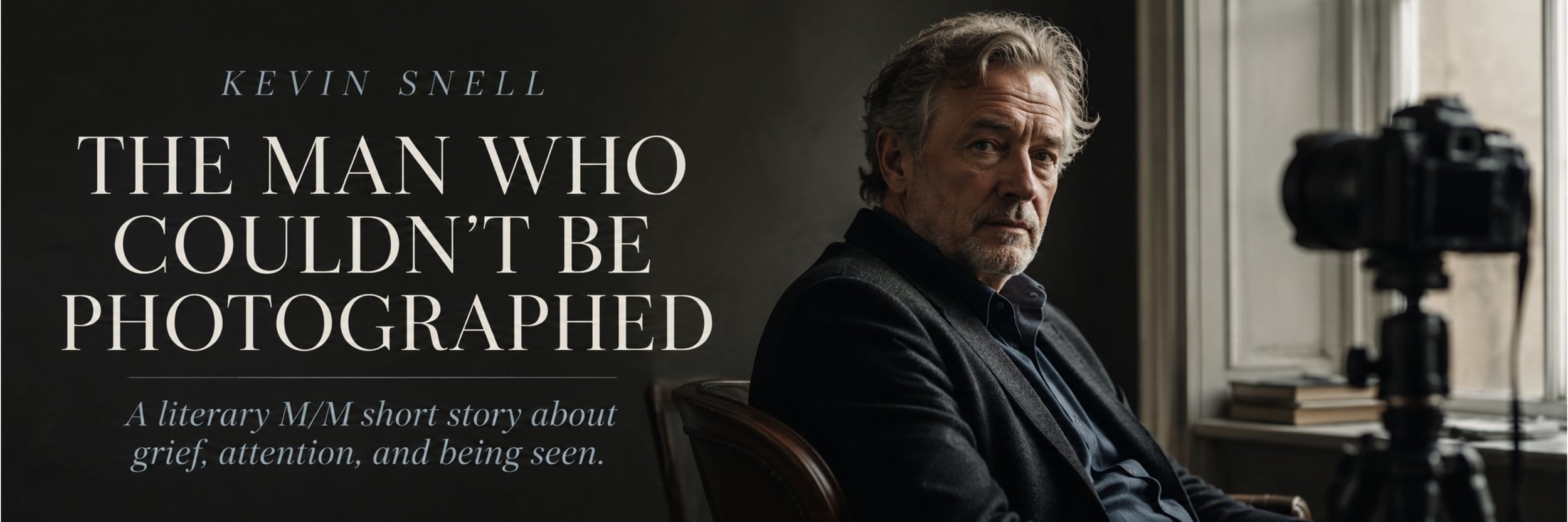
The Man Who Couldn’t Be Photographed - A M/M Short Story
The road up to the house had been cut into the hill in a single switchback, and Wells took it slow in second gear because the gravel ran thin over hardpan and the drop on the left went down into chaparral with nothing to catch a car that lost its grip. He had photographed men in worse places to get to. The difficulty of reaching a person was almost always information about the person, and by the time the house came into view through the live oaks — low, gray-shingled, built long before the road and resentful of it — he already knew three things about Arthur Vane that the publisher’s email had not told him.
The man had chosen the hardest light in California to live in. The house faced north, into the cold even illumination that landscape painters loved and portrait photographers cursed, the light that showed you everything and flattered nothing. He had built no turnaround at the top, so a visitor had to back the whole switchback down or leave the car nose-out against the slope and trust the brake. And he had let the approach grow over. The oaks had been allowed to close above the road until the last hundred yards ran through a green tunnel that a man could stand inside and not be seen from the house, or stand at the house and not be seen from the road. Privacy had been engineered here at the level of the driveway.
Wells left the car nose-out, set the brake, and sat a moment with his hands on the wheel.
The assignment was one image. The publisher’s publicist had said the word one four times in a single phone call, and each time she had said it the way a person repeats a price they expect to be argued down. Arthur Vane had a novel coming in the fall, his first in nine years, and the contract required an author photograph for the jacket, and Arthur Vane had not permitted his face to be printed in twenty years. There was a photo. There had always been the one photo, run on the third book and licensed, since, on every reissue, every foreign edition, every festival program, until the man in it had become a kind of logo for the absence of the man himself. The publicist wanted a new one. Arthur Vane had agreed to exactly one afternoon and exactly one frame, and had made the publicist understand, she said, that the afternoon was a courtesy he was extending against his own judgment and would not extend twice.
“He’s difficult,” she had said.
“Difficult how,” Wells had asked, because there were many ways, and the way mattered.
She had paused. “He’s polite,” she said finally, which was a different and worse answer, and Wells had taken the job partly because of it. He had photographed difficult men for twenty-two years and he had learned that the rude ones were easy. Rudeness was a door left open; you walked through it. It was the polite ones who had built something behind the politeness and tended it, the ones who would offer you coffee and answer your questions and give you a face arranged so completely that you could shoot all afternoon and come away with nothing but the arrangement. The publicist’s word told Wells what he was driving up the hill to meet. Not a man who would fight the camera. A man who had made a peace with it so total that the peace was the problem.
He got the gear out of the back. He carried less than people expected, because the men who had taught him had carried less, and because every case you set down in a stranger’s house was a thing the stranger had to watch you carry, and Wells liked to arrive small. The body, two lenses, a meter he trusted more than the body’s own, a folding reflector, the small tripod that broke down to the length of his forearm. No lights. He had decided on no lights before he left the highway. A man who had refused to be seen for twenty years would read a softbox as an interrogation, and he would not be wrong.
The door opened before Wells reached it.
Arthur Vane stood in the doorway in a gray shirt the same temperature as the light, and the first thing that arrived was that he had not gotten less interesting. The author photo on the third book showed a man of forty looking just past the lens, and the looking-past had read, then, as a kind of distraction, the writer caught mid-thought. Wells had studied it on the drive down the night before, in a motel off the highway, the way he studied any face he was going to be allowed to look at properly. He had thought he understood the photograph. Standing in front of the man at sixty, he understood that he had read it backward. The man in the photo had not been looking past the camera because he was thinking. He had been looking past it because looking into it was already, even then, more than he could do, and someone had loved him enough to take the picture anyway, in the half-second before he turned his face away.
“You found it,” Arthur said. His voice was lower than Wells had built it from the prose. “People don’t, the first time. They drive past the turn and call from the bottom of the hill.”
“The oaks hide it on purpose,” Wells said. “I drove it slow.”
Something moved at the corner of the man’s mouth and did not become anything. “Yes,” he said. “They do.” He stepped back from the door, which was an invitation, and did not offer his hand, which was a fact, and Wells went in past him into a house that smelled of cold woodsmoke and old paper and, underneath, very faintly, of a man who lived alone and had stopped performing the smell of a house for visitors a long time ago.
The front room ran the depth of the house to a wall of north windows, and the bad light Wells had read off the hillside poured in through them gray and patient and merciless. It was a writer’s room and a widower’s room and it had been one for so long that the two had stopped being distinguishable. Books to the ceiling on three walls. A reading chair worn through at the right arm where a hand had rested ten thousand evenings. A desk turned to face the wall instead of the window, which told Wells that the man wrote against the view rather than into it, that the famous gray light was a thing he had arranged to have at his back. And no photographs. Wells looked, because looking was the trade, and there were no photographs anywhere in the room — not on the desk, not on the shelves between the books, not on the deep sill of the north windows where the light would have lain across them all day. A house this old and this lived-in had no faces in it at all.
That was not vanity. Wells knew vanity. Vanity filled a house with the one good angle. This was the opposite, and he had seen the opposite only a few times, and never without a grave somewhere behind it.
“I’ll tell you how this is going to go,” Arthur said, “so we don’t waste the afternoon discovering it.” He had stayed near the door, the length of the room between them, his hands loose at his sides in the particular stillness of a man who had decided not to be the first one to move. “You’ll set up wherever the light is least offensive to you. I’ll sit where you tell me to sit. You’ll take the photograph my publisher needs, which is one usable image, jacket-sized, my face recognizably my face. Then you’ll pack your equipment and back your car down my road and the two of us will never do this again.” He paused. “I want to be clear that this is not a session. I don’t sit for sessions. This is an extraction. You’ve come to take one thing out of this house and I’ve agreed to let you take it because the alternative is a publicist on my telephone until October. That’s the whole of the arrangement.”
“That’s fair,” Wells said, and meant the word the way a man means it when he has already decided to break the arrangement and is only waiting to find out where.
He did not believe in extraction. A face was not a thing you took out of a house like a tooth. But he had learned not to argue with a man’s first speech, because the first speech was the wall, and you did not knock on a wall to find out if it was load-bearing. You set up your equipment in the room it protected and you waited for the man to forget, for a minute, that he was holding anything up at all. So Wells said that’s fair, and he set the case down where the gray light fell, and he began, slowly, to work.
He took longer than the work required, and the length was the work. A nervous subject watched your hands, and if your hands moved like a man in a hurry the subject braced, and a braced face was a closed one. So Wells unfolded the tripod with more attention than its three legs deserved, and screwed the body to the head and unscrewed it and changed the lens and changed it back, and walked the room with the meter held to the light at the windows and the light by the desk and the light in the dead center of the room where nothing in particular happened, reading numbers off it and saying them to no one, building, out of small unhurried motions, the impression of a man who would be here a while and was in no rush to look at anyone. He had learned the trick from a photographer who shot dictators and movie stars with the same patient tedium, on the theory that no one could stay armored against boredom forever. Eventually the most guarded man in the room got tired of holding the wall up against a stranger fussing with a meter, and the wall came down two inches on its own, and you had your two inches.
Arthur sat where Wells put him, in a hard chair carried from the kitchen and turned three-quarters to the windows, and he held the wall up beautifully.
Wells shot a roll’s worth of digital frames he had no intention of using, and watched the back of the camera between them, and what came up on the small screen each time was a photograph of a man not being photographed. The face was composed at the level of the bone. The eyes went to the lens and stopped at its surface, the way a hand stops at glass, present and reflecting and giving back nothing of the room behind them. It was a good face and a dead picture, and it was the same dead picture frame after frame, because the man had made it twenty years ago and refined it since and could hold it now without effort, the way a man who has carried a weight long enough stops feeling it as weight and feels it only as the shape of his own arms.
“That one will do,” Arthur said, after the twentieth or thirtieth frame. He had heard the shutter slow. “I’ve seen the others you’ll get. They’re all that one. My publisher will be satisfied. You can stop now and we’ll both have our afternoons back.”
Wells lowered the camera and looked at him over the top of it, which he did not usually do, because looking at a subject with your own face instead of the lens changed the terms.
“It’ll do,” he agreed. “It’s exposed correctly. It’s sharp where it should be sharp. Your publisher will run it and no one will complain.” He set the camera down on the closed case, deliberately, a thing he did not do in front of a subject he intended to keep shooting. “And it’s a photograph of a man holding very still so the camera won’t get him. You know that. You write people for a living. You know exactly what a closed face does on a page, because you spend your working life prying them open one sentence at a time. You’d never let a character get away with the face you just gave me. You’d write the line where it cracks.”
The room was very quiet. Somewhere in the house a clock Wells had not located moved through its mechanism once, audible only because nothing else was.
He had said too much and he knew it, and he waited to be asked to leave. He had been asked to leave before, by men who paid him anyway and never called again, and it had never once cost him as much as keeping a dead frame he could have prevented. There were pictures that weren’t worth getting the way the subject wanted them gotten, and he had decided a long time ago which side of that he would rather lose on.
Arthur did not ask him to leave. He sat in the hard chair in the gray light with his hands flat on his thighs and looked at the photographer who had just told him, in his own house, that the peace he had spent twenty years building was a lie he was performing, and the wall did not come down but a hairline ran up through it, and through the hairline, for the first time, something that was not arrangement looked out.
“You’re a worse man to send than the others,” Arthur said at last. The voice had changed. It had lost the smooth front of the speech at the door and found the place under it, lower, with grit in it. “The others wanted the shot. They flattered the light, they flattered me, they got their frame and went down the hill grateful. You’ve come into my house and decided to tell me what my own face is doing.” He turned his head and looked, for the first time, away from the lens and at the man behind it. “Why won’t I let myself be looked at. That’s the question you’re circling. Go on and ask it instead of fussing with your meter. You’ve earned the meter trick out before lunch.”
Wells did not pick the camera back up. That was the choice, and he made it where the man could see him make it. He took the hard chair’s twin from beside the desk and carried it over and set it down a careful distance away, angled the same three-quarters to the windows so they would both be looking at the gray light and not at each other, because he had learned that men of a certain age and a certain build told the truth side by side, facing a third thing, and went mute the instant they had to do it eye to eye. He sat. He put his hands on his own thighs, mirroring without meaning to, two men in two hard chairs with the cold even light on the sides of their faces.
“All right,” Wells said, to the windows. “Why won’t you let yourself be looked at.”
“Because being looked at is the beginning of being kept,” Arthur said. “And I’ve already been kept by the only person I was ever willing to be kept by, and he’s been dead eighteen years, and a photograph is a way of letting strangers keep you after you’re gone. I won’t do it. I’ll write the books, because the books are made of sentences and a sentence is a thing I built on purpose and chose every word of. A photograph is made of my face, which I didn’t build and didn’t choose, and which the camera takes whether I consent to the taking or not. You point that thing at me and you get the truth of what’s there whether I meant to give it or not. That’s the whole power of your trade and you know it. I write the version of myself I can stand. You take the version I can’t.”
It was the most he had said, and he said it flat, the way men of his generation said the things with teeth, the affect stripped out so the words could carry the load alone.
Wells let it sit. He had a rule about silence after a man said a true thing: you let it stand long enough that the man heard himself say it, because the hearing was half the work and you did the man no favor by rushing in to be kind over the top of it.
“The photo on the third book,” Wells said, when enough silence had passed. “Who took it.”
The clock moved through its mechanism again.
“You’ve seen it,” Arthur said.
“I studied it last night. In a motel. I study every face I’m going to be allowed to look at.” Wells kept his own eyes on the windows. “I thought, before today, that you were looking past the camera because you were thinking. Writers do that, it photographs well, the distracted genius. I had the whole caption written.” He paused. “I had it wrong. You weren’t looking past it because you were thinking. You were looking past it because looking into it was already more than you could do, even then, and whoever was holding it loved you enough to take the picture in the half-second before you turned away. That’s not a distracted man. That’s a man being caught by someone he trusted, one time, on purpose, while he could still bear it. Who was holding the camera.”
Arthur Vane did not answer for a long time, and when Wells finally turned his head to look, the man’s jaw was working, and his eyes had gone bright and were holding, and he was looking at the gray light at the windows as if the light were the thing that had asked.
“His name was Conrad,” Arthur said.
He said the name the way a man sets down something he has carried so long that setting it down hurts a different muscle than the carrying did. Then he was quiet again, and Wells waited, because the name had cost him and the rest would cost more and you did not hurry a man toward the more.
“He was a cellist. Not famous. Good enough to make a living at it in a city, which is its own kind of rare, and not good enough to be on a poster, which suited him, because Conrad hated to be looked at almost as much as I do, except he hated it for the opposite reason. I hate it because the camera takes what I didn’t choose to give. He hated it because he thought there was nothing there worth taking, which was wrong, and which I spent fourteen years failing to argue him out of.” A breath. “He took that photograph. In our kitchen. It was the morning the third book came in, the box of first copies, and I was holding one, and he picked up the little camera we kept for nothing in particular and he said something that made me laugh, and he took the picture in the middle of the laugh as it was already turning into me looking away, because even with him, even then, I could not hold the looking. And that’s the only photograph of me that I have ever been able to stand, and it’s the only one I gave my publisher, and it ran for twenty years, and every time I saw it on a jacket I was seeing Conrad’s kitchen and Conrad’s hands on the camera and the thing he’d said that I’ve never told anyone, and the publisher thought they were running a picture of an author and they were running a picture of the last morning I was a man who could be caught and not mind it.”
Wells did not write the sentence down. He had a working photographer’s instinct to make a record of a thing that good, and he refused it, because the man had not given him the sentence to keep. He had given it to the gray light, and Wells had only been allowed to overhear.
“He got sick the year the book came out,” Arthur said. “I won’t give you the medical part. It was the kind that takes the mind before it takes the body, which is the cruelty inside the cruelty, because for two years I took care of a man who was forgetting, room by room, where he was and then who I was and finally who he was, and somewhere in the middle of those two years I learned the thing I have organized the rest of my life around.” He turned his head and looked directly at Wells, and the look was the steadiest thing the man had done all afternoon, steadier than the wall, because the wall had been a performance and this was not. “I learned what it is to be looked at by someone who can no longer see you. He’d look right at me. His eyes would land on my face the way your camera’s eye lands on it, present and giving back nothing, and there’d be no one behind the looking. I was being looked at and I was completely alone in it. Two years of that. And I made a decision in that house, watching it happen, watching the looking empty out while the eyes stayed, that I would never again let my face be fixed to a thing that goes on being looked at after the only person whose looking meant anything was gone.” His voice did not break. He had clearly rehearsed not letting it break, for eighteen years, in a house with no photographs in it. “A jacket photograph is exactly that. It’s a face that goes on being looked at by people who can’t see you, forever, after you’re past minding. I had two years of that while I was alive. I won’t sign up for an eternity of it.”
The clock moved. The light at the windows had not changed and would not change; the north light was the one light in California that held still all day, and Wells thought, not for the first time, that the man had chosen the house for exactly that, a light that would never catch him changing.
“So that’s the answer to your question,” Arthur said. He faced the windows again. “Put it in a sentence, the way you put the third-book photo in a sentence. You’re good at it. A photograph is being seen by someone who isn’t looking back. That’s what it is to me. And I would rather not be seen at all than be seen by no one, forever, on the back of a book.”
Wells sat with it. The man had handed him the whole architecture of a twenty-year refusal in the space of one held breath, and the photographer’s reflex was to reach for the camera, because the face that had said all that would be, right now, the most open it had been in two decades, and the trade said you shot the opening when it came. Wells did not reach for the camera. He understood, sitting in the hard chair in the cold light, that to reach for it now would be to prove the man’s entire case — to be the eye that took the opening and gave nothing back, the looker who did not look. So he kept his hands on his thighs, and he gave the man the only thing that was worth more than a frame, which was to be a person sitting with him, looking at the same gray light, having heard the thing and not having taken anything for it.
“I’m not going to argue you out of it,” Wells said. “Conrad spent fourteen years trying to argue you out of a thing you’d decided about yourself, you just told me, and it didn’t take, and I’ve known you four hours. I’m not Conrad and I’m not going to lose the argument he lost.” He let that sit, because it was a gift and the man needed to hear that no one was about to push him. “But I’ll tell you the thing I know that you’ve got backward, and then you can do whatever you want with it, including send me down the hill.”
“Tell me, then,” Arthur said. “You’ve told me everything else.”
“A photograph isn’t the looking,” Wells said. “That’s the part you’ve had upside down for eighteen years. You’ve decided the photograph is a pair of empty eyes landing on your face forever, because that’s the looking you survived, Conrad’s eyes at the end, open and aimed at you and empty behind. But that’s not what’s in a portrait. The empty eyes are the viewer’s. They come and go. They land on the jacket and slide off and forget you by the next book. They were never the point. The looking that’s actually in the photograph is the looking that took it. Conrad’s. His hands, his eye, the thing he said, the half-second he chose to press the shutter because he wanted to keep you laughing. That’s what’s fixed in that picture. Not the strangers’ empty looking. His. You’ve spent twenty years thinking that photograph exposes you to everyone who picks up the book. It doesn’t. It keeps you company. It’s the one place in the world where Conrad is still looking at you and there’s still someone behind the looking, because he put himself behind it on purpose, that morning, with the camera, and the camera kept him there.” Wells stopped, because he had said the true thing and the rule held for him too: you let a true thing stand. “A portrait isn’t being seen by someone who can’t see you. It’s the proof that someone could. That’s the opposite of the two years you survived. It’s the cure for them. You’ve been refusing the one medicine you had.”
Arthur was quiet for a long time after that, and the quiet had a different grain than the earlier silences. The earlier ones had been the man holding still. This one was the man working, the way he must work at the desk turned to the wall, turning a thing over to find the seam in it.
“You said that too easily,” Arthur said finally.
“I’ve had it a while.”
“No.” Arthur turned in the hard chair, all the way, so that the three-quarter angle broke and he was facing Wells directly, the windows now to the side of them both, the gray light coming across instead of along. “You said the looking that’s in the photograph is the looking that took it the way a man says the thing he’s decided about his own life. Not the thing he’s figured out about someone else’s. I write people. You said you write people too, in your way, with the camera. I’m telling you what I heard. You weren’t explaining a portrait to me. You were explaining yourself, and you used me to do it because it’s safer to say a true thing about your own life if you can pretend you’re saying it about someone else’s. I do it on every page. I know the sound of it.” He waited. “How long since anyone’s photographed you.”
Wells’s chest did the thing chests do when a door you didn’t know was a door swings.
“I’m the photographer,” he said.
“That’s not an answer. That’s a position you’ve taken up so you’d never have to give one.” Arthur’s eyes did not move off him. The man who had not been able to look into a lens for twenty years was looking into Wells now with a steadiness that had real weight behind it, present and giving back everything, and Wells understood, too late to brace for it, that he had walked into this house to open a man who had built a wall against being seen and had not once considered that the man would be good enough at his own trade to turn around and find the wall in Wells. “You arrive small,” Arthur said. “You said it yourself, you carry less than people expect, you like to arrive small. You set up where the light is least offensive to you. You ask the questions and you wait out the silences and you put the other man’s truth into a sentence so clean he hears himself for the first time, and you do all of it from behind a machine whose entire purpose is to point away from the person holding it. You’ve organized your working life, maybe your whole life, around being the one who looks. Which means you’re never the one looked at. Which is the most complete version of my refusal that I’ve ever met, and you’ve built it so well you don’t even call it a refusal. You call it a profession.”
The clock moved. Wells did not have an answer, which was itself the answer, and Arthur, who had spent a career listening to the things people didn’t say, heard it.
“There it is,” Arthur said, not unkindly. “You came up my hill to tell me I’d had something backward for eighteen years. You’d had the same thing backward, and you’d had it longer, and you’d just hidden it better, behind a job instead of a house in the hills. At least I admit I’m hiding. I put it in a speech at the door. You put it on a business card.”
Wells looked at the gray light, because he could not, just then, look at the man, which proved every word of it.
There had been a photograph of Wells once. He had not thought about it in years, and he thought about it now, sitting in the hard chair in Arthur Vane’s front room with the cold light coming across his face. A man named — it didn’t matter what the man’s name was, Wells had spent a decade making the name not matter — a man Wells had loved when he was young enough to be photographed had taken a picture of him on a fire escape on a summer morning, and Wells had hated it, had asked the man to delete it, had felt about being looked at the way Arthur felt, that the camera took the thing he hadn’t chosen to give. And the man had not deleted it, and the man had left, the way men did when you would not be seen by them, when you handed them a lens-eye instead of a face, a look with no one behind it, and somewhere in the years after Wells had bought a camera of his own and gotten very good at standing behind it, where the morning on the fire escape could never happen to him again. He had told himself it was the work. He had photographed eight hundred faces and let no one photograph his, and he had called it a profession, exactly as the man across the room had just said, and it had taken a recluse with a dead husband and a north-facing house four hours to find the fire escape Wells had buried under twenty years of being the one who looked.
“His name was —” Wells started, and stopped, because the name still did not matter and the not-mattering was the wound. “There was a man. He took a picture of me once, on a fire escape, a long time ago. I made him delete it. He didn’t, and then he left, partly because of it, because you can’t keep loving someone who hands you a closed face every time you raise a camera, or a question, or a hand. And I bought a camera the next year and I’ve been on the safe side of one ever since.” He made himself look at Arthur. It cost what the man’s confessions had cost; he could feel it costing. “So. Yes. You’re right. I came up here to fix you and I’m the one who hasn’t been seen in twenty years. You found it before lunch was even over. You’re better at your trade than I am at mine.”
“No,” Arthur said. “We’re exactly as good as each other. That’s why neither of us has been caught until now.” Something had eased in his face, in the muscles around the eyes that had held the wall up all afternoon, and Wells realized that the man had relaxed not in spite of the exposure but because of it — that for the first time in the afternoon Arthur was not the only one with a wall, and a man can put his own wall down more easily when the other man’s is down too. “Here’s where we are,” Arthur said. “You can’t take a picture of me being open while you stand behind the camera being closed. The picture would know. They always know — you taught me that, an hour ago, you said the camera takes the truth whether I mean to give it or not. If you point that thing at me from behind your twenty-year wall, mine goes straight back up to match it. That’s what they do. They answer each other. The only way you get the photograph you actually came for is if we both put it down at the same time. You can’t ask me to be seen by a man who won’t be seen. It’s not fair and the lens’ll catch the unfairness.”
“What are you proposing,” Wells said, though he already knew, and the knowing had set up a low alarm under his ribs that had not gone off in twenty years.
“I’m proposing the only honest version of this afternoon,” Arthur said. “We take two photographs. You take the one your publisher needs — of me, open, because I’m going to let you, because you’ve earned it and because I think you might be right that it’s medicine and not poison. And then I take one of you. With your own camera. And you let me. You stand on the side of the lens you’ve avoided for twenty years and you find out whether the thing you’ve been telling me is true — whether being seen by someone who’s actually looking is the cure for being seen by no one. You’ve been prescribing it all afternoon. I want to watch you take your own medicine. That’s my price for the extraction.”
Wells got up and went to the case and picked up the camera, and his hands, which had photographed presidents and men on the last day of their lives and not shaken, were not entirely steady, and he let Arthur see that they were not. That was the start of putting the wall down: not a speech, but letting the camera shake a little in front of the man, the way it had not shaken in twenty years, because the terms had changed and the man should know the terms had changed.
“I’m not going to pose you,” Wells said. “I’m not going to forget-it’s-there you, either. The forgetting’s a trick and you’d see through it and you’d be right to. I want you to know it’s there. I want you to decide, on purpose, with your eyes open, to let one man who is actually looking at you keep one second of you being here. That’s all a portrait is when it’s honest. Not the strangers. Me. Right now. Looking, and meaning it, and the camera holding the second so it doesn’t get lost. Can you do that.”
“I don’t know,” Arthur said, which was the truest thing the man had said all day, truer than the confessions, because the confessions had been about the past and this was about the next thirty seconds. “I haven’t tried since the kitchen. Eighteen years. I might not be able to.”
“Then we’ll find out together,” Wells said. “I’m on the wrong side of a lens for the first time in twenty years right after you, so we’re both going to be bad at this. That’s allowed.”
He did not raise the camera to his eye, because the eye-to-glass was the armor and the man would feel the armor go up. He held it low, in both hands, against his chest, where Arthur could see the whole of Wells’s face above it, and he looked at the man with his own eyes first, plainly, the way you look at someone you have decided to actually see, and he watched the wall that had stood twenty years lean, and lean, and not fall but open, a door in it swinging, and behind the door was the man — not the arrangement, not the logo, but Arthur Vane at sixty in cold light deciding, against eighteen years of his own architecture, to let himself be here while a man who was actually looking looked.
His eyes filled and did not spill. His mouth did the thing it had wanted to do all afternoon and had not let itself do, not a smile, something worse and better than a smile, the face of a man who has put down a weight he forgot he was carrying and is feeling the place where his arms used to hold it.
“Now,” Arthur said.
Wells brought the camera up the last few inches and took one frame.
He did not take a second. He did not chimp it, did not turn the screen to check, did not do the thing the trade had trained into his hands for twenty years, the immediate looking-down to confirm the capture, because the looking-down would have said let me make sure I got you and would have broken the one second back into the old arithmetic of getting and not-getting. He left the man’s face un-judged, which was the only gift he had, and the most expensive one, because a working photographer’s whole nervous system screamed at him to verify the frame and he overrode it on purpose where the man could see him override it. He lowered the camera and held the man’s look with his own eyes again, openly, and said, “Got it,” and knew, the way you know a thing in the body before the screen confirms it, that he had.
Arthur let out a breath that had eighteen years in it.
“Don’t show me,” he said, before Wells could offer. “Not yet. I want to know what it felt like before I know what it looks like. If I see it first I’ll go straight to whether I can stand it, the way I always do, and I’ll lose the feeling.” He sat very still in the hard chair in the gray light, and his hand had come up to rest flat against his own chest, over the place where the breath had come from, and Wells understood the gesture because he had photographed it on other people and never once made it himself. “It felt like the kitchen,” Arthur said, and his voice did the thing it had refused to do all day, it broke, once, cleanly, and he let it. “It felt like being looked at by someone who was actually there. I’d forgotten. I’d told myself it was always two empty eyes. It isn’t. It’s — there’s someone behind it. There was someone behind it just now.” He looked at Wells and the look had the whole afternoon’s weight in it and none of the wall. “You were there.”
“I was there,” Wells said. “I’m still here.”
The light had not changed, because the north light never changed, but the afternoon had moved underneath it, and the room had gone from the room a stranger had walked into to a room two men were standing in together, and the distance between the hard chair and the place where Wells stood with the camera against his chest had become a measured thing, a charged few feet of cold air that neither of them was filling and both of them were aware of, in the body, the way you are aware of a hand you have not yet reached for. Wells set the camera down on the case, slowly, the second deliberate setting-down of the afternoon, and this time it meant something different than the first. The first had meant I won’t take what you don’t want to give. This one meant I’m done hiding behind it.
“Your turn,” Wells said, and the alarm under his ribs was going off in earnest now, the twenty-year-old alarm, the fire escape, the morning he had asked a man he loved to delete him out of existence. “You said you wanted to watch me take my own medicine. The camera’s yours. I’m on the wrong side of it.” He had to make himself say the rest, and he said it, because the man had broken open for him and the only honest answer to a man breaking open was to break open back. “I’m going to be bad at this. I’ve made eight hundred people do exactly what I’m about to fail at, and I’ve never once done it myself, and I’m telling you in advance that I want to ask you to delete it before you’ve even taken it, the way I asked him, and I’m telling you so that when I do ask, you’ll know to ignore me. Don’t delete it. Whatever I say. The asking is the wound talking, not me.”
Arthur stood up out of the hard chair, slowly, a man of sixty who had been sitting tense for hours, and he crossed the charged few feet and picked the camera up off the case, and he held it wrong, the way a man holds a tool he has refused to touch for twenty years, both hands and no confidence, and Wells had to clamp down on the reflex to correct his grip, because correcting the grip would be climbing back behind the machine, and the whole point was to stay in front of it.
“Tell me how,” Arthur said. “I’ve spent twenty years on the other side of these. I don’t know what the buttons do.”
“You don’t need the buttons,” Wells said. “It’s set. It’ll meter the room itself. All you have to do is the part I just did. Look at me. Actually look, not at the camera, not at whether you’re holding it right — at me. And when you can see me, press the one on top, under your finger, the way you’d press a doorbell. That’s the whole of it. The machine’s easy. The looking’s the hard part, and you already know how, you just did it the other direction.”
Arthur raised the camera, and then lowered it again, because — Wells watched it happen — the two of them had walls up in the same room, and the walls had found each other, and Arthur, who had felt his own go down a minute ago, could see Wells’s still standing.
“It’s up,” Arthur said. “Yours. I can see it from here. You’ve got the lens-eye on. I had it on all afternoon — I know exactly what it looks like from the outside now.” He lowered the camera all the way and held Wells’s gaze over the top of it. “You can’t ask me to be the only one who’s actually there. I’m the man who’s looking now. But you have to be the one who’s here. Right now you’re somewhere on a fire escape twenty years ago, asking a dead —” he caught it — “asking a man who left you to delete you. Come back into this room. I can only photograph what’s in front of me. So be in front of me.”
And Wells, who had told eight hundred people some version of be here from the safe side of a lens and had never once had to do it himself, stood in the cold gray light of a recluse’s front room and tried to do the thing he had spent his career demanding of strangers, and found out, in his body, how much it cost, the specific terror of it, the wall wanting up, the old word delete rising in his throat exactly as he’d warned it would. His chest had gone tight the way Arthur’s had, a fist closing under the ribs. His hands wanted the camera. The fire escape was right there, the summer morning, the man’s face when Wells had said get rid of it, the beginning of the end of being loved.
“Delete it,” Wells heard himself say, and his voice came out wrong. “Whatever you get. Delete it.”
“No,” Arthur said. “You told me to ignore that. I’m ignoring it.” He raised the camera again, both hands, steadier now. “Look at me, Wells. Not the lens. Me. I’m here. I’ve got nothing behind my eyes but you, I checked, I just spent four hours learning the difference between empty looking and the other kind and I am giving you the other kind. Come and be seen. It’s medicine. You said so. Take it.”
Wells looked at him.
He stopped fighting the wall and let it go, which was not a decision so much as an exhaustion, twenty years of holding finally setting the weight down, and the room came up around him sharp and cold and real, the books, the desk turned to the wall, the gray light, and the man holding the camera badly and looking at him over the top of it with everything behind his eyes, present, there, a man who had decided to look at him and meant it. Wells’s eyes filled the way Arthur’s had. He did not look away, which was the entire thing he had failed at on the fire escape and the entire thing he had built a career to never have to do again, and he did not look away now, he held it, he let the man see the face under the twenty-year wall, the unphotographed face, the one that had been waiting on a fire escape for someone who would not be made to delete it.
“There you are,” Arthur said softly, and pressed the shutter.
The shutter sounded once in the quiet room.
Arthur lowered the camera, and he did not chimp it either — he had watched Wells not do it and he did the same, left the frame un-judged, the courtesy returned — and he set the camera down on the case beside its twin gesture from twenty minutes before, and the charged few feet of cold air between them had closed to almost nothing, neither of them having decided to close it, both of them having let it close. They were standing very near each other in the north light. Wells could feel the warmth coming off the man, the one warm thing in a room built to hold still and cold. His own hands, empty of the camera for once with nothing to do and nothing to hide behind, hung at his sides, useless and honest.
“That’s the first time in twenty years,” Wells said. His voice had not come all the way back. “That anyone’s. That I let anyone.”
“I know,” Arthur said. “I watched you do it. It was the bravest thing I’ve seen a man do in this room, and a man told me about his dying husband in this room four hours ago.” His hand came up, slowly, the way you move toward a thing that might startle, and he laid it flat against Wells’s chest, over the place where the fist had closed and was now, finally, opening, and the touch went through Wells like the first warmth after cold, almost painful at the edge of it. “Your heart’s going,” Arthur said.
“Yours was too. When I took yours. I could see it in your throat.”
“Yes.”
They stood with the one hand between them, and the few inches of cold air left over the hand, and Wells understood that this was the place — the almost — the place he had walked eight hundred people up to from behind a camera and had never once stood in himself, the half-second before a thing happens that you cannot take back, the half-second Conrad had caught in a kitchen because he loved a man who could not hold the looking. Wells held the looking. He held it, and he closed the last few inches, and he kissed Arthur Vane in the cold gray unflattering light that the man had chosen so that nothing would ever catch him changing, and the light caught him changing anyway, and there was no camera pointed at either of them, and for once in twenty years that was not the safety. It was the loss. There should have been a camera. Someone should have been there to keep it.
Arthur’s hand fisted slowly in the front of Wells’s shirt, not pulling, just holding, the way a man holds a thing he has decided not to lose, and he kissed him back the way he’d said the hard things all afternoon, with the whole of himself and none of the performance, and when they came apart it was only a few inches, foreheads nearly touching, both of them breathing like men who had carried something up a hill.
“There was no camera,” Arthur said, reading Wells’s mind the way he’d read it all afternoon. “You’re already grieving that no one kept it.”
“Twenty years on the wrong side of one,” Wells said. “First thing my body does, the first time it’s worth keeping, is reach for the machine.”
“Then we’ll do it again,” Arthur said simply, “in front of one. Later. When we mean to, with our eyes open, and we’ll keep that one. But not this one.” His thumb moved once against Wells’s chest. “This one we just get to have. No record. The first one’s always the one nobody catches. Conrad never got a picture of the first time I let him look at me either. Some things you only get to keep in the body.”
They looked at the photographs at the kitchen table, which Arthur said was the right place, the only correct place, and Wells understood that he meant the kitchen and not the front room because the kitchen was where Conrad had taken the only photograph the man had ever been able to stand, and that bringing the camera to the kitchen table was Arthur deciding the kitchen could hold a second one.
Wells turned the screen around so they could both see it, and they looked at Arthur first.
The man went very still. Wells had photographed people looking at their own true portrait for the first time, and he knew the stillness, and he let it run as long as it needed to run. The frame had the cold north light coming across the side of the face, and the face was not arranged. The wall was not in it. What was in it was a man of sixty who had decided, after eighteen years, to let himself be present in a room while someone looked at him, and the deciding was visible in the frame the way weather is visible in a sky, not as a thing you could point to but as the whole condition of the light. It was not a flattering photograph. The man had chosen the most unflattering light in the state and Wells had not fought it. It was the truest photograph Wells had taken in years, and he had taken it of a man who had refused to be photographed for twenty years, in the first hour the man had let his wall down, and Wells knew, looking at it on the small screen at the kitchen table, that it was the best work of his life and that almost no one would ever understand why.
“I can stand it,” Arthur said at last, and the surprise in his voice was the surprise of a man finding out a thing about himself eighteen years late. “I thought I wouldn’t be able to. I was so sure of it.” He kept looking at it. “There’s someone behind it. I can see you in it. The whole picture is shaped by the fact that you were there.” He sat back. “Send it to the publisher. Let them run it. I don’t care anymore what the strangers do with it. They were never the part that frightened me.”
“And the other one,” Wells said.
Arthur reached over and turned the screen the rest of the way, to the second frame, and they looked at Wells.
Wells made himself look. It was the thing he had asked eight hundred people to do and had never done, looking at his own face in the half-second it stopped being a wall, and it was every bit as hard as he had told them it wouldn’t be, the strangers had been right to fear it, he saw that now. The frame held a man he did not recognize and did, a man of forty-some standing in cold light with twenty years of camera between him and the world finally set down, the unphotographed face, the fire escape face, and there was someone behind it for once, because Arthur had stood there and refused to let him delete it. His eyes were wet in the frame and he had not looked away. He had not, in twenty years, let anyone keep this, and here it was, kept.
“Delete it,” Wells said, and heard the old word come up out of him exactly as he’d promised it would, the wound talking.
“No,” Arthur said, and reached past the camera and put his hand over Wells’s hand on the table. “You told me to ignore that. I’m ignoring it. You don’t get to delete yourself out of existence in my kitchen. I watched a man do that the slow way for two years. I won’t watch you do it on purpose with a button.” His hand tightened. “That picture stays. I’ll keep it if you can’t. There are no photographs in this house, you saw — twenty years and not one face on any wall.” He looked toward the front room, the books, the bare shelves, the empty sills where the north light lay all day on nothing. “I think it’s time there was one. A man who was alive when I looked at him, and looked back. Conrad would have liked that better than the mausoleum I’ve kept. He hated to be looked at and he loved to look. He’d have wanted a face on the wall that could still see.”
Wells did not say anything for a while. The two photographs sat on the screen between them, the man who couldn’t be photographed and the man who only ever stood behind the camera, the two most complete refusals either of them had ever met, taken in one afternoon in cold light by two men who had spent twenty years each on the safe side of a lens and had, between lunch and the failing of the day, walked around to the front of it for each other.
“The deadline’s Friday,” Wells said finally. “I’ll send the publisher your frame tonight. They’ll run it. No one will complain.”
“And after Friday,” Arthur said. “When there’s no deadline. When there’s nothing my publicist wants and nothing your contract requires and no reason for a man to drive up a hill he can’t find the first time.” He turned his hand under Wells’s so they were palm to palm on the kitchen table, an offer with no word attached, the way you offer a hand to someone on ice. “I’d like you to come back. Bring the camera. I think I might be able to be seen more than once, now that I know what it is, and I think you might be able to be the one seen, with practice, and I’d rather find out with you than alone, in either chair.” His thumb moved once across Wells’s knuckles. “The light in this house is terrible. North-facing. I built it that way on purpose, so nothing could ever catch me changing.”
“I know,” Wells said. “I’ll work with it.”
Outside, the gray afternoon was going down toward a grayer evening, the one light in California that held still all day finally beginning, at the very end of it, to move, and neither of them got up to turn a lamp on. They sat at the kitchen table in the changing light with the two photographs between them and their hands together on the wood, two men who had each driven a long way to find out that the thing they had organized their whole lives around avoiding was the only thing either of them had ever wanted, which was to be looked at, on purpose, by someone who was actually there, and stayed.