Holdover - A M/M Short Story
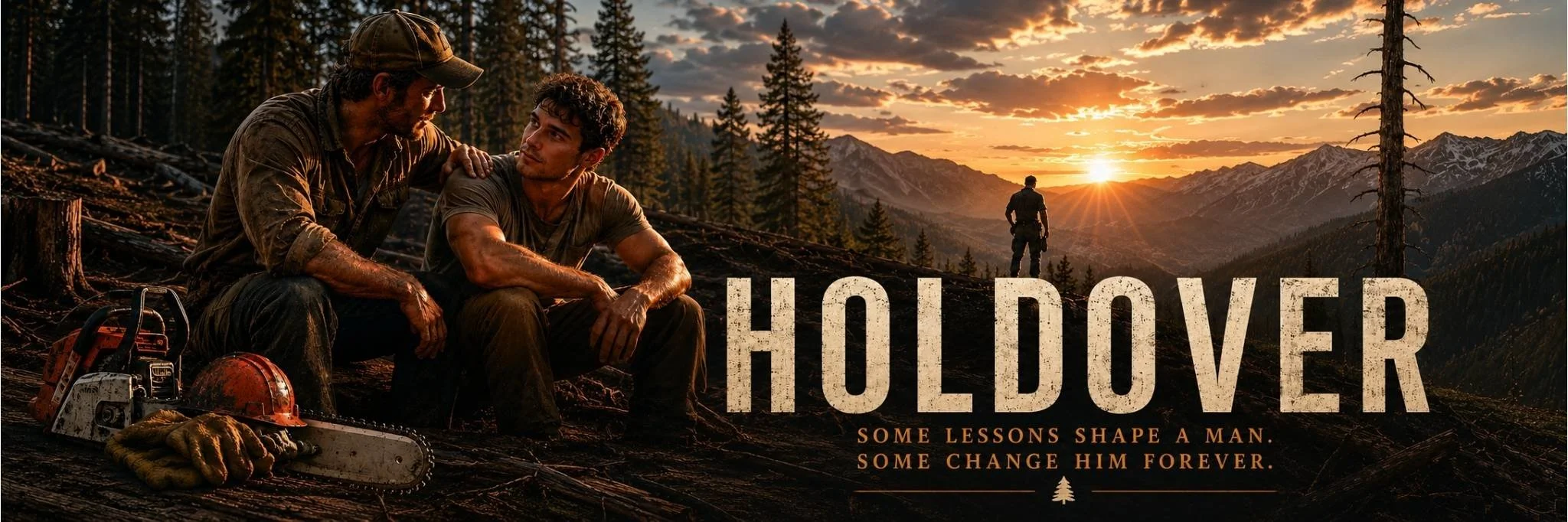
The first thing I taught Austin Dunmore was how to fall a snag without killing the man behind him.
We were on the Camas district that May, cutting handline through a dog-hair stand of lodgepole that had no business being that thick, and the snag stood in the middle of it. A dead larch, sixty feet, the top sheared off years back by lightning so it stood there gray and limbless against a sky going hard blue with afternoon. It leaned downhill, which is the trouble with most of them. Gravity decides where they want to go, and a man with a saw has to argue the rest.
Austin wanted it. I watched him want it. He’d been a second-year three weeks and he still had the rookie hunger to cut the thing nobody else would, and he stood there with the 461 hanging off one arm and his chin tipped up at the snag like it owed him money.
“Show me your face cut,” I said.
“I haven’t put the saw in yet.”
“Show me where it goes. With your hand.”
He drew the wedge in the air with the flat of his palm, low on the downhill side, and he had it right, which annoyed me a little because I’d wanted to correct him. He had good hands. I’d already learned that about him without meaning to. He held a tool easy. The scared ones strangle a saw; he never did. He carried the chain wrapped over his shoulders on the hike in and never once asked me to slow down.
“Escape route,” I said.
“Behind me. Down the black line we already cut. Forty-five degrees off the fall.”
“You walk it. Don’t tell me, walk it.”
He walked it. Counted his steps. Came back and stood beside me, close enough that I could smell the bar oil on him and the sweat in his shirt and underneath it something clean, soap or skin, that had no place on a fireline and that I had no business cataloguing. I stepped back and gave him room he didn’t need.
He dropped the larch clean. It came down right where the lean wanted it, hung up for half a second in a neighbor, then tore loose and hit the slope with a sound that went up through the soles of my boots and into my teeth. Dust and bark and the dry rot of fifty years of standing dead. Austin killed the saw and pushed his glasses up into his hair and looked at me, grinning, the grin of a man who has just done a dangerous thing well and wants to be told so.
“That’s how,” he said.
“That’s how,” I said, and I turned and started cutting brush so I wouldn’t have to keep my face arranged.
I’d been on that crew eleven years by then. Saw boss the last six. The men called me Carrow or they called me nothing, which is its own kind of respect, and I’d built a life out of being useful and unremarkable and gone before anybody got close enough to ask why a man my age was still humping a chainsaw up a mountain every summer instead of running an engine or sitting a desk in the district office where Royce kept telling me I belonged. I liked the work because the work didn’t ask. The work just wanted your back and your hands and your attention, all of it, every hour, and gave you nothing left over to spend on the things a man spends it on at night.
I was thirty-seven that spring. I’d been a soldier before I was a sawyer, and before that I’d been a kid in a town not unlike Camas, the kind of town where you learn early which parts of yourself to fold up and put away where the light can’t get at them. I was good at folding. I’d had a lot of practice.
Austin was twenty-nine and he didn’t fold anything. That was the whole problem with him, if you want the truth of it laid down plain. He came at the world open-handed. He’d tell you he was scared on a steep slope and then go down it anyway. He’d tell you a thing was beautiful and not look around first to see if it was safe to say so. He’d laugh at his own jokes before he finished them. By the end of that first week the whole crew loved him. He hadn’t learned yet that the world would hurt him, and we loved him for not knowing, and I told myself what I felt was the same thing they felt. Just that. The crew’s easy fondness for the new kid who made the long days shorter.
I told myself a lot of things that spring.
• • •
Camas in the off weeks was a town you could walk end to end in the time it takes to smoke a cigarette, if you smoked, which I’d quit. A feed store, a Forest Service compound out on the highway, a church for the Mormons and a church for everyone else, and the Stockman, which was a bar with a grill attached and a parking lot full of trucks every night the crew wasn’t spiked out somewhere on a fire.
June Aldrich ran the Stockman. His father had run it before him and his father before that, and he’d come back from somewhere—Boise, I think, a marriage that didn’t take—and taken it over when the old man’s heart quit on him at the register one Sunday. He poured a fair drink and he remembered what you ordered and he had a laugh that started low in his chest and came up bright, and he was easy to be near. Some people are just easy, and June was the easiest, a south-facing porch on an October afternoon, warm without seeming to work at it. His hair had gone darker at the roots, the sun had cut fine lines at the corners of his eyes, and his forearms were browned from hauling kegs and fixing whatever broke before noon. June was the kind of man people leaned toward without meaning to, and nobody resented him for it, because he carried it lightly and never once seemed to know.
Austin walked into the Stockman the second Friday of the season and June looked up from the taps and the air between them changed, a front coming in, the pressure dropping ahead of a wind that hadn’t turned yet. I felt it before I had a name for it. I was at the end of the bar with a beer I wasn’t drinking, watching Royce work a toothpick and tell Hollis a lie about a fire in ‘04. June straightened behind the taps. Austin slowed coming through the door, the swagger draining out of him and something shyer coming in. He ordered a beer he didn’t want either, just to have a reason to stand where June was, and June pulled it and set it down and held his eyes a beat past where the transaction needed it.
“You’re the new one,” June said.
“I’m the new one.”
“Austin.”
“How’d you know.”
“This is a small town and you’re the only face in it I don’t already have an opinion about.”
Austin laughed, the unfinished laugh, and June laughed his low-then-bright laugh, and Royce nudged me with an elbow and said something I didn’t hear because I’d gone somewhere behind my own eyes for a second, somewhere with the door shut.
“Carrow.” Royce again. “You with us.”
“I’m here.”
“You looked gone.”
“I’m here,” I said.
I drank the beer I hadn’t meant to drink. Across the room Austin had pulled a stool up to the bar and June had leaned his forearms on it and they were talking, and underneath the talking they’d already decided to keep doing it. He had a way of tilting his head when he listened that made whoever he listened to feel like the only lit window on a dark road. I’d been on the receiving end of it for three weeks. I’d let myself stand in that light and pretend the warmth on my face was meant for me and not just spilling off a man who couldn’t help where he aimed it.
It wasn’t meant for me. It was never going to be meant for me. I knew it in the body before I had the proof, the same as weather. You learn to read weather or it kills you.
I left the beer half full and went out to the truck and sat in the dark of the cab and put both hands on the wheel and held still until the wanting went back down to where I kept it. Then I drove the four miles to the trailer I rented from a rancher named Pruitt, and I lay on the bed with my boots on and listened to the cooler tick and I did not think about Austin’s wrist reaching for that beer, the tendons standing up under the skin.
I’d had practice. I told you that.
• • •
There was a man named Reyes, once.
I don’t talk about him. I’m not going to talk about him much now either, except that you should know he existed, because everything I did that summer ran on tracks he laid down without ever knowing he was laying them.
We were in the same platoon, two deployments, a long time ago in a place that no longer means what it meant to us then. He was from El Paso. He talked too much and prayed in the mornings and kept a photograph of a girl he wasn’t sure he wanted to marry, and one night on a roof with the whole valley dark below us he fell asleep against my shoulder and I sat with his weight on me until first light and didn’t move, didn’t breathe right, didn’t do one thing to wake him because the wanting and the not-having had found, for those hours, a place they could both lie down at once. In the morning he stretched and grinned and said his neck was wrecked and never knew. I never told him. There was nowhere in that life to tell him that wouldn’t have ended one or both of us, and so I folded it up and put it where the light couldn’t get at it, and four months later a road did what roads did and there was nothing left to tell.
I came home and I learned the saw and I built the quiet life and I got good at it, and for a long time it held. Years of it held. I’d thought maybe the part of me that did that—that sat all night under another man’s weight and called it enough—had finally gone quiet for good. Burned down to the duff and gone cold.
Then Austin Dunmore dropped a larch clean on a slope in May and looked at me, grinning, and wanted to be told he’d done well.
A holdover is a fire you think you put out. You work the line, you cold-trail it with the back of your hand feeling for heat, you call it contained, you go home. And all winter long, under the snow, down in the root channels and the punky heart of a stump where the air still finds it, a coal you missed keeps breathing. Slow. Patient. It doesn’t need much. Come spring, when the duff dries and the wind comes up, it climbs back to the surface in a place you’d swear was dead and it starts the whole thing over.
That’s what he was. I knew it the first week and I let him burn anyway, down where it didn’t show. I told myself it didn’t show.
• • •
We spiked out on a fire up Owl Creek in late June, a lightning start that got into the timber and ran before anybody could get a line around it, and for nine days we slept on the ground at a spike camp the helicopters kept supplied with sling loads of water and MREs and not much else. Nine days is a long time to live two feet from a man and keep your hands to yourself. You eat next to him. You dig next to him. You wash your face in the same creek and you hang your socks on the same deadfall to dry and at night you lie down in your bag close enough that you can hear him breathe and the breathing is the last thing you hear before sleep and the first when something wakes you.
The eighth night the fire laid down with the evening and the crew was strung out along a meadow above the creek, bone-tired, not talking much. Somebody had a radio playing low. The stars came out as they only do that far from any town, the whole spilled bucket of them, and the smoke had cleared enough that you could see the Milky Way standing up over the ridge, a road you could walk.
Austin came and sat down next to me on the deadfall where I was working a stone over my saw chain by feel, taking the burrs off the cutters, because I’d rather have my hands busy than not.
“You ever look at that,” he said, “and feel like you’re falling up into it.”
“No,” I said, which was a lie. “I look at it and I think about the day’s cut.”
He laughed. “You’re a liar, Carrow.”
I kept working the stone. “Maybe.”
“I had a guy on my first crew,” Austin said. “Old hand, like you. Wouldn’t say two words all day, then one night he tells me the whole sky’s just the same fire we’re standing in, only further off and longer ago. Took me a week to figure out what he meant. By then he’d quit and I never got to tell him I figured it out.” He picked up a piece of bark and turned it in his fingers. “I think about that. How you can be standing right next to somebody and there’s a whole thing going on in them and then they’re just gone and you never got to say the thing back.”
I set the stone down. My hands had gone still on the chain and I made them move again.
“You say the thing back when you can,” I said. “That’s all there is to it.”
“Is it that easy.”
“No,” I said. “It isn’t easy at all. But it’s that simple.”
He was quiet a while. The radio played its low song. Somewhere downslope the fire muttered to itself, a log shifting, a flare and fade. I could feel the heat of him along my side, no more than the heat of any man sitting close, and I held myself still inside it, still as I’d been under Reyes’s weight a lifetime ago, taking what the moment gave and asking it for nothing more, because asking was how you lost even this.
“Can I tell you something,” Austin said.
“You’re going to.”
“I almost didn’t take this job. I had a whole other life lined up. Office thing, my brother set it up, good money. And I’m sitting in the parking lot the morning I’m supposed to start, and I just—couldn’t. Drove out here instead. Didn’t tell anybody for a week.” He shook his head. “Everybody back home thinks I threw it away. My brother won’t talk to me. And I’m sitting on a log on a mountain with no shower and a sunburn and I’ve never been happier in my whole life. Is that crazy.”
“No.”
“My brother thinks it’s running.”
“Your brother’s not out here.” I turned the chain in my hands. “There’s two kinds of people who end up doing this. People running from something, and people running to something. The first kind don’t last. The second kind, you can’t get them to leave. You’ll figure out which one you are by August.”
“Which one are you.”
I didn’t answer that. I’d been running so long the two had stopped being different things.
He bumped his shoulder against mine. Once. The kind of thing men do, the only kind of touch the world had ever let me have, the touch that means I see you and gets to mean nothing more out loud. And I let it land and I didn’t move toward it and I didn’t move away, and we sat there under the falling-up sky with the fire breathing below us, and for the length of one held breath I let myself stand in the land of what would never be. Where a thing like this could be the start of something instead of the whole of it. Where I could turn my head and he could turn his and the cost of being seen wouldn’t be everything I had.
Then he yawned and stood and stretched and said he was going to crash, and the door I’d cracked open swung shut, and I was grateful for the shutting. A tourniquet earns the same gratitude. It hurts and it keeps you alive.
“Night, Carrow.”
“Night.”
I sat out a while longer with the cold chain in my hands. The stars wheeled. I didn’t dream too far. I’d learned not to. A man who dreams too far on a fireline forgets where his black is, forgets the way back to the ground that’s already burned and can’t burn him again, and that’s the man who dies. So I dreamed the careful distance, no farther, and then I folded that up too and lay down in my bag two feet from where he slept and listened to him breathe until I didn’t hear anything at all.
• • •
We tied that fire off and went home and the season went on in bursts and waits. Single-tree starts the engines caught before we even rolled. A week of nothing where we cut fuel breaks and sharpened tools and ran the same six-mile loop out the canyon road until our knees complained. And in the waiting, in town, Austin and June became a thing that everybody knew about and nobody had to be told.
In a town that size it went fast, and everyone watched it go. First they were just talking at the bar. Then June was saving him the good stool. Then he was staying after close, and his truck was in the lot past midnight, and one morning he showed up to PT in yesterday’s shirt with a look on his face that a man can’t hide and doesn’t want to, and Hollis whooped and the whole crew gave him the business and Austin took it grinning, took it gladly, glad to be a man whose happiness was the kind you could hoot at across a parking lot in the morning light.
That’s the part the songs don’t tell you about the wanting. It isn’t the grand denial that breaks you. It’s the mornings. It’s a man you’d lie down in front of a fire for showing up in yesterday’s shirt with that look, and you have to grin and say something so he doesn’t see, and you do, you say the right rough thing and you mean the wanting-good-for-him part of it sincerely, you do want it for him, and that’s what makes it unbearable. That the love is real enough to be glad. That you’d choose his happiness over your own even when his happiness is the precise shape of the door closing on you.
June came up to spike camp once, in July, when we were close enough to town that the road went through. He brought a cooler of real food, burgers and a pasta thing and a sheet cake with the crew’s number piped on it in blue, and he stood in the meadow in the evening with the light going long and gold across the bunchgrass and he fed twenty filthy men off the tailgate of his truck and laughed his low-bright laugh at their jokes and he was so plainly, uncomplicatedly good that I couldn’t even hate him, and God knows I tried, standing at the back of the line with my plate, I tried.
He found me at the edge of it later, away from the fire, where I’d gone to eat alone, which is what I always did.
“I’m June,” he said. “You’re Carrow—Austin talks about you.”
“Does he.”
“All the time. The saw boss. He says you’re the best he’s ever worked under. Says you don’t talk much but when you do it’s worth writing down.” He smiled. The gold light caught in his hair and at the edges of him, and I understood, standing there, exactly why Austin had slowed coming through that door. June was a warm room at the end of a cold day. He was the life Austin let himself want out loud—a man, wanted in the open, the thing I had never once let myself reach for. “He’s a little scared of you, I think. In a good way.”
“He’s a good hand,” I said. “Tell him I said so. He doesn’t hear it enough.”
“Tell him yourself.”
“He’ll listen to it better from you.”
He tipped his head, the same tilt Austin had, or maybe Austin had caught it from him. Couples steal each other’s gestures; they’d already started. “You’re a hard man to read, Carrow.”
“There’s not much to read.”
“I don’t believe that,” he said, not unkindly, and went back to the light and the noise and Austin at the center of it, who looked up when June came and lit, just lit, and that lighting wasn’t for me and was never going to be for me, and I ate my dinner alone in the dark at the edge of the meadow and watched the two of them and called the thing in my chest by every name except its own.
• • •
In August we caught a start up the Tamarack drainage, a one-burner that should’ve been quick and turned into four days because the wind kept it honest, and Austin ran the second saw beside me the whole stretch. There’s a thing that happens to two sawyers who’ve worked enough hours together. You stop talking. You read each other off the cut. He’d start a tree leaning the wrong way and I’d already be moving to the side it was going to go, and he’d glance up and find me there and know I’d known, and neither of us would say a word about it because saying it would’ve spent something we’d rather keep. We worked a quarter mile of nasty line in a day and a half that would’ve taken a green pair a week, and at the end of it Royce walked it and didn’t say anything either, which from Royce was a standing ovation.
The third evening the fire laid down and we got cut loose early, and instead of going to our bags Austin came and found me where I was filing my chain on the tailgate of the buggy, and he stood there a while not saying the thing he’d come to say, which I let him do, because a man works up to things at his own speed and pushing him only sends him backward.
“I want to ask you something,” he said finally. “And I don’t want it to be weird.”
“Then don’t make it weird.”
He laughed, the half-laugh. Then he dug in his pocket and came out with a ring box, the kind that’s velvet on the outside and a little crushed at the corners from riding around in a man’s pants for a while, and he opened it on his palm under the buggy’s dome light. A plain band with one stone, nothing showy, the kind of ring a man buys when he’s been saving fire-season money toward it and means every dollar of it.
“I’m going to ask June,” he said. “End of season. I’ve got it all figured out, the where and the how, I just—” He closed the box. Opened it again. “You’re the only one out here I’d ask. You’re the only one who’d tell me straight. Is it too soon. Everybody back home thinks it’s too soon. My brother says I’ve known him four months and I’m throwing my life away again. Same thing he said about the job.” He looked at me with the whole open face of him, asking me, of all the men on that mountain, asking me. “You always know the right call up here. The escape route, the lean, the weather, all of it. You read things before they happen. So I’m asking. Is it the right call.”
I have done some hard things in my life. I’ve carried men off mountains. I’ve stood in a green slope and done the arithmetic of whether I’d live. None of it was harder than standing on that tailgate with a chain file in my hand and a man I loved holding up a ring he’d bought for somebody else and asking me, in earnest, with his whole heart, to help him do it.
I made my hands keep moving the file. That’s the trick. You keep your hands at the work and the rest of you can do almost anything.
“How do you feel when he’s not around,” I said.
“Like I’m waiting for the season to end so I can get back to him.”
“How do you feel when he is.”
He thought about it. He was a man who actually thought about things when you asked him, which was one of the hundred reasons. “Like I’m already home,” he said. “Like I quit running and I didn’t even notice I’d stopped.”
Running to something, not from it. I’d told him he’d find out which kind he was by August. He’d found out. He was the kind that gets to stop. The kind the world builds a warm room for and hangs a bright window in and lets him slow down coming through the door.
“Then it’s not too soon,” I said. “Your brother’s measuring it by the calendar. That’s not how you measure it. You measure it by whether you’ve stopped running, and you have. Ask him.”
He shut the box. His eyes had gone bright and he wasn’t ashamed of it, he never was ashamed of anything he felt, and he reached over and gripped my shoulder, hard, the grip of a man who’s just been handed back his own courage by somebody he trusts with his life.
“I knew you’d tell me straight,” he said. “Thank you, Carrow. That means—you don’t even know what that means.”
“Go put it somewhere it won’t fall out of your pocket on the line,” I said. “You’ll lose it in the duff and I’m not gridding the whole drainage looking for it.”
He laughed and squeezed my shoulder once more and went, light, lit, off to stow the ring in his pack with the careful hands he had, the good hands, and I sat on the tailgate and filed a chain that was already sharp until I’d taken it down past sharp to ruined, and then I had a reason to swap it out, which gave my hands something to do for another few minutes, which was all I needed. A few minutes. You get through the worst of anything a few minutes at a time, with your hands at the work, and then it’s a thing that already happened instead of a thing happening to you, and you can stand up off the tailgate and go lie down in your bag and listen to him breathe two feet away and call it enough.
I called it enough. I’d had practice. I keep telling you that.
• • •
You learn who you are by August. I’d told him that. I should have told myself.
Here is who I am. I’m the man at the edge of the meadow. I’m the one who falls the snag so the kid behind him lives to drink at the Stockman with the man he loves. I’m the hand on the saw and the back under the load and the quiet at the end of the line, useful, unremarkable, gone before anyone asks. I’m the road that gets walked toward something better. I am not the something better. I was never built to be the bright window a man slows down for. I was built to be the dark a man walks safely home through, and there’s a kind of dignity in that I’ve made my peace with, most days, in the daylight, with my hands full.
It’s the nights that argue.
There’s a place we all go, I think, the ones built like me. A country you steal off to when the lights are out and the wanting won’t lie down. The country of what might have been if you’d been some other man, some easier shape, some boy the world had room for in the bright story. In that country I turn my head on the deadfall under the stars and he turns his and nobody dies and nobody has to fold anything away. In that country I’m the one in yesterday’s shirt with the look I can’t hide. I go there more than I should. I always come back. You have to come back. The fire doesn’t care where you’ve been; it only cares whether you remember your black.
I’d made my peace with being the dark road. I want to be honest that I had, mostly. What I hadn’t made peace with—what Austin pulled back up out of the cold duff where I’d buried it after Reyes—was the wanting itself. Not the having. I’d given up on having before I had a beard. The wanting, though. The pure dumb animal fact of it, the holdover coal that wouldn’t go cold no matter how many winters I packed snow on it. That he made it burn again, after all those years I’d been sure it had finally died, was the cruelty and the gift both, and some nights in the trailer with the cooler ticking I couldn’t have told you which I was grateful for and which I’d have cut off my hand to be free of.
So I worked. There’s a mercy in the work I keep trying to explain to people who’ve never done it. Twelve, fourteen, sixteen hours of it, until your body has no opinion left about anything, until the want and the grief and the country of what-might-have-been all go quiet under the simple animal arithmetic of the next cut, the next step, the next sip of warm water from the bottle in your line gear. I worked, and the fire I was fighting was inside the very tool in my hands, which is what I was.
And I trained Austin, because that was my job and because near him was where the work was, and I taught him everything I knew about staying alive, every trick and rule and hard-won fear, and I told myself that this was the form my love was allowed to take. That I’d keep him alive and never tell him why it mattered so much that he live, and that this would be enough. The night under Reyes had been enough. The shoulder-bump had been enough. I’m a man who’s made a long career out of letting things be enough.
I’d have managed it, too. I’d have folded it up and carried it out at the end of the season and started packing snow on it again and in five years it’d have been a story I almost never thought of, a man named Austin I trained once, a good hand, where’d he end up, somebody said he married the man from the bar.
I’d have managed it, if it hadn’t been for Owl Creek in September.
• • •
The thing came back. The Owl Creek fire we’d tied off in June—it held over. Of course it did. Down in the punky heart of a stump in a corner of the burn nobody’d checked twice, a coal kept breathing all through July and August, and when the fall winds came up dry off the high desert and the fuel moistures dropped into the single digits, it climbed back to the surface in ground we’d all sworn was dead and it took off downhill into timber the first fire had only scorched. Red flag warning. Winds gusting forty out of the east, then backing south, then doing what wind does on a slope in September, which is whatever it wants. They called us out at dawn.
We knew that ground. That was the trouble and the comfort both. We’d cut line through it in June, so we knew the escape routes, knew where the black was, knew the meadow and the creek and the saddle where the road came through. Royce put us on the southern flank to hold the line above the creek and keep the head from crossing into the next drainage, where it would’ve run for miles. We anchored off the creek and started cutting uphill, the saw teams in front, the diggers behind, the order that keeps everybody alive.
Austin was my swamper that day. He’d been bumping up, learning the saw, and I’d had him on the second saw most of the summer, but that morning Bautista was down with a rolled ankle so Austin swamped for me—cleared the brush I cut, dragged the slash clear of the line, kept my escape route open, kept his eyes up. A swamper is the man who watches the world while the sawyer watches the cut. You put your life in your swamper’s hands every time you drop your head to the bar. I’d have put my life in Austin’s hands gladly. I’d been doing it all summer in ways he didn’t know.
We cut up through the morning. The fire was below us and to the east, backing and creeping, nothing dramatic, and the radio chatter was calm, and I started to think it’d be a long boring day of holding line, the best kind. Then around midday the wind did the thing the forecast had promised and nobody had quite believed. It backed hard to the south and came up the slope underneath us, and the fire that had been creeping below stood up.
I felt it before I heard it. The air changed. It went from the bright dry stillness of a hot day to a pressure, a pull, the slope inhaling, and the smoke column that had been leaning lazy to the north snapped upright and started to build, white going gray going that dirty boiling brown that means the thing has found new fuel and a new lung to breathe with. The radio came alive. Royce’s voice came flat and fast, the voice he kept for when it was real—get off the hill, everybody off, down to the black on the creek, now, now.
We had maybe a mile of cut line below us and a fire coming up to meet us through unburned timber and a south wind shoving it. The escape route we’d kept open ran down the line to the creek and the black on the far bank, the ground that had already burned in June and couldn’t carry fire again. I’d walked it that morning. Four hundred yards, then across the creek, then we’d be standing in cold char with the fire on the other side of the water. We had time. If we moved now and didn’t stop, we had time.
“Austin.” I had the saw off and slung before the word was all the way out. “Down the line. Don’t run, move. I’m right behind you.”
He moved. Good kid. No questions, no panic, he’d been listening all summer, he turned and went down the cut at the fast walk that eats ground without spending you, and I came behind him, and below us I could hear the rest of the saw teams and the diggers funneling down toward the creek the same way, the whole flank peeling off the hill in good order, Royce’s voice on the radio counting heads.
A hundred yards down, the fire spotted across the line.
That’s the thing about a wind like that. It doesn’t just come at you. It throws embers a quarter mile ahead of itself, and they land in the dry duff below your escape route and they start new fire there, between you and your black, and the route you walked safe at dawn is a wall of flame by afternoon. I came around a bend in the line and the duff below us was lit, a finger of fire running up to cross our route, cutting us off from the creek, and Austin stopped, and I came up beside him and looked at it and did the arithmetic and the arithmetic was bad.
We couldn’t go down. The spot fire had the route. We couldn’t go up; that’s where the head was. East was the green and the wind. West, the line we’d cut petered out into a slope too steep and too loaded to cross faster than fire could climb it.
There was the black from June. The old burn. It was upslope and east, the wrong way, three hundred yards across the green with the head coming, and it was the only ground in any direction that couldn’t kill us, and three hundred yards is a long way with a crown fire learning to run.
I keyed the radio. “Royce, Carrow. Me and Dunmore are cut off above the spot. We’re going for the old black up east. Three hundred yards.”
A half second of nothing. Then he came back flat. “Copy. Go. I’ve got the rest at the creek. Carrow—go now.”
I looked at Austin. The grin was gone. He had the look I’d seen on men’s faces before, the look of the world narrowing down to the next ten seconds, and underneath it, holding, the thing I’d spent the summer teaching him without telling him why. He was scared and he was listening.
“Old burn,” I said. “Three hundred. We don’t stop. If I go down you keep going, you do not stop for me, you get to the black. Say it.”
“I don’t stop for you,” he said, and even then, even there, his voice broke a little on it, and that went into the place where I kept the things I’d never use.
“Drop everything but your shelter and your water. Go.”
We went.
• • •
I’m not going to make it more than it was. It was three hundred yards through standing timber on a steep slope with a fire coming up behind us, and we ran it, and most of running for your life is just running, ugly and graceless and lung-tearing, your line gear banging your back and your boots finding roots and rock you can’t see for the smoke, and somewhere behind you a sound building that isn’t a roar yet but is going to be.
Halfway up I lost him in the smoke for three seconds and those were the worst three seconds of my life, worse than anything a road in another country ever did to me, because this time I knew exactly what I had and exactly that I was about to lose it, and then the smoke tore and he was there ahead of me, ten feet, going, and I closed it. I got a hand on the back of his pack, not to slow him, to know he was there, to have him under my hand—I’d wanted him under my hand all summer—and this is what it took, the world on fire, this is the only way the wanting ever got to touch the having, and I’d take it, God help me I’d take it, I’d take the worst three hundred yards of my life if it meant my hand on him for the last hundred.
We hit the black.
You don’t understand the word safe until you’ve crossed into a burn with a fire behind you. It’s black ground, ashed-over, the trees standing dead and smoking from before, and there’s nothing left in it to burn, and you stand in the ruin of the last fire and the new one comes up to the edge of it and stops because you’ve taken away the one thing it needs. We stood in the cold char two hundred feet in, far enough, and we turned around, and the head of the fire came up the slope we’d just run and hit the green at the edge of the black and stood up forty feet into the sky and finally roared, the full roar it hadn’t reached climbing the slope behind us, and the heat of it came across the dead ground and pushed flat against our chests, and it could not reach us. We watched it not reach us.
Austin was bent over with his hands on his knees, hauling air, and then he wasn’t, he was up and he had two fistfuls of my shirt and he was shouting something into my face that the fire ate, and then he wasn’t shouting, he had his forehead down against mine and one hand gripping the back of my neck, and we stood there in the smoke and the roar with the world burning at the edge of our little black island and he held onto me like I was the only solid thing left, and I held him back. I’d like to tell you I held him careful. I didn’t. I held him as if he’d already been taken from me and given back. Both arms. All of it. The fold came open and I didn’t fold it back, I couldn’t, there wasn’t anything left in me to do it with, and I had my hand in his hair and his face against my neck and I said his name, just his name, over and over, and it wasn’t a saw boss saying it.
It was a long time, or it was thirty seconds. The fire moved on along the edge, looking for a way around the black, not finding one, going north. The roar dropped. The hand of heat eased off our chests. And we stood there a beat longer than we needed to, a beat we both knew we didn’t need, and then we let go, because you can’t hold a man in the black past the point where holding him is about being alive, not without it becoming the other thing, and the other thing was mine alone and I knew it.
He stepped back. He wiped his face with the back of a black hand and left a smear and laughed, the shaking after-laugh of a man who’s just learned he gets to keep his life, and I laughed too because you do, and the moment when I might have said it—and I want you to know there was a moment, standing in that ruin with my whole self torn open and the want with nowhere left to hide—the moment came and I let it go by.
Because I knew which boy he was. He was the boy who got the bright window and the warm room and the man with the gold-dark hair, who got to want another man in the daylight and never once thought it might cost him the world. And I was the dark road he’d just run home down, and the road doesn’t get to ask the traveler to stay. The road’s whole job is to deliver him somewhere better and lie there in the dark when he’s gone.
“You okay,” I said.
“I’m okay.” He was looking at me. Still looking. There was a question starting in his face, the kind of question a man asks when something just happened that he doesn’t have a word for, and I have asked myself every day since whether I was a coward for not letting him finish forming it, and the answer I keep arriving at is no. Not a coward. Just a man who knew his black and walked into it. There’s a difference, even if it doesn’t feel like one at three in the morning.
“Then let’s get a count to Royce,” I said, and keyed the radio, and the question went out of his face, and he let it, and that was the last of it, the whole of it, three hundred yards and thirty seconds in a burned-over corner of a mountain, and it has to last me the rest of my life and it will.
• • •
We hiked out that evening when the head had run north and the flank laid down with the cooling air. The whole crew got off that hill. Bautista’s ankle and one minor burn on a digger named Cole and that was the butcher’s bill, which on a day like that is no bill at all, which is a miracle, and Royce told us so at the buggy in the language he uses, which was to look at each of us a long second and say nothing and hand us a warm Gatorade out of the cooler one at a time like communion.
He held my arm when he handed me mine. Just held it, his hand around my forearm, the old hand around the younger one, and he looked at me with those flat read-everything eyes he had and he said, low, so only I heard it, “You did right up there.”
“I got us to the black.”
“That’s not the part I mean,” Royce said.
And he let go of my arm and moved on down the line with the cooler, and I stood there holding the Gatorade and understanding that I’d been seen. That somewhere along the summer, or maybe years before it, Royce Tibbets had read the thing I’d kept folded in the dark—he had folded one of his own, I would learn—and had carried the knowing of it quietly and had never once made me hold it alone in front of him, and had just now, in seven words, set it down between us where I could look at it and not die of it. That’s not the part I mean. He meant the part where I told Austin not to stop for me. He meant the part where I’d have stood in the green and let it take me if it bought the kid the black. He’d seen the shape of my love by the shape of what I was willing to lose, and he hadn’t flinched, and he hadn’t said the word, and he’d let me keep my dignity and my silence and given me, in exchange for nothing, the one thing I’d never asked anyone for because I didn’t think it was mine to have.
He’d let me be known. And the world didn’t end. I want to put that down plainly because nobody ever told me, all those years of folding, that the world wouldn’t end. That you could be seen all the way down to the holdover coal and the man seeing you could just hand you a warm Gatorade and say you did right and walk on. I’d built my whole life on the certainty that being seen was the same as being destroyed. I’d believed it as hard as I believed weather. And an old man with a toothpick and flat eyes had just stood in a smoking parking lot and proved me wrong without saying more than seven words, and I had to turn and look at the burned hill for a while so the crew wouldn’t see my face do what it did.
• • •
Austin married June the next June, a year out, in the meadow above Owl Creek where the new green had come in thick over the black, the burned ground throwing up wildflowers and grass so bright it hurts to look at. Fireweed, mostly. It’s the first thing that grows back. It comes up purple and tall out of the worst ground there is, and there’s a lesson in that I’m too tired to draw out for you.
I went to the wedding. Of course I went. The whole crew went, in clean shirts, scrubbed and strange-looking out of our line gear, and Royce stood up beside Austin because Austin asked him to, and I stood in the back where I always stand, and June came down through the bunchgrass in a shirt the color of the cream-pale inside of a ponderosa, and Austin watched him come and lit up, and that light was always going to be his and never mine, and I was glad. I keep telling you that and I keep needing you to believe it, because it’s the part that’s hardest to believe and the part that’s truest. I was glad. The love had outlasted the wanting. Green outlasts a burn. I wanted his happiness more than I wanted my own and I got to stand in a meadow and watch him have it and there are men who never get even that.
He found me after, at the edge of it, where I’d gone with a plate to be alone, which is what I do.
“You’re always out here at the edge,” he said. “Every spike camp. Every party. Out at the dark edge with your plate.”
“Somebody’s got to watch the world while everybody else watches the fire,” I said.
He went quiet. He’d pushed his glasses up into his hair, which he only did when he was thinking, and the evening light was going long and gold across the meadow behind him, gold in the grass and gold at the edges of him, the exact light that had been in June’s hair that first July, and for a second the whole world arranged itself around him, as it always had. The world does that around the ones built for the bright story.
“Owl Creek,” he said. “Up in the black. When we—” He stopped. He started again. “There was a thing I almost asked you. After. And you didn’t let me. You handed me the radio.”
The fireweed stood up purple all around us out of the year-old burn.
“There was,” I said.
“Was I wrong,” Austin said. “What I almost thought. Was I wrong.”
And there it was. The moment again, a year later, in a green meadow this time instead of a burning hill, and he was a married man now and it changed nothing and it changed everything, and I could have told him. He’d handed me the door and stood there holding it open, a beat past where the moment needed him to, the same beat June had once held his eyes. I could have told him the truth, that he wasn’t wrong, that I’d loved him the whole season, slow and patient and underneath where it didn’t show, a coal breathing in the duff, that I’d have stood in the green and let the fire take me, that there’d been a moment on a deadfall under the stars when I’d let myself dream three hundred yards too far. I could have set it down between us, the same gift Royce had given me, and let him carry it, and maybe the world wouldn’t have ended this time either.
But Royce had given me that grace because it cost him nothing and freed me everything. If I gave it to Austin now it would cost him his clean glad heart on his wedding day and free me nothing, because there was nothing left to free. The wanting was real and the wanting was mine and a man can own a thing all the way down without ever needing to hand it to somebody who doesn’t have a free hand to take it. That’s the last lesson the work taught me, and it taught it late. You can love a man enough to keep him alive on a burning hill and you can love him enough, the next year, to let him keep the lightness that’s the whole reason you loved him. Both of those are love. The folding can be love, when you choose it instead of fearing it. That’s the only difference between the man I was and the man I’d become—not that I’d stopped folding, but that I’d learned to choose it with my eyes open, in the light, knowing the cost and paying it on purpose.
“No,” I said. “You weren’t wrong about much, up there. You did everything right. You didn’t stop for me. That’s the whole reason we’re standing here.” I let him have the true thing that wasn’t the dangerous thing. “You’re a good hand, Austin. You always were. I should’ve told you more.”
He looked at me a long moment, and something moved behind his face, and I’ll never know how much of it he understood and how much he chose, as I’d chosen, not to. He’s not a stupid man. He came at the world open-handed but he wasn’t a fool, and I think—I’ll never be sure, and being unsure is its own kind of mercy—I think he understood enough. I think he let it go by, as I’d let it go by on the hill, the two of us keeping each other safe one last time, him from a thing that would’ve cost him his wedding day, me from a thing that would’ve cost me the dignity I’d nearly died to keep. I think that’s what passed between us in the gold light with the fireweed standing up purple all around. Two men choosing, with their eyes open, what to fold away.
“Thanks, Carrow,” he said, and his voice did the thing it had done on the hill, broke a little, and he put his hand out and I shook it, and then he didn’t let go of it right away, he held it a beat past where the moment needed him to, the same beat June had held his eyes, the same beat I’d held him in the black, and that was my answer, the only one I was ever going to get and the only one I’d let myself need. I know. I knew. Thank you for not making me hold it.
Then June called his name from the lights, and he turned, and he lit up, and he went to him, down through the gold grass toward the warm room and the bright window and the life you could hoot at across a parking lot, and I stood at the dark edge with my plate and watched him go.
• • •
I’m still on the crew. I took the assistant super job when Royce retired, which means I don’t carry the saw as much, which my knees thank me for and the rest of me doesn’t, because the saw was always how I kept my hands too busy to spend on the things a man spends them on. I’ve had to learn other ways. I call the ache by its name now. It’s grief and it’s love, the same thing wearing different shirts, and I’ve stopped trying to put either of them out.
You can’t put out a holdover by packing snow on it. All you do is drive it deeper and buy yourself a colder, longer fire next spring. The only thing that works is to dig it up—find the coal in the heart of the stump where you swore the ground was dead, bring it into the daylight, and let the air have it. Sometimes it flares when the air hits it. You stand there and let it, in the open, instead of leaving it underground where it would have waited for you forever.
I loved a man named Reyes once and never told him, and a road took him, and I packed snow on it for fifteen years. I loved a man named Austin and didn’t tell him either, but that one I dug up—not for him, for me—and I let an old man with a toothpick see it, and the world didn’t end.
Here is the part I didn’t see coming.
Royce knew what I carried because he’d carried one of his own, folded just as deep, longer than I’d been alive. He told me the first cold week of that off-season, on my step, a thermos between us, in the flat voice he kept for the things that were true. There had been a man, a long time ago, in a life that had no room for it either. Royce had folded it and carried it out and never said it, and the man had died not knowing, and Royce had spent forty years being somebody’s dark road and calling it enough.
“I’m too old to do that twice,” he said. He was looking at the mountain, not at me. “Be the road. Watch the thing go by.” Then he turned those flat read-everything eyes on me, the eyes that had found me across a smoking parking lot a year before. “I don’t want to do it again, Carrow. I don’t think you do either.”
I’d spent my whole life sure I would never be walked toward. I was the dark a man crossed to get somewhere brighter, and I’d made my peace with it. And here was Royce Tibbets on my step in the cold, an old man who had seen me all the way down and not flinched, telling me he’d come the rest of the way if I let him.
The old reflex was right there. Say something rough. Watch him go. Lie down in the dark glad somebody else got the light. I knew exactly how. I’d done it my whole life.
I didn’t.
“No,” I said. “I don’t.” And I put my hand over his on the cold board of the step, in the daylight, where anybody on the county road could have seen two men sitting too close, and I left it there. He turned his hand over under mine. Two old hands stayed on a cold step while the mountain didn’t care either way, and I let myself be seen doing it.
That was the bravest thing I ever did. Not the three hundred yards—anybody scared enough will run three hundred yards. Not even letting Austin hold my hand a beat too long the year before and not lying about which of us I was. The brave thing was leaving my hand where it could be seen and not reaching for the fold, letting myself be the one walked toward, for once, instead of the road.
I used to tell myself I wasn’t that boy. Not the one who slows coming through the door, not the warm room, not the gold in anybody’s hair. I was the dark a man walks safely home through, and I built a life out of being it, and there’s no shame in the dark—I want that on the record. But I’d had the arithmetic wrong. I thought the road only gets to love them and let them go. I didn’t know the road gets walked too, that a man can look at all of it—the folding, the coal, the fifteen years of snow—and choose to come down it toward you and stay.
The fireweed comes up purple again every year up the meadow above Owl Creek, out of the worst ground there is. It’s the first thing to grow back. You can’t see the black anymore; the green has taken it. But it’s all still under there, holding the new green up. That’s the only place it ever grows from.
Royce comes up there with me now, in the off weeks. We don’t say much. We were never men who say much. But his truck is in my lot past midnight and nobody makes a story of it, because we’re too old and too plain to bother with, and that suits us fine. The coal still flares some nights. I don’t pack snow on it anymore, and he doesn’t pack snow on his. We sit in the daylight with our hands full of each other, for once, and we watch it the whole way down.