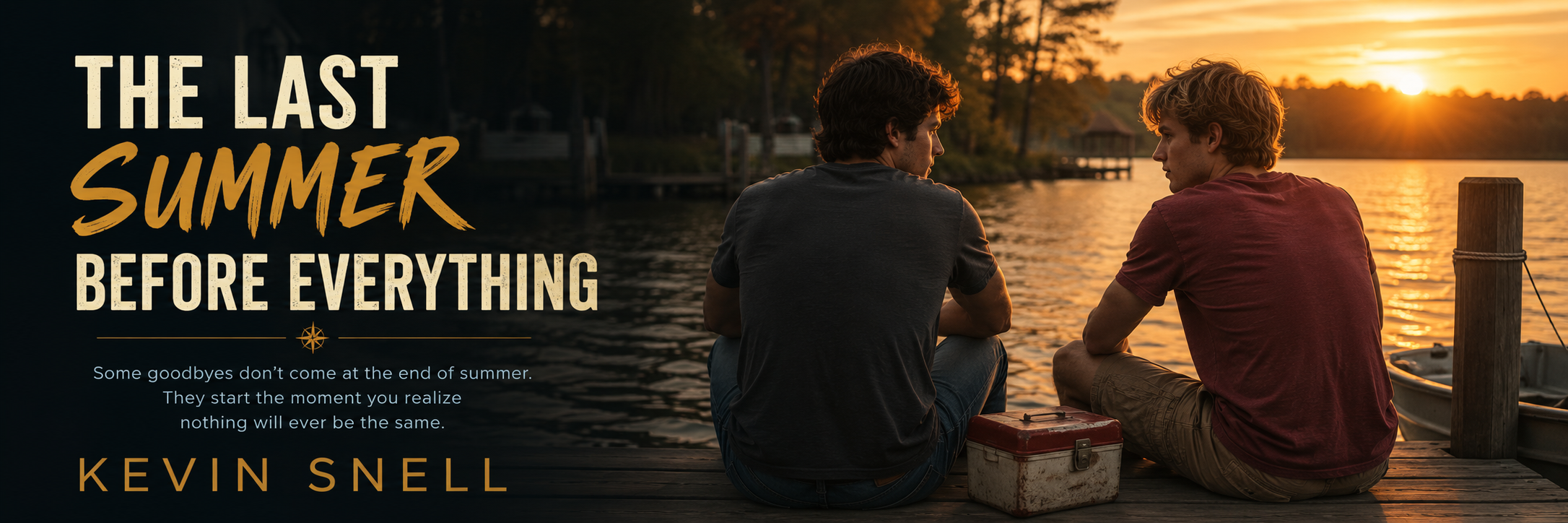
The Last Summer Before Everything
The Calendar on the Fridge
The calendar on the fridge ran in two colors. Black for Parker’s shifts at Hartley’s, red for everything that belonged to the rest of them—Dani’s swim meets, Cole’s appointments, the gas bill, the nights his mother worked the late table at the Lamplight. He filled in July with the black pen, and the month closed over him the way water closes over a dropped wrench. Quiet. Total. Already done.
He’d worked it so the black and the red almost never touched. That was the trick of the thing. If he took the early shifts he could get Cole to swim practice and still be home when his mother came in at midnight smelling of coffee and fryer grease and the particular tiredness she’d carried since their father stopped being a name they said out loud. Parker had gotten good at the arithmetic of other people’s lives. He could look at a week and tell you down to the hour how much of himself it would cost.
Cole was at the kitchen table not doing his summer reading, the book open and face-down over his phone like a tent he was hiding under. He was eleven and built entirely out of elbows and grievance.
“You’re supposed to read the actual book,” Parker said. “Not the four-sentence version a fourteen-year-old wrote on the internet.”
“The four-sentence version is more efficient.”
“That’s going on your tombstone. Here lies Cole Wold. He was efficient.” Parker took the phone, and Cole made the sound of a kettle, and Parker set it on top of the fridge where the boy couldn’t reach it yet and pointed at the book. “Twenty pages. Then I’ll drive you to the pool. Real pages, the kind with the words.”
Dani came down the stairs in a wet braid and a town-meet shirt two sizes too big and ate a banana standing up at the counter, which was the only way she ever ate anything. “He spent the knife money,” she told Parker, conversational, the family’s wire service.
“I know about the knife.”
“He told Mom it was for a science project.”
“There’s no knife in a science project, Cole.”
“There could be,” Cole said, with dignity, to the book.
This was the whole house, and Parker stood at the center of it—who needed driving, who’d eaten, whose shirt was clean for tomorrow—and most nights he didn’t mind, or he’d stopped letting himself check whether he minded, which from a certain angle was the same thing.
His phone went off on the counter. He knew before he flipped it over. There were maybe four people in the world who texted him after ten, and three of them lived in this house.
back in town. for real this time. you working tomorrow
He looked at it longer than the words deserved. Eleven of them, the question mark filed off, which was how Merritt had always asked for a thing—as though scrubbing the punctuation scrubbed the asking. Parker typed who is this and watched the dots rise and vanish and rise again.
the love of your life. you forgot already
ah. the tall one. owes me twelve dollars
i owe you eleven
see how you remember the math when it’s yours
He set the phone face-down and stood there with the marker still uncapped, and he didn’t move for a while. Through the window over the sink the backyard had gone blue-dark, the swing set Cole had outgrown rusting out there in the weeds, and Parker had the feeling he got too often lately—that he was watching his own life from a few feet behind himself, near enough to touch it, not near enough to change it. Merritt was back. Merritt was back for the last time he’d ever be back like this, with a whole summer ahead of him and nothing yet decided, and in eight weeks he’d be gone to a university up in Michigan where the dark came at four in the afternoon and the lake was the size of a sea. After that the summers would stop being summers. They’d be visits. They’d come with edges.
Parker capped the marker. In the box for tomorrow he wrote off, in black, where a shift should have gone, and then he traded a Saturday for it so the week still balanced, because some stubborn part of him refused to let wanting cost the family one thing it could measure.
“Who was that,” Dani said, watching him over the banana with the unbearable radar of a sixteen-year-old.
“Nobody. Hartley’s.”
“Hartley’s texts you the love of your life?”
“Read your phone less,” Parker said, and she grinned, because she’d seen it upside down, because there were no secrets in a house this size, only things everyone agreed not to say.
• • •
Mrs. Flynn’s car was the kind of green nobody made anymore, and it sat in the driveway when Parker pulled up, which meant Merritt had driven the eleven hours from school in one shot again, the same as always, the same that made his mother furious and proud in the same breath. Parker let the engine tick a second before he killed it. He’d known this house his whole life. He’d learned to ride a bike falling off it into the Flynns’ hedge. He’d spent the worst week of his life in their guest room the spring his father left, because his mother couldn’t let the kids see her face yet and the Flynns had simply made up a bed and asked nothing. He knew this house down to the give of its third porch step, and his stomach still did its old stupid thing.
Then the screen door banged and Merritt came down the steps two at a time, taller than ten months ago, which couldn’t be true and was, and Parker’s whole chest reorganized itself around the sight of him.
“You look like a man who drives a truck now,” Merritt said.
“I’ve driven a truck for three years.”
“Yeah, but now you’ve got the squint. The hardware-store squint. You’re one flannel off giving a stranger advice about grout.”
“I give strangers advice about grout. It’s my entire personality.” Parker climbed out, and then came the half second where neither of them knew what to do with their hands, which there always was, which neither of them had ever named, and then Merritt caught him by the back of the neck and hauled him in and it was a hug and it wasn’t, never quite had been, Merritt’s mouth at his ear, low, hey, like a thing they were keeping from the street.
“Hey.” Parker said it into his shoulder. Merritt smelled of the inside of a car after eleven hours and under that of himself, and Parker held on exactly as long as he was allowed and let go one beat before he wanted to, which he’d had years of practice at.
They stepped back. Merritt was grinning, and his eyes ran their old inventory, fast, head to feet and back, the once-over Parker had never decided whether Merritt knew he did.
“You eat?” Parker said. “There’s a new place. Well. It’s the old place. They redid the sign.”
“The Bluebird?”
“The Bluebird’s been shut two years, man. Where’ve you been.”
“Michigan,” Merritt said. “Briefly. Theoretically.” He came around to the passenger door and got in like he’d never once stopped getting in, and put his feet on the dash, and Merritt could be gone ten months and then fold himself straight back into the shape of your life, and you didn’t know how carefully you’d been holding the space until he filled it and you could breathe again.
Parker backed out of the Flynns’ drive. On the dash, in the dust by the vents, sat the flat grey stone he’d kept up there since spring, the good kind, the kind that skipped. Merritt picked it up and turned it over once and put it back without a word, and Parker watched him do it and said nothing either, and that was the entire language between them, right there—two people not saying things in a moving truck.
“Eight weeks,” Merritt said, out of nowhere, to the window.
“I know how long a summer is, Flynn.”
“I’m saying it out loud. So it’s real.” His elbow rode the door, his head tipped back. “Everybody keeps telling me how exciting it is. My mom cries about it about once a day. Happy crying, she says. I can’t tell the difference anymore.”
“It is exciting,” Parker said, and meant it, and hated that he meant it. “You got the funded one. You know how many people get the funded one?”
“You looked it up.”
“I did not look it up.” He had looked it up. The night Merritt called about the acceptance, one in the morning, Parker had read everything the program’s website would give him about exactly where Merritt would be standing for the next two years—the buildings, the inland sea, the snow that started in October and didn’t quit. “Congratulations. You’ll design a bridge that falls down and they’ll name it after you.”
“That’s not what civil engineers do.”
“You don’t know what you do yet. That’s the whole point of going.”
Merritt laughed, and it filled the cab, and Parker drove with both hands on the wheel and the windows down and the warm dust of the town coming in, and he thought, clear and from a few feet behind himself, this is the part you’ll want back, and then he turned the radio up so he’d stop thinking it.
Familiar Roads
The roads past the reservoir hadn’t been paved in Parker’s lifetime and never would be, and they drove them too fast like always, the truck shuddering over the washboard while Merritt held a gas-station coffee dead level out of long habit. There was no reason to be out there. That was the reason. It was the driving you did at nineteen, bored and broke, the driving that turned nothing into something with the simple addition of speed and a person you liked, and they’d never grown out of it because they’d never had a summer that made them.
“Pull over by the silos,” Merritt said. “I want to see if it’s still there.”
It was still there—the barn the lightning took the summer they were sixteen, half of it caved and silvered, the other half just standing there, refusing. They leaned on the hood and looked and didn’t go closer, because the magic of the place had always been in the looking.
“My dad used to swear they’d tear it down,” Parker said. “Every year. For ten years. It’ll outlive all of us.”
“How is he?”
“I wouldn’t know.” Parker said it easy, a fact with the heat scrubbed off, the voice he’d built for exactly this. “He’s in Reno. Or he was. He sent Cole a birthday card in May with forty bucks in it, which Cole spent on a knife, which I had to take away, so. Net negative.”
Merritt didn’t say I’m sorry, which Parker loved him for. He’d had two years of people saying I’m sorry, and the words had worn to nothing, two coins rubbed blank in a pocket. Merritt only looked at the barn a while longer and then knocked his shoulder into Parker’s and said, “Cole bought a knife. That kid’s going to be fine,” and somehow it was the most useful thing anyone had said to Parker about his family in a year.
They drove. They did errands, because Parker always had errands now, that was the grain of his life, and Merritt rode along for all of them and made each one worse and better.
Petras had the garage on Route 9 and he’d coached them both in Little League and he called them by the wrong names on purpose, had for fifteen years, the joke so old it had gone soft and dear. “Flannery,” he said to Merritt, wiping his hands, “and the Wold boy. You break it or you bring it?”
“Oil change,” Parker said. “And it’s pulling left.”
“It’s an old truck. It’s allowed to want things.” Petras put it up on the lift, and they stood in the open bay in the smell of rubber and cut metal while he worked, and he asked Merritt about the program in the way the town asked, which was to make it bigger than it was. “Michigan. Engineer. Look at you.” He pointed a wrench at Parker without turning his head. “This one keeping the place running while you’re gone?”
“He keeps everything running,” Merritt said, and there was no joke in it, and Petras grunted as though that were obvious, as though it weren’t the whole thing Parker spent his life not being thanked for, and Parker looked at the oil draining black into the pan and didn’t say anything at all.
Cole was waiting outside the pool at four, dripping on the curb with his towel around his neck like a cape, and his face did a complicated thing when he saw Merritt fold out of the passenger side—half delight, half the wariness of an eleven-year-old who’d learned that good things didn’t always stay. Merritt had been gone most of two years of Cole’s short memory.
“You got taller,” Cole accused.
“You got meaner. It suits you.” Merritt took the wet towel off him and snapped it at his legs, and Cole shrieked and dodged and was a kid again, just like that, and Parker stood by the truck with the door open and watched his brother and the boy he loved chase each other around a parked car in the pool lot, and the want in him turned over and showed its other face, which was this: not only don’t go, but look how easy you make us. Look what you do to this house just by walking back into it. Cole climbed into the middle seat between them on the bench and smelled of chlorine and asked Merritt forty questions about Michigan, did it really snow in October, were there wolves, and Merritt answered every one like it mattered, and Parker drove his family home through the four-o’clock light and didn’t say a word, because there wasn’t a word for it, and because his throat wouldn’t have held one.
The grocery store killed the warmth dead with its flat overhead light. Merritt pushed the cart and read the list off Parker’s phone in the voice of a nature documentary—and here we observe the North American male selecting the most economical ground beef, a behavior handed down through the generations—and a woman from the church gave them the look, two grown men laughing in the meat aisle, and Parker felt the town cinch a notch tighter around him and for once didn’t care, because Merritt was inside the notch with him. They argued about cereal. Merritt put back the brand Parker grabbed and got the one Cole actually ate, because Merritt remembered things like that, what an eleven-year-old who wasn’t his would eat, and Parker had to look at the freezer case a second until his face was his own again.
That was the trouble. Everything was easy. Everything dropped back into its old worn groove the second Merritt touched it, and the ease was a lie, because in eight weeks—seven, now—the groove would be empty, and Parker would be standing in this aisle alone reading the list in his own flat voice, and he made himself think it on purpose, standing there, the way you press a bruise to learn if it’s still a bruise. It was still a bruise.
In the lot Merritt loaded the bags into the bed and stood a second with his hands on the sun-hot tailgate, watching Parker dig for the keys.
“You do a lot,” Merritt said.
“It’s groceries.”
“No. I mean—“ He stopped. He had a habit of stopping in the middle of a sentence the second it got truer than he’d planned, and pulling back, and Parker knew the move because he owned it too. “You hold a lot of it together. Your mom. The kids. The whole—“ His chin tilted at the truck, the bags, the town. “You’re load-bearing, man.”
“That’s an engineering insult.”
“It’s an engineering compliment. The load-bearing wall’s the one you can’t take out.” He said it light, and then it sat in the parking lot not light at all, because they both heard the rest of it, the half neither of them said—and I’m the one who gets to leave. Merritt looked off first. He lifted the last bag off the asphalt and set it in the bed careful, like it was something that could break, and the careful told Parker that Merritt had just understood, maybe for the first time standing there, that leaving was a luxury. The understanding crossed his face, and he folded it away, and Parker let him, and they got in the truck and drove the groceries home before the cold stuff turned.
The Almost History
They went to the lake after dark because they were twenty-one and twenty-two and there was nowhere else to be that didn’t have a clock in it. Bell Lake at night was the same as every night of their lives—the water going green to black at the edge of the light, the float still chained out past the drop-off, the same families’ initials in the same dock posts gone soft with rot. They’d had every important conversation of their lives out here, and most of the unimportant ones, and the lake held them all, giving the day’s heat back slow long after the sun was down.
They swam to the float and lay on it on their backs and let the boards dry the water off them. The stars were stupid out there, more than a person had any use for.
“We almost died on this thing,” Merritt said.
“We did not almost die.”
“You jumped off the high side onto a beer cooler.”
“That was Tyler Honce.”
“That was you, Parker. I’ve got the photo. You’ve got the scar.” Without looking, Merritt reached over and found the place on Parker’s shin where the cooler had opened him up, and pressed it, two fingers, like testing a wall for the stud, and Parker went still as a held breath. The float rocked under them. Out past the light a fish took something off the surface. Merritt left his fingers there one beat past the joke and drew them back, and Parker breathed out at the dark and the stupid stars.
He was good at the things that were nothing. He’d had years to get good. They had one towel between them, because Parker only ever brought one, on purpose or not he’d never let himself decide, and swimming back in they used it as always, passing it hand to hand, and there came a moment with the cotton tented over both their heads, both of them ducked under it in the dark, faces a hand’s-width apart, that he’d have called nothing if anyone had asked. It was nothing. It was a towel.
They drove to the Bluebird after and parked nose-out in the empty lot, because the streetlight there built a box of orange in the dark and the dead diner asked nothing of anyone. They sat with the doors open and their wet feet up and drank the two warm beers Merritt had been hiding under the seat, and the thing that lived between them rose up near the surface, late, with the whole day behind them.
“Can I say something,” Merritt said, “and you don’t make it a joke.”
“No promises.”
“Parker.”
“All right. All right. No joke. Soldier’s honor.” Parker set his beer on the dash beside the stone and looked at the dead diner instead of at Merritt—the dark window where the counter used to be, where both their mothers had once, separately, in a different decade, in different lives, carried plates.
“The night before I left for school. The first year.” Merritt turned the can in his hands. “You drove me to the bus. We sat in this truck.”
And Parker was there again before Merritt finished the sentence, because he’d never once left it.
It had been August then too, the bus at 6:10 a.m. out of the Sunoco lot, and Parker had volunteered to drive because the alternative was Merritt’s mother crying at the wheel and Merritt arriving at college red-eyed. They’d sat in the truck in the dark with the duffel between them and the engine running for the heat, eighteen and nineteen and so far from saying anything true that the not-saying had its own weather in the cab. Merritt had his hand on the gearshift. Parker had been looking at that hand for what felt like the length of the night, the knuckles, the bitten thumbnail, and then the bus came around the corner with its headlights swinging across them both, and something in Parker that he’d never been able to name or explain or undo had reached over and put his hand down over Merritt’s on the shifter. Just covered it. Neither of them moved. The bus idled. The driver looked at his clipboard. And for a whole minute—a real minute, sixty actual seconds, Parker had counted them since a hundred times—they sat there with Parker’s hand on Merritt’s hand and the future running its engine ten feet away, and everything Parker would never have the nerve to say crowded up in his throat, and then the moment got so big it scared him, and he heard his own voice say something stupid about the bus being late, and he took his hand back, and Merritt got out, and that was that. They’d buried it the second it happened. Two summers of weather over the top of it, and never once the word for what it was.
“You put your hand on mine,” Merritt said now, in the orange dark, “and you didn’t move it. And I didn’t move mine. And then you cracked some joke about my bus and you pulled back, and we never—“ The laugh came out of him wrong, more breath than sound. “Two years, man. We never said it.”
Parker looked at the diner. He could feel Merritt looking at the side of his face. He knew the exact shape of what he could say—it was right there, whole, finished: I pulled back because if I hadn’t I’d have asked you to stay, and I didn’t have the right, I’ll never have the right, you don’t ask a person like you to stay in a town like this. What came out instead, quiet, aimed at the windshield, was, “It wasn’t nothing.”
The most he’d ever given it. Three words, fired at glass.
Merritt was quiet a long time. The streetlight buzzed overhead. Then, just as quiet: “No. It wasn’t.” And he didn’t reach across the seat, and Parker didn’t reach across the seat, and they sat in the orange light with the truth finally in the truck with them, taking up a seat, and neither of them had any idea what you were supposed to do with it now that it had a body. He could see the thing clear now, and still had no idea how to hold it.
“We should go,” Parker said, eventually. “I’ve got the early shift.”
“Yeah,” Merritt said. “Yeah. Okay.”
He drove Merritt home with the truth riding the seat between them the whole way and dropped him at the green car in the dark drive, and Merritt got out and leaned back in through the window, and there came a second—Parker felt it swing open like a door—where either of them could have, the streetlight dead on this block and the street asleep and nobody on earth ever to know.
“Night, Wold,” Merritt said, and rapped the doorframe twice with his knuckles, and went inside.
Parker drove home the long way, past the silos, too fast, alone.
The Deadline Moves Closer
For a few days after the Bluebird, they didn’t see each other, and neither of them called it that. Parker picked up an extra shift he didn’t need. Merritt had things to do for the program, forms, a doctor’s note for the move, and they texted, except the texts got shorter, lost their jokes, went to how’s the store and fine, you and the long silences in between that a phone makes feel like a held breath. The truth had been easier as a thing they didn’t say. Said, it sat between them and made everything formal, and Parker, who could keep any feeling in the world as long as nobody acknowledged it, found he had no idea how to be around a Merritt who knew. So he stayed at Hartley’s. He stayed where he was good.
The store was where Parker felt most like himself and least like a person with a future, both at once. Hartley’s was eighty years old and smelled of cut keys and fertilizer and the machine oil they sold by the quart, and old man Hartley had handed Parker more of the running of it every season since the spring everything fell apart, not with ceremony, just by being elsewhere more, trusting Parker to know which contractor was good for thirty days and which needed to pay cash. Parker knew the place in his hands. He could lay his palm on any bin in the dark and tell you the gauge of the screws inside it. He liked the work, was the embarrassing truth of it—liked solving a stranger’s leak in four sentences, liked the weight of competence, and hated that liking it felt like agreeing to something, like signing a thing he hadn’t read.
Merritt came by on the Tuesday near close and leaned on the counter and watched Parker cut a key for a woman who’d locked herself out of her late mother’s house, watched him talk her down easy while the machine screamed and threw bright filings, watched him not charge her, and when she’d gone Merritt said, “You’re good at this. Like—actually good. You know that?”
“It’s a key, Flynn.”
“It’s not the key.” But he let it go, because the bell over the door went and a man came in needing a propane fitting, and Parker handed it to him without looking, eleven o’clock to the bin’s two, and Merritt watched that too, and didn’t say the thing his face was saying, which was some version of you could run this. You could run anything. And nobody up where I’m going will ever know that about you.
Merritt started coming over after Parker’s shifts, and that was how he ended up inside the machinery of the Wold house on a Wednesday near eleven, when Parker was at the kitchen table with the shoebox of bills and the checkbook and the calculator app open on his phone, doing the part of his life nobody ever saw him do. Cole had gone down hard at nine and come back up at ten with a bad dream he wouldn’t describe, and Parker had sat on the edge of the boy’s bed in the dark until the breathing went even, and now he was awake with the gas bill and the water bill and the math of which one could wait, and Merritt sat across from him not talking, just there, the way you’d hold a flashlight for somebody working under a sink.
The door went a little after eleven and his mother came in off the late table, and Parker watched her come in—the careful way she took the step down into the kitchen, favoring the right knee that the doctor said was bone on bone and that she said was fine, the same word she used for everything that wasn’t. She had the diner on her, coffee and grease and the particular grey of a woman who’d been on her feet eight hours for people who tipped on the pre-tax total. She kissed the top of Cole’s empty chair out of habit, then laughed at herself, then saw Merritt and her face opened.
“They’re working you to the bone down there,” Parker said.
“It’s fine.” She got her shoes off standing at the counter, one hand on the fridge. “Dani won the two hundred. Did she tell you. Beat the Carlisle girl by a full second.” She said it proud and exhausted in equal measure, and Parker wrote the time down in the red pen on the calendar for her even though she’d already told him, because the writing-down was a thing he could give her, and she squeezed his shoulder on her way to bed the same as she’d squeeze Merritt’s three nights later over the lemon thing, and then it was just the two of them again under the kitchen light with the bills.
Merritt didn’t say anything for a while. Then, quiet: “How long have you been doing this?”
“Doing what.”
“This.” He meant the table, the shoebox, the kid upstairs, the woman down the hall, the red pen. He meant the hour. “Since your dad.”
“Somebody’s got to keep the lights on.” Parker capped the pen. “It’s not a tragedy, Merritt. It’s a Wednesday. People do this everywhere, all the time, it’s just—life, it’s just the bill being due.” But Merritt was looking at him across the table the way he’d looked at the careful bag of beans in the parking lot, and Parker understood that his friend was doing the same arithmetic Parker did every night, and arriving, for the first time, at the size of the number. Once Merritt saw it he couldn’t make it small, and Parker had spent two years making it small so he could lift it.
The boxes started that same week. Parker came in off a shift and they were just there in the Flynns’ front room, flat-packed and waiting, and Merritt was on the floor with the packing tape making the sound Parker would hate for the rest of his life, that shriek of tape off the roll, and Parker stood in the doorway and looked at the boxes and understood the leaving in a way the calendar had never made him.
“You’re packing already? You’ve got three weeks.”
“Two and a half. And you don’t pack a life in a weekend, Parker, you pack it in increments so you don’t notice you’re doing it.” Merritt didn’t look up. He was good at this, good at anything with a system in it. He labeled every box on two sides in block capitals—KITCHEN, BOOKS, WINTER—and WINTER got Parker right under the ribs, because there’d be a winter up there, a real one, with Merritt inside it, in a coat Parker would never see.
“You want help, or you want an audience?”
“Both. Mostly help. Hand me that.” So Parker got down on the floor and helped, because the only thing worse than helping would have been refusing, which would have told Merritt everything. They built boxes. They wrapped Mrs. Flynn’s good glasses, the ones she was sending up because she couldn’t stand the thought of her son drinking out of plastic in the cold. They argued about whether you needed a book once you’d read it, Merritt for keeping, Parker for letting go, and it was not about books.
It was the shirts that did it. Late, the room half-emptied, Merritt folding shirts into a box and Parker handing them off the bed, and Parker’s hands knew these shirts. The grey one from the lake trip the summer they were seventeen. The flannel they’d stolen back and forth so many times neither of them owned it anymore. The hoodie—
“That’s mine,” Parker said.
Merritt held it up. Faded grey, the cuffs gone to felt, the Hartley’s logo cracked across the chest from a thousand dryers. “I know. I keep meaning to give it back. I’ve had it since March.”
“Keep it.” Parker heard the words leave him and couldn’t catch them. “It’s cold up there. You’ll want it.”
Merritt looked at him then, really looked, the hoodie in both hands, and something moved behind his face that Parker couldn’t afford to watch, so he stood off the bed and said he had to call his mom about Cole, which was a lie, and went out onto the porch and stood in the dark with the phone in his hand calling no one.
The thing was, wanting had started to feel like something he ought to be ashamed of. Not the wanting itself—he’d carried that for years, it was an old weight, he had the calluses for it. It was that the wanting had gone loud, now, with the clock running down, and every honest thing he did, every shirt he handed over, every box he taped shut, was secretly an argument for Merritt to stay, and Parker couldn’t stand to be a man making that argument. Because Merritt had earned this. Merritt had done it all right—the grades, the test, the application Parker had watched him sweat at this same kitchen table—and the lowest thing a person could do, the most selfish, was to stand in the doorway of all that and say but me, though. What about me. So Parker did the opposite. He helped pack the boxes faster. He held the door of Merritt’s leaving open with both hands and his whole body, and the more it cost him the wider he held it, and somewhere in that week he started to go quiet.
It showed. With Merritt it always showed; there’d never been a version of Parker that Merritt couldn’t read across a room.
“You’ve gone weird,” he said, coming out onto the porch with two beers, handing one over.
“I’m tired. The store’s been slammed. It’s grilling season, the whole town needs a propane fitting at once, it’s a migration.”
“That’s not it.”
“It’s propane fittings, Merritt. You wouldn’t understand. You’ve never load-borne a propane fitting in your life.” The joke landed and Merritt let it land, because he was kind, and they stood on the porch and drank, and a storm was building off the west, an August storm, the air gone green and electric and close, and you could smell it coming before you could see it.
“My boxes are on the porch,” Merritt said.
“The covered part?”
“The not-covered part.” And then the sky let go all at once, and the two of them were off the steps and moving before they’d decided to, hauling the boxes Merritt had stacked by the railing in under the eave, and KITCHEN was already going dark at the corners and Parker put his body between the rain and the BOOKS box without thinking, his back to the weather, carrying Merritt’s whole packed-up future into the dry while the rain ran cold down his neck and soaked him through to the skin. They got them all in. They stood in the doorway after, both of them streaming, breathing hard, the rain roaring on the porch roof a foot above their heads, and Merritt looked at Parker—soaked to the bone for a box of books bound for Michigan—and his face did the thing again, and this time he didn’t put it away.
“Why are you like this,” Merritt said. Not a question. His voice had gone rough. “You’d stand in a hurricane for a box of my books and you won’t even—“
“Don’t,” Parker said.
“Parker.”
“I’ve got the early shift,” Parker said, which was becoming the truest lie in the world, and he went out into the rain to the truck and sat in it in the Flynns’ driveway with the wipers off and the windshield gone to water, and watched the smear of Merritt standing in the lit doorway watching him not leave, and he didn’t leave, and he didn’t go back in. He sat in the rain in the dark in the space between the two impossible things, and then he turned the key and drove home soaked to the skin with the heater roaring, shaking, not entirely from the cold.
The Confession That Is Not a Plan
The night before the party Parker came back for the keys he’d left on the Flynns’ counter, and the house was dark but for the blue of a laptop down the hall. Merritt was on the floor of his stripped room, back against the bare mattress, the screen open to the enrollment portal with the cursor sitting on CONFIRM and not moving. He didn’t perform when Parker came in. He didn’t rearrange his face or reach for the joke. He looked up, caught, and looked back at the screen.
“It’s a button,” Merritt said. “I’ve pressed a thousand buttons.”
Parker sat down beside him against the mattress, shoulder to shoulder, and looked at the one word with him. The whole future was behind it.
“Everybody keeps congratulating me,” Merritt said, “like I’m not allowed to be scared. Like being scared means I’m not grateful for it. And I am grateful, I worked for this, I want it—I just keep thinking the second I press it, it’s true, and then I have to go be a person who did this.” He breathed. The cursor blinked. “And I don’t get to say any of that out loud, because everybody’s so proud.”
Parker didn’t tell him it would be fine. He didn’t reach over and press it for him. He sat with his shoulder against Merritt’s in the blue light of the dismantled room and said, “You don’t have to press it tonight.”
“No,” Merritt said. “I know.” And he didn’t, and they sat there a while with the future waiting under the cursor, and then Parker drove home, and neither of them said the scared thing out loud again until the dock.
The Flynns threw the send-off on the second-to-last Saturday, in the backyard, with a cooler and a folding table and the citronella candles that never worked. Half the town came through, because Merritt was the kind of kid a town like this was proud of, the one who got out, the proof that getting out could be done. People kept saying it. That was the thing Parker hadn’t braced for. They said it to Merritt with a hand on his shoulder—you’re getting out, look at you, getting out—as though the town were a wreck they were all going down with and Merritt had found the one seat in the one boat. Every time they said it, it landed somewhere else. It landed on Parker. Because if Merritt was getting out, then Parker was the thing you got out from.
The town came at Parker the way it always did, in pieces of who he used to be. Mrs. Adler, who’d taught them both fourth grade and still saw the nine-year-olds under the men, held his face in both hands and told him he’d grown up handsome and steady, steady, the word landing on him like a verdict. The Honce kid, who’d thrown the beer cooler off the float a hundred years ago, was selling insurance now and shook Parker’s hand too long and said they should grab a beer sometime, the way men say it when they both know they won’t. And old Ruiz, who’d worked the line at the plant with Parker’s father before the plant closed and the father left, found Parker by the fence and didn’t say anything about any of that, just stood next to him a minute looking at the party and said, “Your dad could’ve stayed and been half the man you are. You know that.” And walked off before Parker could answer, which was a mercy, because Parker didn’t have one.
That was the town. It held every earlier version of you at once and handed them back without asking which you wanted. Merritt got it easier—the town’s memory of Merritt was a clean upward line, the smart Flynn kid made good—but Parker’s was a knot, the boy whose dad left, the one who stayed, the one who turned out steady, steady, and every handshake tightened the knot a little, and he loved these people and he could not breathe.
He was at the cooler when Merritt’s uncle said it. A big man, a few beers in, meaning nothing by it, clapping Parker on the back hard enough to rock him. “Good for the kid, huh. Smart. Not like some of us. Some of us were always gonna stay put.” And he laughed, friendly, and wandered off toward the burgers, and Parker stood with his hand in the ice and understood that the man hadn’t even been cruel. He’d only said the thing the whole town thought and was too polite to say to your face, the thing Parker said to himself at two in the morning. Some of us were always gonna stay put. As though it were a flatness in you. As though it were the absence of a thing other people were born with.
Parker put his unopened beer back in the ice and walked out of the party. Nobody saw him go, which was its own fact about his life. He got in the truck and drove to the lake, because there was nowhere else his body knew to take a thing like this, and he went out to the end of the dock and sat with his feet over the black water and didn’t cry, only sat out there with the whole weight of it and no one to hand it to, and after a while he heard the truck again—his own truck, Merritt had lifted the keys off the seat—and then footsteps coming down the boards, and Merritt lowered himself down beside him without a word and pressed a warm beer into his hand.
They sat. Out past the light the float knocked against its chain.
“My uncle’s an idiot,” Merritt said.
“He’s not wrong, though.”
“He’s an idiot, Parker.”
“I’m staying put.” Parker said it to the water. “That part’s just true. Call it whatever you want. I’m twenty-one and I work at a hardware store and I’ll be here when you come back at Christmas and I’ll be here the Christmas after, and you’ll be building bridges in—wherever, and that’s good, that’s right, that’s how it’s supposed to—“ His voice did something he hadn’t authorized, and he shut it down. “I’m not getting out. There’s no out for me. There’s Cole’s swim meets and the gas bill and my mom’s knees. That’s the whole map.”
“Don’t do that.”
“Do what.”
“Make it small so it stops hurting. You always do it—you flatten it out, the gas bill, my mom’s knees, like it’s nothing, like you’re nothing.” Merritt’s voice cracked open down the middle. “You held a hurricane off a box of my books. You know to the dollar what Cole spent on a knife. You carry an entire family up a hill every day of your life and you crack a joke about propane while you do it, and you’ve decided I’m the impressive one because I filled out a form correctly.”
Parker said nothing. He couldn’t. The thing in his chest had outgrown any sentence he could get around it.
“I’m scared out of my mind,” Merritt said, lower. “That’s the part nobody gets to say at the party. Everybody’s so proud, and I’m going to drive eleven hours up there in three weeks and not know a single face, and it’ll be dark by four in the afternoon, and I’m going to be alone in a way I have never once in my life been alone, because I have always, always had—“ He stopped. The stop. But this time he didn’t pull back from it. He turned in the dark and looked at Parker and said it. “I’ve had you. My whole life I’ve had you a phone call away, and I’m about to not, and I keep telling everybody I can’t wait to go, and the truth is I’m terrified I built this whole future out of leaving the one person who actually—“ His voice gave out under him.
“Say it,” Parker said. He hadn’t known he was going to. It came up out of him low and shaking. “Just once. So I’m not the only one who—“
“I love you,” Merritt said. “Okay? I’ve loved you in every single version of leaving I ever ran in my head. I’d lie awake up there last year planning my whole life and you were in all of it, you were the part I couldn’t engineer out, and I gave up trying to. I love you. I’ve loved you since this dock. I just never once figured out how to want you and want the future at the same time, like they were the same size and I only had the room for one of them.”
The water moved against the pilings. Parker heard himself breathe.
“I don’t want you to go,” Parker said.
It was out before he could stop it, the thing he’d sworn he would never let loose, and the second it hit the air he was already hauling it back, already ashamed, already a selfish man at a cooler. “I—forget that, that’s not fair, I know it’s not fair, you have to go, you should go, I’d never actually ask you to—“ The words came fast, falling over each other, undoing the truth as quick as he’d said it. “I’d never ask you to stay. That’d make me the guy who—I just. You asked me to say it so it’d be true for both of us. And it’s true. I don’t want you to go. And also you have to. And I can hold both of those, I’ve held both of those all summer, I’m fine, I’m—“
“Parker. Parker.” Merritt had his hand on the back of Parker’s neck now, the same as the driveway in July, and he leaned their foreheads together in the dark, and Parker stopped talking. “You’re allowed to want me to stay. Wanting me to stay isn’t the same as making me. You know that, right. You can want a thing and not turn it into somebody’s cage. You’ve never once in your life made anything a cage—that’s the whole—God, you’re so scared of taking up room you’d have let me drive off thinking you didn’t care.”
“I care,” Parker said, wrecked, into the inch between them. “You know I care.”
“I know,” Merritt said. “I finally know.”
And then the kiss, and it wasn’t a victory, it didn’t feel like winning a single thing, it felt like the opposite—like grief got a body for a second and the body was this, two people at the end of a dock at the end of a summer kissing for the first time and the last time at once, the future already standing out in the gravel lot with its keys in its hand. Salt and warm beer and two years of it wasn’t nothing. It was a careful kiss, and when it ended they didn’t pull apart, they stayed forehead to forehead breathing the same square foot of air, and the terrible thing, the true thing, was that nothing was solved. The plane ticket was still real. The boxes were still taped. They’d finally told the truth and the truth couldn’t drive Merritt to Michigan or pay Parker’s gas bill or hold the summer open one extra day. All it could do was make the ending honest.
“This doesn’t fix it,” Parker said.
“No.”
“You’re still going.”
“I’m still going.” Merritt’s thumb moved against the back of his neck. “I don’t know how to not go, Parker. I wish I could tell you I figured it out walking down the dock. I didn’t. I just couldn’t let you sit out here believing you were nothing to me. I couldn’t carry that up there with the boxes.”
“Okay,” Parker said.
“Okay.”
They stayed on the dock until the candles at the party had burned down and the cars had all pulled out, and they didn’t make a plan, because there wasn’t one.
One Week Left
They gave themselves the last week. Nobody named it out loud, but that was what it became—a week stolen out of the middle of the ending and spent, by agreement neither of them spoke, telling the truth, since the worst of it was already said and there was nothing left to guard.
It was nothing anyone would have filmed.
Monday it was the depot run two towns over, the special-order brackets, and on the way back Merritt fell asleep in the passenger seat with his head against the glass, mouth open, twenty-two years old and wrung out from folding a life into cardboard, and Parker drove five miles under the limit so it would last and took the long road past the silos for no reason except that it added eleven minutes. He didn’t wake him. He drove with one hand and watched the road and, once, at a red light, let himself look over at Merritt asleep and undefended in the seat that had been his since they were sixteen, and the wanting in him that week had stopped being a wound and become something quieter and worse, a kind of grieving you do in advance, with the person still warm and breathing right beside you.
Tuesday his mother knew, the way mothers know. She didn’t make it a conversation. She set a fourth place at dinner without being asked, and on the Thursday she made the lemon thing Merritt had loved since he was nine and set it down in front of him without a word, and Merritt looked at the plate and then up at her, and Parker watched his friend understand he was being told we see it, we see you two, it’s allowed, in the only language Parker’s mother had ever trusted, which was food. “Thank you, Mrs. Wold,” Merritt said, in a voice that didn’t hold quite level, and she squeezed his shoulder on her way to the stove, and that was the whole of the blessing.
Wednesday Dani caught them at the stove, Merritt’s hand on the back of Parker’s neck while the eggs went, and she stopped on the bottom stair, sixteen and sharp as a tack, and looked at the two of them, and Parker braced for whatever was coming. His sister only looked a beat longer at Merritt’s hand on the back of Parker’s neck, and then said, “The eggs are burning,” and got the orange juice out of the fridge and went out the door to practice, and that was the entire coming-out of it, swallowed whole by an ordinary morning, and Parker loved her so hard in that second he had to turn back to the pan so she wouldn’t see his face do what it did.
Friday Parker got off at two and they had the lake to themselves in the daylight, which never happened, which felt stolen. The families came in the evenings; at two on a weekday there was only the heat coming off the water and the dock boards soft and warm underfoot, and they swam out to the float in the full sun this time, no dark to hide in, and lay on it dripping with the light pressing down on them, and it was different in the day. At night the lake let you pretend. In the day there was just Merritt’s shoulder a finger’s width from his, freckled and real, and the water sound, and the whole bright fact of it. Merritt reached over without looking, the same as the first night, and found the cooler scar on Parker’s shin and pressed it, two fingers, except this time he didn’t take his hand back. He left it on Parker’s leg in the sun, and Parker watched a hawk turn over the far trees and didn’t move and didn’t breathe wrong, and they lay there a long time not saying anything, the float rocking under them, two boys in the middle of a lake in the middle of a Friday with the world’s whole weight of summer light on them and eight days left.
“I keep trying to memorize it,” Merritt said, to the sky. “This. I keep going, remember this, remember exactly this, and then I get scared I’m doing it wrong, that I’m going to remember the remembering instead of the thing.” He turned his head. “Is that—do you do that?”
“All the time,” Parker said. “All summer. From a few feet behind myself.”
“Yeah.” Merritt looked back up at the blue. “Yeah. That.”
They swam back in slow and used the one towel between them, the same as always, except now there was no pretending it was nothing, and so when the cotton came up over both their heads in the bright two-o’clock air, faces close, water running off them, Merritt kissed him under the towel, slow, salt on both their mouths, in the daylight, where the only witness was the empty lake. It was a kiss with no clock in it for exactly as long as it lasted, and then the clock came back, the way it would for a thousand miles and ten months and however much longer after that they could keep this from becoming a thing they used to do. They drove home with wet hair and the windows down, and Parker took the long road past the silos, and neither of them said why.
It was holding hands in the truck where the console hid it, Merritt’s fingers laced through his at every red light and let go before they rolled, a thing that lived only in the gaps between motion. It was the porch after his shifts, shoulder to shoulder on the steps, not even talking, Merritt’s leg warm along his, the citronella finally lit and finally working, doing its one job for once in its life.
One of those mornings—the sky not even grey yet—Parker came down for the 6 a.m. open and the kitchen light was already on. Merritt stood at the stove in yesterday’s shirt with his hair flat on one side, scraping at a pan, and smoke was lifting off the toaster, two slices gone past brown to black.
“You’re awake,” Parker said. Merritt had never once met 6 a.m. on purpose in his life.
“I’m making you breakfast.” He said it like a dare. “Don’t look at the toast.”
Parker looked at the toast. It was past saving. He sat down at the table anyway, under the two-color calendar with his shifts in black and the family in red, the house quiet over them, Cole and Dani and his mother all still asleep, and Merritt set a plate in front of him—eggs overcooked and broken, the black toast scraped at with a knife in a way that had only moved the burn around—and sat across from him with his elbows on the table, watching Parker take the first bite like he’d staked something on it.
Parker ate the toast. All of it. He ate the bad eggs and the burnt toast in the grey kitchen at six in the morning while the boy who’d made them watched him do it, and it was the nearest thing to a life he had ever wanted, this exact ordinary thing, the two of them at a table with the day not yet started and no one else awake. He understood it even then, chewing scorched bread: this was the one he’d want back. Not the dock. Not the kiss. This. The toast.
Then the day came on. His phone went off with the alarm for the open. Merritt’s boxes were stacked by the front door where Parker would have to step around them on his way out. The life they were playing at had a clock bolted to the underside of it, and Parker rinsed his plate and kissed Merritt once at the door, toast and all, and went to open the store.
The cruelty was that knowing it was love didn’t shrink it down to something he could carry off and survive. It made it bigger. Before, he’d been losing a maybe. Now he was losing a fact. And he wouldn’t have traded back—he’d lain awake on the narrow bed with Merritt’s breath gone slow beside him and asked himself, honestly, whether he’d rather have never known, rather have let Merritt drive off believing it was nothing, and the answer came back no, never. He’d take the heavier grief every time before he’d let Merritt go north not knowing he was loved.
The last night, the room was already gone. That was the thing that undid him. They lay on the narrow bed in what had been Merritt’s room and was now just a room, the walls bare of the band posters and the swim ribbons and the periodic table he’d had up since he was twelve, the closet open and empty, the boxes all gone ahead in his mother’s car or stacked by the front door for morning, and the room had the sound a room gets when it’s stopped being anybody’s, that flat echo, and they lay in it shoulder to shoulder in the dark and didn’t sleep.
“I can hear the room being empty,” Merritt said.
“I know.”
“It’s so loud.” He found Parker’s hand in the dark between them and held it, not the red-light way, the let-go-before-it-counts way, but the whole way, fingers laced and staying. “Tell me something true. So the last thing isn’t this echo.”
Parker lay there with his friend’s hand in his and the bare walls around them, and reached for something true that wouldn’t ask for anything, that wouldn’t be a hook in Merritt’s coat the whole drive north. “When you used to leave for school,” he said, “the first couple years. I’d drive past your house. Not even meaning to. I’d just end up on your street, and the green car would be gone, and I’d—I don’t know. I’d feel better, just seeing the house. Like part of you was keeping the place.” He breathed. “I’m going to drive past a lot, this fall.”
Merritt didn’t answer for a moment. Then he turned and pressed his face into the side of Parker’s neck, and Parker felt the wet there, and didn’t say anything about it, because some things you let a person do in the dark in an empty room without naming them, and they stayed like that until the window went grey, and neither of them ever said they hadn’t slept.
Departure
The morning Merritt left, the green car was packed by seven and the sky did nothing at all, only hung there flat and white and ordinary, which felt like an insult. Parker had taken the day. He’d quietly traded two shifts for it weeks before, in black pen, and never told a soul why.
Mrs. Flynn was crying the happy crying you can’t tell from the other kind. The neighbors came out onto their steps. It became a whole thing, a hometown send-off, and Parker’s family came too—his mother in her good cardigan with a foil pan of the lemon thing for the road, Dani sullen and red around the eyes and pretending it was allergies, Cole standing too close to Merritt and not asking the question all over his face, which was are you coming back, the question kids ask with their whole bodies and no words. Merritt crouched down to Cole’s level on the lawn and said something Parker couldn’t hear, and Cole nodded hard, twice, the way you nod when you’re not going to cry in front of people, and then Merritt gave him a thing out of his pocket—a multi-tool, the good kind, the kind Cole had wanted and Parker had said no to—and Cole looked at Parker over Merritt’s shoulder with a question, and Parker, who had taken a knife away from this boy in May, looked at the multi-tool and at his brother’s face and said, “Don’t lose it, and don’t show your mother,” and Cole’s whole year was made.
Parker stood at the edge of all of it with his hands in his pockets, because the truth of the two of them was still a porch-and-kitchen-table truth, a thing his family held and the street didn’t, and neither of them had decided to make it the street’s business on the worst possible morning to decide anything. His mother knew. She stood beside him and didn’t say it, only put her hand flat between his shoulder blades for a second, the spot you press to tell a person I’ve got you and I’m not going to make you talk, and took it away before anyone could read it.
Then the car was loaded and the goodbyes were said and there was nothing left but the part Parker had spent eight weeks not thinking about. Merritt came over to where he stood by the truck, a little apart from everyone, and for a second neither of them knew what to do with their hands—the very first thing about them and the very last, unchanged across all of it.
“So,” Merritt said.
“So.” Parker’s throat had shut. He’d promised himself he wouldn’t make it hard. He wouldn’t beg. There was nothing to beg for—there was no version where Parker found the right words and Merritt unpacked the car, and they both knew it, and the not-begging was the last gift Parker had left to give, so he gave it. He kept his hands in his pockets and his voice level and he did not ask for one single thing.
“I’ll call you from the road,” Merritt said. “Every time I stop for gas. I’ll call so much you’ll get sick of me.”
“You won’t. You’ll get up there and there’ll be all these new people and the four-o’clock dark and you’ll forget I exist for ten months, and that’s fine, that’s the deal, that’s what you’re supposed to—“
“Parker.” Merritt’s eyes had gone wet. “I’m not going to forget you exist. I have never once in my life forgotten you exist. That was the whole problem.”
Parker laughed, and it broke coming out, and he looked at his shoes. Then he took his hand out of his pocket—he’d put it there that morning on purpose—and held out the stone. The flat grey one off the dash, the good one, the kind that skipped. Merritt looked down at it.
“It’s a rock,” Parker said. “Before you make it weird. It’s a rock, Flynn.”
Merritt took it. He closed his hand around it.
“There’s water up there,” Parker said, and his voice was going now and he let it, just this once. “That lake the size of an ocean. So. For when you find it. You always threw like you were mad at the water, but you’ve got it in you—keep your wrist loose, it’ll skip. I’ve told you a hundred times. Keep your wrist loose.” He stopped. He’d run out of things to say about throwing rocks. “It doesn’t mean anything. It’s not a promise. I’m not asking you for anything. It’s just—it’s from here. So you’ve got a thing from here.”
Merritt looked at the stone in his palm, and then he looked up at Parker, and his face was wide open, no joke anywhere in it, nothing held back, and he stepped in and put his arms around Parker right there at the edge of the driveway in front of the neighbors and the crying mother and the flat white sky, and held on. Parker held on back. And for once Parker didn’t let go a beat early. He held on exactly as long as he wanted to. He’d waited his whole life to do that, and he got to do it once, in a driveway, while a boy he loved left town.
“Keep my wrist loose,” Merritt said into his shoulder, wrecked, laughing and not.
“Keep your wrist loose.”
“This isn’t goodbye,” Merritt said. “I don’t know what it is. But I’m not going to pretend it’s clean. I’m not going to drive off and pretend it didn’t—you matter to me more than the program does. I need you to know that I know that, even though I’m still getting in the car. Both things. I’m holding both things.”
“I know,” Parker said. “I taught you that one.”
Merritt laughed for real then, the wet kind, and let go, and got into the green car. He set the stone in the cupholder where Parker could watch him do it, on purpose, the same as Parker had once put a hand on a gearshift and not moved it—a thing said without a word in it. Then he backed out of the drive, and lifted two fingers off the wheel, and drove down the street he’d grown up on and turned at the end of it and was gone. The street went back to being a street. The sky went on doing nothing. And Parker stood in his mother’s driveway and let his mother put her arm around him, and did not, in the end, cry. He had the early shift in the morning. And some part of him was already, quietly, working out the arithmetic of how to carry this too.
After the First Week
A week is nothing and a week is forever. Parker worked it. He opened the store and closed the store and drove Cole to swim and balanced the calendar and let the days take him as days do, and the missing was a flat ache he carried under everything, present and quiet, the way you carry a healing rib—not a wound exactly, by then, only a thing you breathe carefully around.
Merritt called from the road like he’d said, twice the first day, then the signal died somewhere up in the pines and there were two days of nearly nothing, a text arriving hours late—made it. it’s so green up here you’d lose your mind—and Parker read it standing in the hardware aisle and put the phone away and helped a man find a propane fitting and did not think the thing he was thinking, which was I would. I’d lose my mind. Take me with you. He didn’t think it. He’d retired that thought on a dock. It was a thing you got to want and didn’t get to make true, and he’d made his peace with the shape of that, or he was learning to, which on a Tuesday is close enough.
He thought it would be the long fade from here. The calls getting shorter, the texts further apart, the slow honest disappearing of a thing that had no room to live in two states—it always went that way, when one of you stayed and one of you left. He’d braced for it. He was good at bracing. He told himself the kiss had been a true thing and a finished thing at once, like the float out past the drop-off, a place you swam to once and kept. He almost believed it.
The house was the thing. He hadn’t braced for the house. Merritt had only been there a summer, but he’d filled the space so completely that the space remembered him now—the porch step where the two of them sat was just a step again, the fourth chair came back off the table, the lemon thing went unmade. Cole asked on the third day, over cereal, not looking up, “Is Merritt your boyfriend now or did he just leave,” and Parker stood at the counter and thought about how to answer a question that had no clean shape and said, “Both, kind of. He’s far away and he’s still mine. People can be both.” And Cole considered that with the gravity of eleven and said, “That’s stupid,” and Parker said, “Yeah,” and meant it, and they finished their cereal, and that was the most honest conversation Parker had all week.
He drove past the Flynns’ once, the second night, not meaning to, ending up on the street the way his body had learned. The green car was in the drive—Mrs. Flynn’s, home from the long drive back without her son in it—and the house was lit and ordinary, and Parker idled at the curb a second feeling like a man casing his own past, and then drove home. He’d told Merritt he would. He just hadn’t told him it would feel like this.
Then, the Sunday, eight days out, his phone went off on the counter at the Lamplight where he’d come to bring his mother her lunch, and he flipped it over knowing and not knowing.
It was a photo. Cold water, slate under a slate sky, the kind of northern water that never warms, a shore of dark stones running out to a lake so wide the far side was only weather. And in the corner of the frame, held up too close to the lens and blurred for it, the flat grey stone off the dash. The good one. The kind that skipped.
Under it, three words, the punctuation filed off the way he always filed it, so it wouldn’t read as asking:
found your water
Parker stood at the counter with his mother’s lunch going cold in the bag and looked at the photo a long time. It wasn’t a promise. There was no plan in it. No come up here, no home for Christmas, no future he could hold in his hand and count on. It was a boy a thousand miles north standing at the edge of a cold lake holding up a rock from home, telling him in the only language they’d ever trusted, the one with the question marks scrubbed off—it wasn’t nothing. It still isn’t. I’m carrying it. Look. I’m carrying it.
Parker typed, and stopped, and typed again, and what he finally sent was the only true thing he had, the thing he could give across a thousand miles that asked for nothing and meant all of it:
keep your wrist loose
The dots came up. Went away. Came up again.
He put the phone in his pocket without waiting to see, and picked up his mother’s lunch, and carried it in to her, because that was who he was. And somewhere up north a boy he loved stood at the edge of the biggest water either of them had ever seen and sent a stone out low across it, wrist loose, and counted the skips.