Hours With No Edges
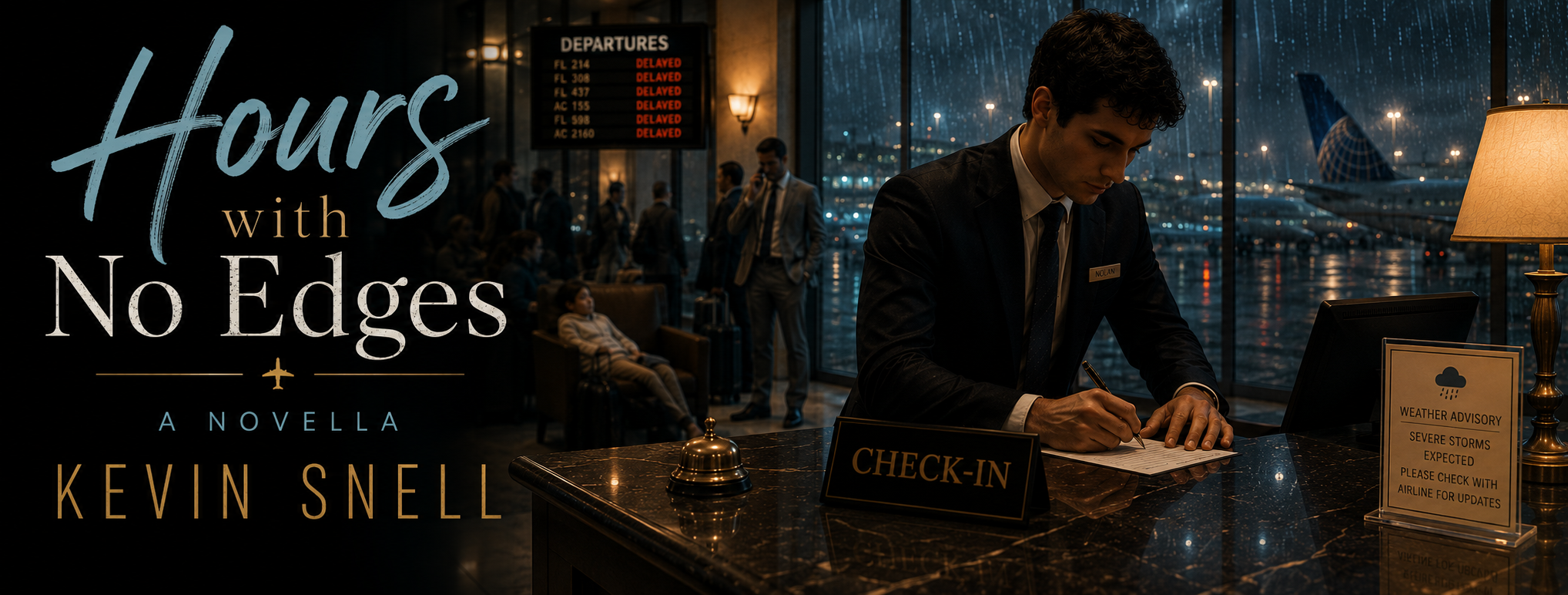
Part One — Check-In
The lobby held more people than chairs, and most of them had stopped pretending to be patient.
A family had colonized the seating by the window, suitcases standing guard around a kid asleep across two armchairs. By the elevators a man in a wrinkled suit walked a six-foot rectangle, phone to his ear, repeating a flight number to someone who could do nothing about it. The departures board in the corner had frozen on a screen of red. Rain came at the glass sideways, and past it the runway lights smeared into long wet streaks that meant nothing was leaving tonight, and nothing was coming in that wasn’t already late. Out past the glass, a few aircraft sat where they’d been parked hours ago, lit and going nowhere. An airport at a full stop has a quiet all its own, and the lobby had filled with the people that quiet had stranded.
Nolan worked the desk the way he worked every bad night—one thing, then the next thing, then the thing after that. He’d stopped looking at the clock around midnight. The clock didn’t help. The line helped, when it moved.
It wasn’t moving.
The card reader had died at 11:40, which was its own catastrophe, because the manual process took three times as long and the people in line could watch exactly how long it took. He keyed a confirmation number by hand. He slid a paper form across the counter. He said, “Sign at the bottom, please,” and the woman signed at the top, and he turned the page around and put one finger where the line was, and she sighed as though he had built the storm himself.
The phone rang. It was the shuttle driver, who wanted to know why three guests were standing at the terminal expecting a pickup that no one had told him about. Nolan told him. The driver said something about the loop and the rain and hung up. Nolan wrote shuttle—:30 on the pad by the phone so he wouldn’t forget to send the next ones the right way, and turned back to the form, and the woman was gone, the form unsigned. He set it on the stack of other things that would have to wait for daylight and a person who got paid more than he did.
A woman set her bag on the counter and told him, before she gave her name, that the last time she’d stayed here the wake-up call never came and she’d missed a flight to a funeral. Nolan hadn’t worked that morning. He opened his mouth to say so, heard how it would sound, and closed it. He didn’t tell her the system dropped calls on its own, that he’d logged the fault twice and watched the ticket sink into whatever place those tickets went to die. He took her name and wrote it on the pad, under the shuttle note. The day manager would follow up, he said. She didn’t believe him, and she was right not to.
The man behind her wanted a low floor, away from the elevator, and a late checkout, and he wanted all of it fast. Nolan started to say that late checkout depended on—
“On availability, sure.” The man finished it for him, jumping the gap because the gap made him uncomfortable, not Nolan. He’d guessed wrong. It depended on the morning crew, and the rooms were spoken for tomorrow either way. Nolan let the wrong version stand. Correcting it would cost two more sentences and another pause, and the man had already decided what the answer was. Nolan gave him the low floor and no promise on the checkout. The man left satisfied with a thing that wasn’t true, which was the cheapest way through most nights.
A man near the front leaned over the counter, close enough that Nolan could smell the airport on him, recycled air and someone else’s cologne. “How many rooms do you actually have?”
“We’re—” The word caught. He felt it catch, the way you feel a stair that isn’t there, the foot already committed to the drop. He breathed through the bottom of it. “We’re full. The board outside lists other—”
“So you don’t have rooms.”
“Other properties on the—”
“You said you’re full.” The man had an audience now, three or four people behind him, and he could feel them, and that made him louder. “So which is it.”
Nolan set both hands flat on the counter. The pause opened and he stood inside it. He knew what it looked like from the other side—a guy who didn’t know his own job, stalling—and he let it look like that, because the alternative, the visible struggle, the face people made while they decided whether to feel sorry for you, was worse.
“Both,” he said, when the word came loose. “We’re full. There are rooms across the loop. I can call the shuttle.”
The man took the printed list and walked off without thanking him, which was its own kind of relief. The next three were easier. A delayed crew from a regional carrier, checking in tired and grateful and asking for nothing. A honeymoon couple rerouted from somewhere warm, too in love to be angry yet. A woman who only wanted to know if the bar was open, and who took it well when he told her it had closed at eleven, because by now she’d expected the answer to be no.
This was the part of the night Nolan was good at. Not the rush. The thinning. When the lobby emptied down to the people who’d accepted they weren’t going anywhere, the building got quiet in a way that suited him. Fewer faces meant fewer faces doing the math. He could work. He could let the silences sit where they fell.
He’d put in for the day-manager job in the spring. Better hours, a schedule that touched the rest of the world, a way out of a life that happened while everyone he knew slept. He wanted it. He also knew what the lobby looked like at two in the afternoon, full of people who expected to be talked to, who watched your mouth while they waited for the back half of a sentence. He didn’t look too hard at the part of him that was relieved the job hadn’t come through yet.
By one the lobby had thinned to the stubborn and the stranded. The pacing man had given up and folded himself into a chair. The family by the window had gone still, the parents trading the watch in shifts. The coffee station against the far wall held two carafes, one empty, one that had cooked down to the taste of the inside of a thermos. Nolan refilled the empty one anyway. People didn’t drink it for the taste. They drank it to have something to do with their hands at one in the morning in a place they hadn’t planned to be.
The doors opened on a gust of wet air and a man in a pilot’s uniform.
He came in shaking rain off the shoulders of his jacket, rolling a black crew bag that had crossed a lot of floors. Four stripes on the cuff. His eyes went around the room once—the suitcases, the sleeping kid, the line that wasn’t a line anymore—and something moved behind his face and resolved, a recalculation done so many times it barely surfaced. Then he crossed to the counter and got in behind the last person and waited his turn. Most crew didn’t. Most came to the desk expecting the block held and the line to part, because they’d been on their feet longer than anyone and the uniform usually bought them that much. This one stood behind a man in a bathrobe and waited, four stripes and all.
When he reached the desk he set both forearms on it. Not leaning, exactly. More like a man putting down something he’d been carrying a long way.
“Hi,” he said. “Keats. There should be a crew block.”
Nolan pulled it up. “Simon Keats.”
“That’s me.”
The block was three rooms. Two had already keyed out to the rest of the flight deck and the cabin crew, who’d come through an hour before, louder, doing the joking that crews do when the day has beaten them. He took the last room.
“Long day,” Simon said. Not a question. The kind of thing a person says to fill the gap while paperwork happens, and he said it easily, the way he’d probably said it across two hundred seatbacks that afternoon.
“Mm.”
“We were supposed to be in at nine. Diverted to—” he named a city two states off “—sat on the ground three hours, came back, and they canceled us anyway.” He smiled. A good smile, warm and aimed an inch over Nolan’s shoulder, the smile of a man who’d learned to make being looked at comfortable for everyone but himself. “So. Here I am.”
Nolan slid the form across. “Sign at the bottom.”
Simon signed at the bottom. First one all night.
“Room’s on four,” Nolan said. “Elevator’s—” The block came again, softer, on the s, the sound just gone, the place where it lived empty. He waited it out. He didn’t look up. People did the math while you waited; he could feel them deciding what you were. “—around the corner.”
Simon hadn’t done the math. He’d kept his eyes on the form and let the word take the time it took. “Thanks,” he said, when it arrived. As though nothing had happened. Because, his whole manner said, nothing had.
Nobody waited. That was the thing about the block—people would do almost anything to fill the silence except leave it alone. This one left it alone.
“Wake-up call?” Nolan asked.
“Please. Five-fifteen.”
There it was. Please, at half past one in the morning, eighteen hours into a day that had ended in a canceled flight and a hotel he hadn’t booked. Most people stopped saying please around hour twelve. This one hadn’t.
Nolan keyed the wake-up into the system. Then he took the pad by the phone and wrote it again by hand—KEATS, 415, 5:15—and underlined the time. The system had dropped two wake-ups that week and killed the card reader for an encore, and he wasn’t going to hand it a man who had to be back at the airport by six. Not after the woman with the funeral.
Simon watched the pen move. “You don’t trust the computer.”
“No.”
“Good.” He picked up the key card, and the smile came back as he did it—except this one came back crooked, just the one corner, and it landed on Nolan instead of going over his shoulder. “Neither do I.”
It was the first thing he’d said all night that wasn’t built to put a stranger at ease. He read the name tag then, last item on the checklist. “Greer.” He tried it once. “Thanks, Greer.”
He rolled the crew bag toward the elevators, slowed, and took the stairs instead.
Nolan set the pad back beside the phone, time underlined, and turned to the family by the window, who were finally giving up on the airport and wanting a room. He found them one. The next shuttle went the right way around the loop. He did the next thing, and the thing after that.
The rush was over. What was left was the long flat middle of the shift, the hours with no edges, when the building belonged to the people who couldn’t leave it and the one man behind the desk who wasn’t supposed to want anything from any of them.
But the name stayed past the point a name should. Keats. Four-fifteen. Five-fifteen. He’d remember the wake-up call without the pad, and he knew it, and he didn’t let himself ask why.
Part Two — The Second Delay
Two weeks went by before the weather turned again, and this time it found the hotel nearly empty.
No convention had booked the block. No regional carrier had dumped a grounded flight at the door. The storm was the same storm—the same sideways rain, the same runway lights bleeding into the glass—but the lobby under it held only the night and the things that lived in the night—the hum of the cooler behind the desk, the coffee station ticking as it cooled, the carpet running off toward the elevators in a green nobody had chosen on purpose. Nolan had the place to himself, the way he liked it. He’d worked the audit down to nothing by two, and now he was doing the thing he did in the dead hours, which was read.
The paperback lived in his lap below the lip of the counter, where a guest coming through the doors wouldn’t see it. It was a western, the spine cracked white, bought for a quarter from a bin at a shop that no longer existed. He wasn’t ashamed of it, exactly. He just didn’t want the conversation. People saw a man reading and felt they had permission to ask what, and then to have opinions, and the whole transaction cost more than the page was worth.
The doors opened on wet air.
He had the book under the counter before he looked up. It was reflex by now, faster than thought, the same motion every time. Then he looked up, and it was the pilot.
Simon Keats, out of the rain again, the black crew bag rolling behind him, four stripes dark with damp at the cuff. Two weeks had put more wear in him—or maybe the day had; there was always a day. He crossed the empty lobby with no one ahead of him to wait behind, and that changed nothing about the way he walked, unhurried, a man with nowhere he could be that was better than here, which tonight happened to be true.
“Greer,” he said, before Nolan said anything at all.
So he remembered. Nolan had spent two weeks not deciding whether he would. He’d carried the name around for that whole stretch, a stone in a coat pocket, taking it out when the floor went quiet, turning it over, putting it back. Keats. And here was the man it belonged to, saying Greer like it was worth keeping track of.
“Mr. Keats.” He kept it at the counter, where his voice was steadier. He’d had two weeks to build a version of this where the pilot came back spent, impatient, the charm worn through to whatever was under it—because that was the pattern. People were patient on the first night and shorter on the second, and by the third they finished your sentences and called it helping. He’d half-expected to dislike the man tonight. It would have been easier.
Simon set his forearms on the counter, the old gesture, putting something down. “We were almost in,” he said. “Holding pattern for forty minutes, then they sent us back out to the alternate, then the alternate timed out, and here we are.” He said it lightly, the way he said everything, but there was sand in his voice, the bottom of a long day. “Your weather has terrible manners.”
The block tonight was a single room; the rest of the crew had gone to a property closer to the field. Nolan pulled it up and started the paperwork, and the screen turned, and Simon watched it turn and said, “I’m going to have to start getting my mail here.”
It was a joke, and a true thing under the joke—the man had no address that meant anything, and he’d just named it out loud and made it sound like banter. Nolan felt the corner of his own mouth want to go, and he didn’t let it. Letting it go would mean something. He kept his face at the counter.
But Simon had seen it, the almost. The polished smile dropped off, and the other one came up in its place, the crooked one, one corner, aimed across the desk and not over Nolan’s shoulder. He’d seen the almost-smile and answered it with the real one. That was a kind of patience too—the kind that waited for the thing you weren’t going to give, and didn’t push.
“Be honest with me,” Simon said. “The coffee. Is it as bad as I remember, or did I dream that?”
Here was a pause Nolan could choose. Not the other kind—not the word that caught and emptied out, the stair that wasn’t there. This one had no catch in it. This was him standing at an open door, deciding whether to walk through, whether to be, for one sentence, a person who was funny on purpose with a guest at three in the morning instead of a man behind a counter who gave correct answers.
He walked through it.
“Worse,” he said.
Simon laughed—not the polished laugh he gave passengers, a shorter, realer sound—and the lobby got warmer by a degree it didn’t have a number for.
Nolan turned the form around. “Sign at the—” The word went. Right there, mid-sentence, no warning, the way it came when he’d let his guard down and the muscle forgot to brace. The bottom of the word stayed empty. This was the other pause, the one that happened to him, and the difference between this and the last one was the whole difference—the one he could feel from the inside and assumed nobody could feel from the outside.
Simon waited, eyes on the form, the pen already in his hand. He didn’t finish it. He didn’t say bottom to be helpful, didn’t fill the silence to spare them both, didn’t do the thing nearly everyone did, which was treat the gap as a problem that belonged to them.
“—bottom,” Nolan said, when it came.
“Bottom,” Simon agreed, and signed there.
This was the thing Nolan turned over later, in the flat hours after the pilot went up—that Simon had treated the two pauses exactly the same. The one Nolan chose and the one that chose him—same patience, same waiting, no difference made between them. As though it didn’t matter which kind it was. As though the time was Nolan’s to take either way, and Simon was only ever going to give it to him.
He didn’t have anywhere to put that, so he put it nowhere.
“Room’s on three this time,” he said. “Wake-up?”
“No wake-up. First decent shot at sleep I’ve had in a week, if I can take it.” Simon picked up the key card. “Don’t write me down. Let me find out if the bed’s any good without a phone yelling at me at five.”
“It’s the same bed as every room.”
“Then let me have the illusion.” He hooked the crew bag and—Nolan was watching for it now, which was its own admission—turned toward the stairwell instead of the elevators. Three floors, after a day on his feet. It went onto the short list of things Nolan didn’t understand about him, and he left it there.
Simon came back down a little after four.
Nolan was at the coffee station with the cabinet open, restocking for the morning crew—the sleeves of cups, the tray of creamers that never needed refrigerating, the burned smell already back in the carafe though he’d made it fresh an hour before. He had his back to the lobby and the supply keys in his hand, and he knew it was Simon before he turned, because the footsteps came down the stairs and not out of the elevator, and because no one else was awake to be walking anywhere.
“Couldn’t sleep,” Simon said. “Turns out the illusion only goes so far.”
Without the counter between them it was a different geometry. Nolan didn’t have the paperwork to look at, the screen to turn, the form to point at. He had a sleeve of paper cups in one hand and a man four feet away in a t-shirt and the uniform trousers, off duty and creased, and without the jacket and the stripes he was just somebody’s tired brother who couldn’t sleep.
“Coffee’s fresh,” Nolan said. “Which doesn’t help it.”
“I drink it for the warmth. There’s no flavor to ruin.” Simon poured a cup anyway, in the half-dark of the closed station, and drank it leaning against the wall where the lobby light didn’t quite reach.
They talked the way you talk in those hours, which is sideways, in pieces, nothing leading anywhere on purpose. Simon’s schedule, which was less a schedule than a list of cities he’d be briefly inside of. Nolan’s nights, the upside-down of them, sleeping through the daylight other people lived in. The carpet—Simon had a theory that every airport-adjacent building in the country bought the same roll from the same warehouse, the green-and-rust nothing pattern, because it hid stains and refused to be remembered, and a place built to be forgotten needed a floor that helped. Nolan said that was the most thought anyone had ever given that carpet. Simon said he had a lot of hours in buildings like this and not much to do with them.
“You don’t sleep.” Nolan said it flat, not asking.
Simon tipped the cup. “Not in these. Different bed every night, and your body stops believing in any of them.” He looked at Nolan over the rim. “You?”
“I sleep when everyone else is awake. So—no. Not really.” It came out without a catch, and he let it.
It was easy. That was the dangerous part. The block barely came, and when it came Simon waited, and the waiting had stopped being remarkable, which was its own kind of remarkable. Nolan heard himself saying more than he said to anyone, three and four sentences at a stretch, because the man across the dark station wasn’t doing the math, had never once done the math, and a person stops bracing when no one’s swinging.
Simon turned the empty cup in his hands. “It’s strange,” he said. “You spend half your life in places like this and you never know anybody in them. The whole point is that you don’t. You check in, you check out, nobody learns your name.” He looked at the dark lobby, the frozen board, the runway lights past the glass still doing their slow useless blink. “No one stays here long.”
“That’s the point,” Nolan said.
It came out flat, automatic, the thing he’d have said to anyone—and then it was in the air and he heard it the way Simon would hear it, and it wasn’t a line about the hotel anymore. It was a line about him. About the life he’d built where nobody stayed long because staying was where the cost lived. He’d handed it over without meaning to, the truest thing he’d said all night dressed up as a shrug.
He didn’t take it back. Taking it back would have meant explaining, and explaining would have meant the block, and anyway it was true. He let it stand in the dark the way he’d let the wrong checkout answer stand for the man two weeks before—except that had been to get rid of someone, and this was the opposite, and he didn’t have a word for the opposite, or wouldn’t let himself reach for one.
Simon didn’t fill the silence. He set the cup down on the station, careful, as though he didn’t want the sound of it landing on top of what Nolan had said.
“Yeah,” he said finally, and nothing else.
Then he pushed off the wall and said goodnight and took the stairs back up—three floors, again, the long way—and left Nolan alone with the open cabinet and the cups and the smell of coffee no one would drink for hours.
He finished the restock and locked the cabinet. Back at the desk he took the western out from under the counter, found he’d lost his page, didn’t mind, and read until the windows started going gray.
Part Three — Familiar Strangers
By the third month Nolan knew the airline’s inbound list the way he knew his own register, and when Simon’s crew showed on it he held a room before anyone asked him to.
It was a thing he did without deciding to do it. The block came through the system, the same flight code, and his hand was on the keyboard pulling a room on the far side—away from the ice machine, away from the elevator bank, the quiet side, where the runway light came in clean and the hall stayed empty after midnight—before the rest of him had worked out why. He told himself it was efficiency. The quiet side was where you put guests who’d had bad days, and Simon’s days were bad by definition; he only ever came here when something had gone wrong in the sky. That was true, and it was also not the whole of it, and Nolan kept the part that wasn’t to himself.
When Simon came in they didn’t do the whole thing anymore. He didn’t announce the crew block; Nolan already had it up. Nolan didn’t ask for the wake-up; he slid the pad across and Simon wrote the time himself, in the pilot’s flat all-caps, and underlined it, because somewhere in there it had become a joke between them that the system couldn’t be trusted and the pad could. There was an order of operations now. They’d worn a groove in it. The whole exchange ran shorter every time, not because there was less to say but because more of it had stopped needing saying.
“You always take the stairs,” Nolan said, one of those nights.
He said it to the form, not to Simon, the way you say a thing you’re not sure you’re allowed to ask. It wasn’t a question. It had a question in it. They’d both gotten good, by now, at hearing the question folded inside the flat sentence—it was how Simon had said long day on the first night, how Nolan said most things—and Simon heard it.
He was quiet a second. Then he said, “I’m strapped in a box for ten, twelve hours. Same seat, same six feet, can’t get up, can’t walk it off. By the time I’m on the ground the last thing I want is to get into another box that closes its doors on me.” He said it plainly, no performance over the top of it, no charm laid down first. “On the stairs I’m moving. Nobody’s shutting me in. It’s stupid.”
“It’s not stupid.”
“It’s a little stupid.” But the crooked smile came up when he said it, the real one, and it took the sting out of having told the truth.
Nolan thought about that for as long as it took to finish the form. Then he reached under the counter and took out the western and set it on the desk between them, face up, the cracked spine showing, the quarter-bin price still penciled inside the cover. He didn’t say anything about it. He didn’t have a flat sentence ready that would carry the weight, and he wasn’t going to block his way through building one in front of him. He just put it where Simon could see it, the thing he hid from every other guest who came through those doors, and let that be the trade.
Simon looked at the book. He didn’t pick it up. He understood the arithmetic of it—one secret laid down for one secret, his in words because words were what he had, Nolan’s on the desk because that cost him less than saying it would.
“Any good?” he asked. He didn’t ask what it was, or why a grown man hid a paperback under a desk from strangers. He asked if it was any good.
“It’s terrible,” Nolan said. “I’ve read it four times.”
That got the real laugh, the short one.
After that the weeks ran together the way the good ones do, which is to say they stopped keeping their edges. Simon came when the weather sent him, and sometimes when it didn’t quite—a delay another pilot might have pushed through. Not every week. Often enough that Nolan started leaving a gap in his own night where the man fit, and hating the gap on the weeks it stayed empty.
He talked more. That was the thing he’d have denied if anyone put it to him, but it was true. Across the dark coffee station, in the slack hours, he ran three and four and five sentences together, and the blocks came less, because the blocks came worst when he was watched, and Simon had a way of not watching that was its own kind of attention.
One night—he couldn’t have said how it started—he told Simon about the apartment. That he’d lived in it two years and still had boxes stacked against the wall of the second bedroom, taped shut, the marker labels gone soft. That he kept meaning to. That a man could get used to stepping around a stack of his own things until the stack stopped looking like a problem and started looking like furniture. It came out in pieces, a block in the middle of it where the word for the room wouldn’t come and he had to go the long way around it, and Simon waited, and Nolan kept going—which was the part that surprised him after, that he’d kept going, that he’d let the sentence cost what it cost and finished it anyway instead of folding it down to the short safe version. Simon didn’t tell him to unpack the boxes. He didn’t say it was sad, or fixable, or anything at all about what it might mean. He said he’d lived out of a roller bag for nine years, and the difference between them was that Nolan at least owned the boxes. Nolan said owning them wasn’t the same as opening them. Simon said no, but it was a start, and let it go.
One night Simon set a paper cup on the counter, a real one, the logo of the decent place out past security, the coffee in it still hot. “They gave me two by mistake,” he said, which was a lie, and a bad one, because nobody at that counter gave anybody two by mistake and they both knew it. Nolan took it and drank it and thanked him for the extra, and let the lie stand the way he’d once let a stranger walk off sure of a checkout he wasn’t getting—except that had been to make a man go away, and this was a man bringing him something warm and pretending he hadn’t. There was a whole vocabulary built out of letting the wrong thing stand. Some of it was how you got rid of people. Some of it was how you kept them.
There were good nights in there too—nights with no weather in them at all, when Simon came through on an ordinary overnight and could have stayed anywhere and stayed here. Those were the ones Nolan didn’t know what to do with. The bad nights had a shape—a man came in wrecked, and you helped, and helping was a thing Nolan understood. The good nights asked nothing of him, and that was harder.
On one of them Simon came down a little after three and they ended up at the dark station, and for a while there were words. Simon told a story about a passenger who’d spent a whole boarding trying to force the lavatory door that said push, and Nolan told him the worst complaint he’d ever logged at the desk—a man genuinely furious that the hotel could do nothing about the noise of the planes, at the airport, where he had chosen to sleep. Simon laughed the real laugh, the short one, twice. Then the words ran out, the way they do, and neither of them reached for more.
The coffee went cold in both their cups. The runway lights did their slow blink past the glass. Somewhere upstairs the ice machine dropped a load and went still again. And the silence between them wasn’t the kind Nolan defended, or the kind he chose, or the kind that happened to him and cost him—it was a fourth kind he had no name for, a silence with two people in it, a thing you could sit inside instead of behind. He’d spent his whole life making silence into a wall. He hadn’t known you could make it into a room.
That scared him more than the bad nights did. A man came to expect the bad nights; they were the job. But a man could build a life on the good ones, and Nolan had spent two years being careful not to build anything—two years of taped boxes against a wall—and here he was, off the clock inside his own head, furnishing a room he had no lease on.
The world started to see it before either of them said it.
A crew came through one night ahead of Simon, loud the way crews are when the day is finally over, and one of them—a younger guy, first officer’s stripes, the kind who hadn’t yet learned which jokes to keep—looked at the room assignment and grinned. “Quiet side again. Keats gets the suite.” Then, across the lobby, lobbing it back toward Simon coming through the doors. “Cap, your hotel boyfriend’s holding your room.”
Simon laughed. The polished one—the laugh he gave passengers, aimed an inch over everybody’s head, warm and weightless and meaning nothing. He had it out and working before the kid finished the sentence.
But Nolan knew the two smiles by now the way Simon knew the two pauses, and under the polished laugh something went wrong in Simon’s face for the length of a blink. Not anger. Not even embarrassment. Something closer to a man stepping on a stair that wasn’t there. Then it was gone, smoothed flat, the captain’s easy hand back on the room. The kid never saw it; the kid wasn’t watching for it. Nolan was, and he wished he hadn’t been, because now he knew the joke had landed somewhere true, and he couldn’t tell whether the true place was that Simon hated the idea or that Simon couldn’t let himself have it.
The day manager said it too, in his own register, at the seven o’clock handoff when the lobby was going bright and ugly with morning. He came around the desk with his coffee and his lanyard, looked at the inbound notes, and said, mild as anything, “Your pilot’s becoming a regular.”
“He’s not my pilot.”
“Didn’t say he was yours.” The day manager smiled into his cup. “You did.”
Nolan logged out of the register harder than he needed to. He gave the man nothing else, which was the wrong amount of nothing—too much of it, a guilty quantity—and they both heard that too. He drove home in the daylight and didn’t sleep, and lay in the half-moved-in apartment looking at the ceiling, and the gap in the night had followed him home.
The bad night came in the fourth month.
There’d been weather across the whole region since the early evening, the real kind—a front the forecasters had named, cells stacking the whole corridor, the arrivals board going from delays to a column of red. Nolan worked a full lobby again, the way he had the first night—the same stranded families, the same dead card reader, the same people taking the storm out on the man behind the desk. But this time he was running two jobs. He worked the floor, and underneath it, in a part of himself he didn’t approve of, he watched one flight code.
It came up delayed. That meant nothing; everything was delayed. It went to diverted, and he found the alternate field on the map without meaning to, and worked out the drive back from it, and hated that he knew the drive. For most of an hour the code showed nothing at all—not delayed, not diverted, a line that had simply stopped updating—and Nolan checked it between guests, and checked it again, and the not-knowing sat in him, a thing swallowed wrong. He was no one to this flight. He had no standing to be afraid. He was afraid anyway, and the fear put his hands a half-second too fast on the keys, and the block came hard with the guests, because fear was its own kind of being watched—watched from the inside.
Then the code moved. It landed, very late, but it landed.
When Simon came through the doors, Nolan knew before the man reached the counter that something had gone wrong up there, because the polish was still on and there was nothing behind it. That was the tell. Simon’s whole working life was the polish—the calm voice, the steady hand, the smile that told two hundred strangers the man at the front of the airplane was not afraid, because if he was afraid they would know it, and his job, his actual job under all the other jobs, was to be the one who wasn’t. He was good at it. He was good at it now, crossing the lobby, nodding to the desk, the captain’s face still bolted on. But it was running on nothing. He’d spent all of it on the airplane. He’d been the calm one for everybody who needed a calm one, the whole way down through the weather, and he’d walked off the jetway and through the terminal and onto the shuttle and into this lobby still wearing it, because he didn’t have another face to put on, and there was no one left who needed this one, and he didn’t know how to take it off by himself.
He set his forearms on the counter, the old gesture, except tonight he wasn’t putting something down with it. Tonight it was the only thing holding him up, and he leaned into it without seeming to know he was.
Nolan didn’t ask if he was all right. The question was useless; it asked a man to perform an answer, and performing was the whole problem. He didn’t say anything at all.
He took the ring of keys from the drawer—the supply keys, the cabinet keys, and the one for the breakfast room that the morning staff wouldn’t unlock for another three hours—and came out from behind the counter, which he never did, which broke every line of the job that kept him safe, and crossed the lobby, and unlocked the dark breakfast room, and held the door.
Simon looked at the open door. Then at Nolan. The captain’s face was still on, but it was coming apart at the edges now, and for once he wasn’t doing anything to hold it together.
He went in.
Nolan held the door, and the dark room took them both, and neither of them had said a word.
Part Four — The Breakfast Room
The breakfast room had no good light in it.
Nolan hit one bank of switches and left the rest. The fluorescents along the far wall buzzed up to a flat institutional white that turned everyone the color of a bad night’s sleep, and he didn’t touch the other bank, the one over the tables, because the half of the room they needed didn’t have to be lit like a place where things got decided. The chairs were up on the tables for the morning mop, legs in the air. The juice machine ticked in the dark. The whole space smelled of industrial cleaner and the ghost of yesterday’s coffee, and there was nothing romantic in any of it, which was the only reason it could hold what it was about to.
He took two chairs down off a table by the window and set them at right angles, not across from each other—across would have been an interview—and sat in one, and after a second Simon sat in the other.
Out past the door the lobby had finally emptied to the stranded sleepers, and the entrance would chime if anyone came; he would hear it. For now there was no one. There was this room, and the bad light, and the two of them in it.
In the lobby Simon had still been mostly upright, the captain’s posture doing its work even with nothing behind it. Sitting down undid him by degrees. Under the fluorescents the wear came up in his face that the polish had covered—gray at the temples damp with old sweat, a muscle ticking in his jaw, a stillness that came from the bottom of the tank. He’d spent every reserve he kept for other people. He had nothing left over for looking fine, and for once he didn’t try. That was new. Four months Nolan had watched him manage his own face for an audience of one tired night clerk, and now he’d stopped, and the stopping was the most naked thing about him—more than anything he was about to say.
Nolan didn’t ask him anything. He’d learned the lesson the man had taught him across four months without either of them naming it as a lesson—that the kindest thing you could do with a silence was leave it open and not climb into it. So he sat in the bad light with his hands on his knees and left the silence open and waited, the way Simon had waited through a hundred of his blocks, and didn’t make the struggle in the other chair into a problem that belonged to Nolan.
The runway lights kept going past the window, slow, out past the parked aircraft, doing the one thing they knew to do whether anyone was leaving or not.
“We lost the approach twice,” Simon said, finally.
He said it to the window, not to Nolan.
“First time, windshear alert on short final, we went around—that’s normal, that’s the system working, you go around and come back. Second time was worse. We were configured, we were on it, and the airplane just—” His hand moved, a flat thing tipping. “It stopped doing what the numbers said it should. Eighteen years, and I have never—” He stopped. Started again, lower. “I flew it out. That’s the job. You fly it out. I put us on the ground on the third try with the fuel where I never want to see it again, and I taxied in, and I shut it down, and everybody clapped.”
He said the last word like it didn’t fit in his mouth.
“They clapped. Two hundred people clapping because the man up front sounded calm. And the whole time—”
This was the part he hadn’t said to anyone. You could hear it in the place where the flat account ran out of facts, where there was nothing left underneath the facts but the thing itself.
“The whole time, I was as scared as anybody on that airplane. More. They didn’t know what they were looking at. I did. I knew exactly how thin it was.” He turned from the window. The captain’s face wasn’t on anymore; there was just a tired man in a creased uniform under a bad light. “That’s the part nobody tells you. Everybody thinks the guy in front isn’t scared. The guy in front is the only one who isn’t allowed to be. A hundred and ninety people back there got to scream, and one flight attendant cried after, and every one of them got to feel it the whole way through, because feeling it was allowed for them. And I had to pick up the handset and say, in the voice—you know the voice—folks, sorry about that, bit of weather, we’ll have you on the ground shortly. While my hands—”
He held one out, over the table, into the light. It was steady. He looked at it like it had betrayed him by being steady.
“Eighteen years of training so the scared part of me can’t reach the part of me that flies the airplane. And it works. That’s the horror of it. It works. I can be that frightened and you’d never know, nobody would ever know, and the better I get at it the less anybody can tell there’s a man in here at all.” He put the hand down. “I don’t know who I am when nobody needs me to be calm. I’ve been doing the voice so long I think it might be the only one I’ve got left.”
He stopped. The admission sat on the table between them, something he’d coughed up and couldn’t take back, and his shoulders came down off the captain’s frame, as if the uniform had been holding them up by itself. He looked, for a second, ready to apologize for it—for the size of it, for having put it in the room—and Nolan watched him gather himself to do the thing people do after they’ve shown you too much, which is to laugh it off, undercut it, hand you a clean way to pretend it never happened.
Nolan didn’t give him the opening. He didn’t tell him he was safe now. He didn’t say you did great, or it’s over, or any of the things that would have handed Simon back the job of making someone else comfortable. He let it sit. That was the whole of what he had worth giving, and it was the thing Simon had given him a hundred times across a desk—a silence with no rush in it, a silence that didn’t ask the man inside it to hurry up and be all right.
The juice machine ticked. The fluorescents buzzed. After a while—and the while was the point—Nolan put down next to it the truest thing he had that was the right size.
“I like the night shift because nobody expects me to talk.”
It wasn’t the whole of it, but it was a door into the whole of it, and Simon turned to listen, no clock running.
“At night it’s systems. Names and room numbers. Wake-up calls. Nobody needs me to be—” The block came. Not the chosen pause; the other one, the word gone, the empty place behind it where it should have been. He didn’t fold the sentence down to the short version. He’d watched Simon hold a hand he was ashamed of out over a table and tell the truth into bad light, and the least he could do was not run from a word. So he stayed in the block, in front of someone, on purpose, which he never did, and let it take what it took. Simon waited. Of course Simon waited.
“—charming,” Nolan said, when it let go. “Daytime people want you charming. They want the conversation to go a certain way, on time. And when it doesn’t—when I—” Another catch, shorter. “—they get impatient. They finish it for you. They look at your mouth while you fight it. And you can feel them deciding what you are.”
He’d never said that to anyone. The bad light made it easier, the way the dark station had, because there was something about being seen badly that let you be seen at all.
“I put in for days,” he said. “Day manager. Better hours. A life that lines up with everyone else’s.” He looked at his own hands now, the way Simon had looked at his. “And every time it gets close, I find a reason it’s fine that it didn’t come through. Because days mean people. Days mean being watched while I do this.” The block hovered; he went around it. “And because if I work days and come home at six like a normal person, I’ll have all that time, and there’s nothing in it. I’ve got an apartment with boxes I haven’t opened in two years. The night hides that the same way it hides everything else. Nobody’s around to see there isn’t much of a life here. Including me.”
Simon didn’t say it wasn’t true.
That was the thing Nolan would turn over after. The lobby Simon, the captain, would have reached for the reassurance, because reassurance was his first language—he’d have said you’ve got more of a life than you think, or the boxes don’t mean anything, and it would have been kind, and it would have been the voice. The handset voice. The thing he did to make a frightened person feel better. He didn’t do it. He let Nolan’s thing sit in the room next to his own, the two of them ugly under the fluorescents, unfixed.
“We’re the same animal,” Simon said. “You built a life where nobody waits for you to finish. I built one where I’m gone before anybody can ask me to stay. You hold still, I keep moving, and we both end up in the same empty room at four in the morning.”
He turned the steady hand over and looked at the back of it. “You want the real reason I’m always already leaving? It isn’t the schedule. The schedule’s a good excuse—nobody questions a pilot who has to go. The reason is that if I stopped, if I stayed somewhere long enough that staying was the thing I did, I’d find out whether anyone actually wanted me there. And as long as I’m leaving, I never have to find out. I get to keep the version where they would have. You can’t be turned down for something you left before anyone could offer it.” The captain’s reflex tried to lay a gloss over the top of it, a half-smile, and the gloss wouldn’t take. “Moving isn’t freedom. I worked that out somewhere over the middle of the country about a year ago. Moving’s just the longest way there is to not get an answer.”
“This isn’t an empty room.”
It came out before Nolan could decide whether to let it, and it was the most exposed thing he’d said all night—more than the boxes, more than the block—because the boxes were about the past and this was about right now, about the two chairs and the bad light and the man in the other one.
It was also, though he hadn’t built it to be, an answer to the thing Simon had just said—someone in a room telling him it wasn’t empty, telling him he could stop now and find out, and that the finding-out wouldn’t be the thing he’d spent a year flying away from. Nolan hadn’t meant to offer that much. He’d only meant that it was true.
Simon looked at him a moment. Then he reached across the corner of space between their chairs—not for Nolan’s hand, which would have been a question with only one right answer, a thing that demanded a yes—but for the cuff of Nolan’s sleeve, the edge of it, two fingers on the fabric at his wrist, where it meant I’m here and meant are you and left every door open. It left Nolan all the room in the world to move his arm two inches and end it and have it cost nothing.
Nolan didn’t move his arm.
He could feel the warmth of two fingertips through the cotton, which should not have been enough to feel and was. His pulse was going where the fabric met the edge of Simon’s hand, and Simon could feel it there—the give-away under the cuff—and Nolan let him. He’d spent his whole life making sure nobody could feel his pulse. He let this one feel it.
That was all. Two fingers on a shirt cuff in a closed breakfast room, and a man choosing not to pull away, and between those two facts the entire thing they hadn’t said. Neither of them looked at it. Looking at it would have made it have to be something with a name, and it wasn’t ready for a name, and they both knew enough about temporary things to let this one stay unnamed a while longer.
They sat like that, more or less, until the window started to go gray.
There was more talk and less of it mattered than the quiet did; the night had already given up its one real thing, and the rest was the two of them not wanting to be the one who stood first. But dawn came the way dawn comes, indifferent, and Simon’s duty day won out over the man in the chair. He stood. He put the chairs back up on the table, both of them, without thinking about it—he left every place the way he found it.
“I should try to sleep,” he said, and didn’t move toward the door.
“You should.”
He went, finally. Nolan walked back out to the desk because that was where he belonged, and watched Simon cross the lobby toward the stairwell—the long way, three floors, because of the box, because of everything—and the lobby was the same lobby it had been at eleven the night before. The same frozen board. The same green nothing carpet. The same too-bright nobody-light.
It wasn’t the same. That was what put the cold in him. The room hadn’t changed and it felt entirely different because a particular man was walking across it, and that meant the difference wasn’t in the room. It was in Nolan. He’d let it get inside, where he couldn’t reach back in and take it out, and on the nights the man didn’t come the lobby was going to feel like this in reverse—different because of an absence, haunted by someone who was only ever passing through.
Simon reached the stairwell door and paused and looked back across the bright empty space at the man behind the desk, and lifted two fingers off the handle—the same two fingers, barely a wave—and went up.
Nolan stood at the desk in the coming daylight, more afraid than he’d been all night. Nobody had clapped. There was no voice to put on. And he had no idea at all who he was when he wanted something this much.
Part Five — The Missed Night
The storms came back the third week of the month, a whole line of them walking up the corridor the way they had the night Simon lost the approach, and Nolan was getting ready before he understood he was doing it.
He didn’t decide to. He pulled a room on the quiet side out of reflex when the airline’s block came through, the same reflex four months deep now, and he had it held and clean before the rest of him asked who it was for. He told himself it was good practice. He told himself a lot of things across that shift.
The crew came in close to one, loud and damp, the same airline on their bags, and Nolan’s eyes went down the list for the name and the name wasn’t on it. A first officer he half-recognized, two flight attendants, a captain who wasn’t Simon. He checked them in. He gave them rooms—not the quiet side; he kept that one held, which made no sense, which he did anyway—and he asked the first officer, in a voice he worked to keep level, whether the rest of the crew was still coming.
“This is us,” the kid said. “Why, we short a room?”
“No. You’re all set.”
So the airline was flying. The weather hadn’t grounded them; it had only rerouted the pieces, and Simon was a piece somewhere else tonight, in some other city, under some other roof, and there was no reason on earth that should land in Nolan’s chest the way it did.
He gave himself the speech. Simon was a guest. Guests were the entire point of the building; they arrived and they left, and the leaving wasn’t a wound, it was the floor plan. A hotel that kept its guests would be a prison or a home, and this was neither. He’d known the man four months across a desk in the middle of the night. That was not a thing you got to miss. There were rules about what you were allowed to miss, and a guest who’d touched your sleeve once did not clear the bar.
The speech didn’t work. It had never once worked on anything.
He checked the arrivals board between guests. He told himself he was checking it the way he checked everything, professionally, the night auditor keeping an eye on his inbound—and then he’d find the airline’s other flights and read down the diversions and reroutes for a tail number he wouldn’t have recognized anyway, and put the screen down, and pick it back up four minutes later. He hated the picking-back-up. It was the exact thing he’d promised himself he was too sensible to become.
Around three a man came to the desk to complain that his room smelled of smoke, and Nolan, distracted, embarrassed in a way the man couldn’t see and wouldn’t have cared about, blocked on the word non-smoking so badly that the man finished it for him and then said it back slow, the way you talk to someone you’ve decided isn’t quite all there. Nolan moved his room and apologized and took the charge off and felt the old heat come up the back of his neck, the heat of being caught doing the thing—except tonight the thing wasn’t really the block. The block was just where it came out. The thing underneath was that he was standing at a desk in the dead middle of the night aching over a man who hadn’t come, and the ache was leaking into his mouth and costing him words in front of strangers, and that was new, and he didn’t like what it meant.
The offer came at the handoff, in the daylight, which was its own joke.
The day manager brought it around the desk with his coffee like it was nothing, like it was good news, which it was. The trial had cleared upstairs. They wanted Nolan on days—a thirty-day run starting the next week, day-manager-in-training, the desk in daylight, the schedule that touched the rest of the world—better hours, more money, the path out he’d asked for in the spring, back when he still wanted it without complication, back when the night was a thing he was stuck in and not a thing that had started to hold the only good hours he had.
“This is what you’ve been after,” the day manager said, because it was, and because Nolan’s face wasn’t doing the thing a person’s face is supposed to do when it gets what it asked for.
“Yeah,” Nolan said. “Thank you. Yes.”
He said yes. That was the part he’d turn over later, driving home in the light he’d soon be working in. He said yes because there was no version of no he could explain. No came with a reason, and the reason had four stripes and took the stairs, and Nolan was not going to stand in a bright lobby at seven in the morning and tell his manager he couldn’t move to days because a pilot might come looking for him at night and not find him. You couldn’t say that. It wasn’t even sane. So he said yes to the life he’d wanted, at the exact moment it had quietly become a different life he wanted more, and the wanting he couldn’t name lost to the wanting he could.
The anger came later, at home, in the half-moved-in apartment with the boxes against the wall. Not at Simon—Simon had done nothing, Simon had flown a leg to a city the way a pilot does, Simon didn’t owe him a single delayed night. The anger was all his own, and it was clean and cold and it had a simple shape—he had spent two years and more building a life with no one in it, precisely so no one could do this to him, and it hadn’t worked. He’d left one door open a crack, across one desk, on the night shift, and a man who might never come back had reached through it and changed the shape of everything in front of Nolan, the day job included, and Nolan had let him, and you couldn’t take that back. You couldn’t un-want a thing once you’d let yourself want it. He lay on the bed in the gray morning light with his shoes still on, angry at himself in a tired, hopeless way, and didn’t sleep.
• • •
Simon was four states away, in a city he hadn’t picked, in a hotel that did everything right.
The bed was good. That was the first wrong thing about it. The linen was heavy and cool and the mattress held him the way the cheap ones never did, and the room was wide and dark and quiet—real quiet, the quiet that costs money, double glazing and a door that shut with the heavy sound of a vault. Down in the lobby a bar stayed open past one, a man in a vest who’d called him sir and meant nothing by it. A menu sat on the desk for food that would come to the door at any hour. The window gave him a city, lit up and going about itself, towers and a river and traffic crossing a bridge, instead of a flat black field with runway lights blinking at nothing.
It was, by every measure he’d spent his life using, a better place to be.
He lay in it and couldn’t sleep and missed an ugly lobby four states away with a coffee station that tasted of the inside of a thermos.
He’d built a whole life out of rooms like this one. That was the thing he wasn’t going to look at straight, lying there, though it stood in the corner of the room and watched him not look at it. It had all been frictionless and anonymous—a vest who called you sir, a door that sealed, nobody on the other side of any of it who needed a thing from you or knew your name. For thirty-five years that had been the prize. You moved, and the moving was clean, and no place got its hooks in you because no place was anything but a place. He had an apartment somewhere that was exactly this—handsome, neat, nobody’s, a set of rooms he passed through between the rooms he passed through. He’d liked it. He’d told himself he liked it for so long that the telling had worn the same groove the truth wears, and you couldn’t feel the difference under your hand anymore.
The ugly hotel didn’t do any of this right. The coffee was a crime. The lobby was too bright, the carpet was chosen to be forgotten, the bar shut before anyone interesting was awake. And somewhere in it there was a man who held a room on the quiet side before anyone asked, and waited out a blocked word without once making it a problem, and let a paperback sit face-up on a desk as the only way he had to say here, this is the thing I hide, and did not need Simon to be impressive. That was the part. The vest downstairs didn’t need him to be impressive either—but the vest didn’t need anything from him at all, and that was a different thing entirely from being let off the hook by someone who could have asked for the captain’s voice and chose, instead, to want the man who couldn’t find his next word.
The hotel’s number was in his phone. Of course it was; he’d stayed there a dozen times, the confirmations stacked in some folder, the front desk a thumb’s reach away. There was no rule against a man calling a hotel. People called hotels. He could call and ask a reasonable question, a guest’s question, whether they had rooms next week, and the night auditor would pick up because the night auditor always picked up, and Simon would hear the voice—clipped, careful, taking the pause it needed—and that would be enough, that would be a thing he could hold for the length of a sleepless night in a city he hadn’t chosen.
He pulled the number up. His thumb sat over it.
And the old thing rose in him, the thing he’d told Nolan about across two chairs in bad light without quite believing he’d ever have to live inside it again. Calling was staying. Calling was a hand reaching for a thing it wanted, and a hand that reached could be met or not met, and as long as he didn’t call he got to keep the version where the room four states away was not empty, where the man behind the desk would be glad. To dial was to find out. And finding out was the one thing he’d built an entire life around never having to do.
He put the phone face-down on the good linen.
He lay in the expensive dark with the city going on without him past the glass, and was, for the first time in a long while, exactly where he’d always arranged to be—somewhere clean, somewhere temporary, somewhere no one could reach him—and he understood it, finally, for the thing it had always been, which was not freedom and had never been freedom. He didn’t call. He told himself it was the sensible thing. He’d spent his whole life being sensible at precisely this moment, and it had carried him here, to a perfect room he couldn’t sleep in, and the sense of it had never once felt less like winning.
• • •
The same dawn came up over both cities, the cheap one and the expensive one, indifferent to which was which.
In one of them a pilot lay in good linen with his phone face-down and didn’t sleep. In the other a night auditor lay in a half-furnished apartment with his shoes on and didn’t sleep, and somewhere between them, held for no one, a room on the quiet side waited with its curtains open and its bed made, and would go unrented, and neither man would know the other had lain awake the same hour, four states apart, wanting the same impossible ordinary thing and reaching for none of it.
Part Six — Return
Simon came back eleven nights after the one he didn’t, and Nolan had made himself stop expecting him, which was the only reason it hurt.
He’d done the work to stop. Eleven nights of it. He’d taken the held quiet-side room off reflex and made himself rent it to whoever needed it, and he’d kept his eyes off the arrivals board, and he’d started the paperwork for the day trial—the schedule, the new badge, the orientation with a manager who lived in daylight—and every piece of that was a brick he laid in the wall between himself and the thing he’d let happen across this desk. By the eleventh night the wall was most of the way up. He could go a whole shift without the gap in it showing.
There was a clock on it now, too. The trial started the next week; these were the last of his nights, a dozen left at most, and some part of him had already begun saying goodbye to the desk—to the dead hours, to the one stretch of the day that had ever fit the shape of him. He’d decided that was lucky. A clean break. You can’t keep missing a man on a shift you no longer work. By the time it could hurt again he’d be gone up into the daylight, where none of this had ever happened.
Then the doors opened on wet air, and there he was, and the wall did not matter at all.
Simon looked worn down in a way that had nothing to do with one bad flight. He came across the lobby with the crew bag and the four stripes and the easy walk, and the walk was the tell, because he only put the full performance on when there was something underneath it he didn’t want read. He set his forearms on the counter, the old gesture.
“Hey,” he said. “You’re a sight.”
It was the wrong thing to say, or the right thing said into the wrong room. Eleven nights ago Nolan would have taken it like the gift it was meant as. Tonight it landed on the wall he’d built and slid off, because a man does not get to be a sight for someone who vanished for eleven days and then strolled back in as though he’d stepped out for ice.
“Mr. Keats,” Nolan said, and pulled up the block, and the formality of it—the surname, the clerk’s voice—went across the counter like a slap delivered politely.
Simon’s face changed somewhere behind the easy walk. “We back to Mr. Keats.”
“You’re checking in.”
Nolan slid the form across. He didn’t slide the pad with it. That was the thing Simon would feel, if he was paying attention, and Simon was always paying attention—the pad stayed under Nolan’s hand. The machinery of them, the wake-up written by hand, the trust in the pad over the system—Nolan kept it on his side of the counter. He wasn’t ready to share the machinery again with a man who’d shown him exactly how little it would cost that man to disappear.
Simon signed. He looked at the bare space where the pad should have been. Then he tried, because he was Simon and trying was the reflex he reached for when something hurt, the charm laid down over the wound like a hand over a cut.
“I didn’t know I was supposed to report in,” he said.
He’d meant it light. It came out with an edge it hadn’t planned to have.
“You weren’t,” Nolan said.
And that was the whole thing, right there, eleven words across a counter with nothing raised. You weren’t. Because Nolan could not say the true sentence. The true sentence was I needed you to come, and I have spent my whole life making sure I never needed anyone to come, and you made me need it, and then you didn’t. That sentence didn’t exist in a shape he could get out of his mouth. So he said you weren’t, which meant you owe me nothing, which meant don’t you dare see how much I wanted you to, which was the most defended a man could be while bleeding.
Simon stood there with the signed form between them. For a second—and Nolan saw it, the thing he’d learned to read—the captain’s face came apart at one corner, and underneath was someone who had no idea what he’d done wrong, which was its own kind of terrible, because he had done something wrong and could not name it either, and the two of them were now both holding a wound neither one could find.
Nolan opened his mouth.
He was going to say it. Some of it. Not the whole sentence—he could never get the whole sentence—but one true piece of it, a door—I thought you weren’t coming back. Four words. They were even true. They were even fair. And the block took them.
It wasn’t the chosen pause. It was the other one, the worst one, the kind that came when he was most exposed, that locked the throat and emptied the word and left him standing with his mouth open and nothing in it. He could feel the four words. They were right there. They would not come. His face did the thing it did, the stalled thing, the thing he hated, and for once in four months it could not have come at a worse moment, because the man across the counter had always, always waited—
—and this time misread it.
Because Simon, hurt and undefended and out of his own depth, looked at Nolan’s open mouth and the nothing coming out of it and read it as the door closing. He took the silence for a wall, the way the whole world took it, the way Nolan had spent his life teaching the world to take it. He saw a man who’d gone cold and wouldn’t speak to him, when what stood in front of him was a man fighting with everything he had to speak and losing. The one person who had never once gotten it wrong got it wrong, on the single night it mattered, because the dam looks exactly like a wall from the outside, and Simon had no way to know the water was rising behind it.
“Okay,” Simon said, low. “Okay. I’ll—” He took the key card. “Goodnight, Nolan.”
And he went to the stairs.
The word came loose about four seconds after the stairwell door shut—coming, just the tail of the sentence, useless now, said to an empty lobby. I thought you weren’t coming back. He stood at the desk with the true thing finally in his mouth and no one to give it to, and understood, the way you understand a thing you already knew but had never had proof of, that the block was not only a wall he hid behind. It was a wall that could hide him by accident, from the one person he wanted on the other side of it.
For four months the block had been the one thing about him the man handled gently. Simon had waited through a hundred of them and never once flinched, never finished a word, never made the silence Nolan’s fault. And tonight, when it counted more than it had ever counted, when the words behind it would have closed the whole distance, the block did the thing Nolan always swore it did to everyone else and never quite let himself believe—it spoke for him. It told Simon a lie in Nolan’s own voice—gone cold, shut the door, want you gone—and Simon believed it, because why wouldn’t he, because that was what a closed mouth meant everywhere else on earth. The one man who had always read it right had finally read it the way the world read it. And Nolan had no way to call up the stairs after him and say it wasn’t that, it was never that, it was the opposite of that—because the saying was the exact thing he couldn’t do.
Simon came back down twenty minutes later.
Nolan heard the stairwell door and didn’t look up, because if he looked up too fast it would show, and he had nothing left to defend himself with and couldn’t afford to show it. The footsteps crossed the carpet and stopped at the counter.
“I couldn’t—” Simon started, and stopped, and Nolan looked up after all.
Whatever Simon had come down to say, he hadn’t built it on the way. He had the look of a man who’d gone up to lie in the dark and gotten ambushed by something there and come back down still bleeding from it. No charm on. No captain. Nothing laid over the top.
“I went up there and tried to be angry at you,” Simon said. “For the Mr. Keats thing. For the wall. Because angry is easier, and I couldn’t make it hold. I started doing the math instead. On why I wasn’t here eleven days ago, and why I’m so—” His hand moved, helpless. “—wrecked that I wasn’t.”
He put both hands flat on the counter, the way Nolan did when a word wouldn’t come.
“I keep telling people I fly where the weather sends me. I say it like it’s the most settled fact in the world. And I started counting on the stairs just now—the nights I ended up here. How many were really the weather.” He stopped. The floor was going out from under him in real time, and Nolan watched it go. “Half of them, I’m the one who sent us. The marginal calls. The divert-to-the-alternate another captain pushes through and I didn’t. A hundred and ninety people behind me, and I made the conservative call, the defensible call, the right call—and the alternate I kept reaching for was this field. This one. And I signed it off as weather. I believed it was weather. I believed it right up until I’m standing here saying it out loud to you.”
He wasn’t performing any of it. The handset voice was on, but this time it wasn’t covering fear; it was the only thing he had left to hold the words level.
“I didn’t come back,” he said. “That’s what I came down to tell you, except I didn’t know it until the stairs. I’ve been coming here. For months. I made the weather mean what I needed it to mean, because the job was the one place I could want something without admitting I wanted it.” A breath. “I’m the gap I told you about. The space between how calm I look and what’s actually going on under it. It’s been flying the airplane this whole time, and I never caught it, because I’m the one thing it doesn’t occur to me to check.” He looked at Nolan. “The weather’s been sending me to you. I just didn’t read it that way until right now.”
Nolan had no words at all—not blocked, just gone, scoured out the way a room goes empty after something true is said in it.
Simon didn’t fill the silence. For the first time he stood inside one of Nolan’s silences and didn’t need it to end, didn’t need Nolan to hurry up and make him feel better about what he’d just put in the room. He let it be there. He’d learned that somewhere. He’d learned it here.
“Can we sit in the breakfast room?” Simon said. It wasn’t the captain asking, and it wasn’t charm. He’d stopped moving, and he was asking to be let in.
“I’m on the desk,” Nolan said. It was true. It was also the last wall he had, and they both knew it, and he hated how thin it sounded.
“I know.”
And then Simon did the thing Nolan had done for him a hundred times, the thing that had taught Nolan a person could be waited for. He stopped. He didn’t push, didn’t charm, didn’t reach across the counter, didn’t leave. He stood in the too-bright lobby at the worst hour of the night, with the truth he’d told still cooling in the air between them, and he waited—and left Nolan all the room in the world to move two inches and end it and have it cost nothing.
It was Nolan’s turn to choose whether to be met.
Part Seven — What Staying Looks Like
Nolan didn’t say yes.
He couldn’t have gotten the word out clean if he’d tried, and anyway yes was the wrong instrument—yes was a thing you said, and what he had to give wasn’t a thing he could say. So he gave it the only way he had. He reached under the counter for the ring of keys, and he came out from behind the desk—the second time in his life he’d done it for this man, the second time he’d broken the one line that kept him safe—and he crossed the lobby to the breakfast room and unlocked the dark door and held it open, the way he had the first time.
Except the first time he’d done it for Simon, to give a wrecked man somewhere to be. This time he did it for himself too, and that was the difference, and it was the whole difference.
The room was the same ugly room. The chairs were up on the tables, legs in the air. The fluorescents along the far wall buzzed their flat white when Nolan hit the one switch. The coffee machine on the side counter had been left running by somebody on the last shift, and it hummed and ticked to itself in the corner, brewing nothing, the way those machines never fully stop. It smelled of cleaner and old coffee. It was the least romantic room in the building, and somewhere in the last months it had become the only room either of them had.
They took the same two chairs down and set them at right angles, not across. Nolan had set them that way the first night without thinking about why, and he set them that way again, and the sameness of it was a kind of language.
Simon sat. He didn’t reach for charm. He’d left it somewhere on the stairs and not gone back for it.
“I missed you,” he said. “That’s the start of it. I don’t have a clean way to say the rest.” He turned the words over like they were heavy and unfamiliar in his hands, which they were; this wasn’t a language he was fluent in. “My life is a mess to run alongside. My schedule’s a joke. I’m in a different city four nights out of seven and I own an apartment I couldn’t tell you the color of the walls in. I can’t offer you normal. I’d be lying if I sat here and told you I knew how to do normal, and I’m done lying to you—I did enough of that to myself on the stairs for one night.”
He looked at the humming machine, then back. “But I know what I’ve been doing. I’ve been making you into another place I pass through. A good one. The best one. But still a place—somewhere I touch down and leave, a thing I do between the things I do. And you’re not that. You stopped being that a long time before I let myself notice. I don’t want to keep doing it. That’s the truest thing I’ve got, and it isn’t pretty, and it doesn’t come with a plan attached. I don’t have the plan yet. I just know I don’t want to keep passing through you.”
It was Nolan’s turn, and Nolan had nothing that would come.
This was the most exposed he had ever been—more than the boxes, more than the breakfast room the first time, more than the pulse he’d let Simon feel under his cuff—because all of that had been Nolan letting himself be seen, and this was Nolan being asked to speak, to reach back, to put a true thing of his own into the air across from a true thing of Simon’s. And the block came down.
It wasn’t the chosen kind. It was the worst kind, the same one that had stood in the lobby an hour ago and lied to Simon in Nolan’s own voice. It locked his throat. The words he wanted—and he wanted them, he could feel the shape of them, he had things to say and for once in his life he wanted with his whole body to say them—sat behind it and would not pass.
But this time was not the last time.
This time there was no counter between them, no crowd, no misreading. This time Simon did the thing he’d always done, the thing he’d failed to do exactly once, an hour ago, when it cost them both—he waited. He sat in the bad light and watched Nolan fight and didn’t take the fight for a wall. He knew the difference now. He’d been taught it the hard way, on the stairs, and he would not get it wrong twice.
“Take your time,” Simon said. His voice stayed even. “I’ve got nothing but time, in here. I’m not going anywhere until you’ve said it. However long that is.”
And because Simon waited—because the block only ever held when someone was pulling on the other side of it, and Simon wasn’t pulling, Simon was just standing there with all the time in the world—the lock eased. Not all at once. Nolan got the first word, and then the next, the way you get up a steep grade in low gear.
“I’m—” The catch. He stayed in it. Simon stayed in it with him. “—moving to days.”
It landed in the room, and Nolan watched it land.
Here was the test, though Nolan hadn’t built it as one; it just was one. The old Simon—the lobby Simon, the man who turned everything light—would have made the joke. So much for the night shift. Or he’d have done the logistics, the calendar in his head already solving for it, when do you start, what days, treating Nolan’s leaving as a scheduling problem between two people who’d found each other convenient at a particular desk at a particular hour. Either of those would have told Nolan what he was to Simon—a fixture, a thing reliably found in a known location, a good place.
Simon did neither.
Something crossed his face that he didn’t hide—the cost of it, the loss of the thing he’d had, the desk where Nolan would always be, gone—and he let Nolan see the cost, and then he said, “Good.”
He meant it. That was the part. He said it the way you say a true thing that hurts you, with the hurt left in.
“That’s good, Nolan. That’s the thing you wanted. Days. People. A life that isn’t upside down.” His jaw worked. “It costs me the only version of you I knew how to find. And it’s still good, and I’m still glad, because if I were only in this for the desk—if what I wanted was a reliable man at a reliable counter at one in the morning—then I’d be sitting here trying to talk you out of it right now. I’m not. I want you to have the daylight. I just also—” the plain man, reaching for the plain word “—want to be in some of it.”
And that was the thing that moved Nolan out of his chair.
It wasn’t a decision, exactly—more the last brick coming out of a wall he’d spent two years building and the last months quietly taking down without admitting it, so that when it went there was nothing left holding the rest up. He’d spent his whole life not reaching. Letting himself be reached for, on his best days—the sleeve, the pulse under the cuff, the allowing. But reaching was the thing he didn’t do, the thing that cost too much, the thing that could be refused.
He reached.
He stood, and crossed the right angle between their chairs, and Simon looked up at him with the captain gone and the charm gone and nothing on his face but the plain hope of someone who’d said everything he had and was waiting to learn what it bought—and Nolan bent and kissed him.
It wasn’t a cinematic kiss. Neither of them had a cinematic kiss left in them; it was past four in the morning, and they’d both been broken open and put back together wrong-side-out over the course of one night, and what they had was tired and careful and certain. Nolan’s hand found the side of Simon’s jaw, the jaw that had worked all night to hold words level, and steadied it. Simon went still under it. He’d given this up—Nolan could feel the jolt go through him, the particular shock of a thing you’ve grieved arriving back in your hands. The coffee machine hummed in the corner, brewing nothing. The fluorescents buzzed. It was the least romantic room in the building, and the kiss in it wasn’t hungry and wasn’t the beginning of hunger; it was a yes, finally, in the only grammar that had never once failed Nolan—not the words, never the words, but the hand, the lean, the choosing to close a distance instead of guarding it.
It felt less like an ending than a door unlocked from the inside.
When it ended—and it ended the way careful things end, slowly, by degrees, neither of them in a hurry to be the one who pulled back—Nolan stayed where he was, his forehead close to Simon’s, and didn’t say anything, because there was nothing that needed saying, and for once the not-saying wasn’t a wall or a dam or a failure. It was just the quiet—the fourth kind, the one with two people in it, that you could sit inside instead of behind, except now they were both inside it on purpose, with the door shut and the lights bad and the machine humming, and no one passing through.
Outside the window the field was still dark. Dawn was an hour off, maybe more. They had that long, at least, before the daylight came and the world started asking them what they were going to do about all of this.
For now there was the room, and the two of them in it, and that was the whole of what staying looked like—not a promise, not a plan, not a cure, just one man who’d stopped moving and one who’d finally reached, choosing to stay in a bad-lit room longer than either of them had to.
Part Eight — Daylight
The lobby was a different country in the daytime.
Nolan had worked the night side of this room for so long he’d thought he knew it, and he hadn’t known it at all. In daylight it filled up. Tour groups and business travelers and families with strollers, the shuttle disgorging a fresh load every half hour, three people deep at the desk and a phone that never stopped. The light came in hard through the front glass and showed every worn patch in the green carpet, and there was nowhere in it to be unseen. At night the lobby had been a held breath. In daylight it was a thing with its mouth open, always talking.
He was three weeks into the trial and he was not transformed.
He still blocked. He blocked worse here, some days, because daylight people came to the desk already moving fast, already half into the next thing, and they wanted the answer quick and smooth, and when the word caught they did the daylight version of waiting, which was not waiting at all—the glance at the watch, the look past his shoulder to see if another clerk was free, the helpful finish that got it wrong. He felt the old heat on his neck more mornings than not. There were hours he wanted the night back so badly it was an ache in his teeth.
But he stayed in it. That was the new thing, the thing he was still getting the hang of. When the block came he didn’t fold the sentence down and he didn’t apologize it away. He stood in it and let it take its time and finished what he’d started, in front of the watch-glancers and the line and the hard unforgiving light, and most of them got impatient and a few of them didn’t and the world did not end either way. He was learning the thing Simon had taught him without meaning to teach it—that the silence was his to take, and the people who couldn’t sit through it were telling him something about themselves, not about him.
Simon came in on a Tuesday morning with the nine o’clock rush, and he wasn’t in uniform.
That was the first thing—no four stripes, no crew bag, no captain. Just a man in a gray jacket and an open collar—anyone, any traveler crossing any lobby—except he came straight through the crowd to the desk, and stood at the back of the short line like he had all the time in the world, and waited his turn the way he had the very first night, four stripes and all, except now there were no stripes and it was the middle of the morning and nothing at all had gone wrong in the sky to send him here.
Nolan looked up from the guest in front of him and saw him there in the daylight, in the line, out of uniform, on no schedule’s orders, and he smiled before he could stop himself.
It got away from him completely. The face he’d spent his whole life managing, the controlled face, the clerk’s face—it just opened, right there at the desk, in front of the nine o’clock rush, and there was nothing he could do about it and he found he didn’t want to do anything about it. Simon saw it happen. The crooked smile came up to meet it, the real one, the one-corner one, except in daylight Simon didn’t aim it over anyone’s shoulder. He aimed it right at Nolan, across a lobby full of strangers, in the unforgiving light, where anyone could see.
When Simon reached the desk he set his forearms on it, the old gesture, and said, “I was in town.”
Nolan let the pause come—the good kind, the chosen kind. He looked at the man out of uniform in the middle of a workday morning, and he didn’t let the easy fiction stand, the way he’d once have let a stranger’s wrong checkout stand, because this wasn’t a stranger and the fiction wasn’t a kindness anymore, it was just a thing in the way.
“No,” Nolan said. “You weren’t.”
Three weeks ago those two words had been a wall. You weren’t. He’d said them across this same counter at the worst hour of a worse night and meant don’t you dare see how much I wanted you to. He heard the echo of it now, in the daylight, and so did Simon, and that was the point—the same two words, turned all the way over, meaning the opposite now. It wasn’t a door shutting. It was a door held open.
“No,” Simon said. “I wasn’t.” He didn’t reach for a recovery. He’d come to say the true thing in the open and he said it. “I bid the line. The one that flies here. On paper, weeks out, with my name on the request where the whole crew desk can read it. I’ll be through regular now—every week, scheduled, legitimate—and none of it’s weather, and none of it’s a call I’ve got no business making with people sitting behind me. I’m done flying myself to you inside a lie I tell the dispatcher.” His voice was level and plain and entirely his own, no handset in it. “If I’m going to come to you, I’m going to come the honest way. The daylight way. My name on the line where anyone can see it. I’m not making two hundred strangers part of how I get to you anymore—that was never theirs to carry. And today I just took the day. Flew in on my own dime to stand in your lobby in the morning, because I wanted to see what you looked like in the daytime.”
And there it was, the whole of it, the two of them in the hard morning light at a desk in front of everyone—the one who’d come out of the night into the daylight to be seen doing the thing he was worst at, and the one who’d taken the wanting he’d hidden his whole life inside weather and schedules and lies of omission and signed his name to it, in the open, where it could be refused. They’d each carried the hidden thing into the light by hand. Neither of them had been cured of anything. They’d just stopped hiding.
When Nolan’s break came at nine-thirty, the two of them walked into the hotel restaurant—the real one, the lit one, the one with a hostess and a menu and other people in it—and sat down as two guests having breakfast, in the daylight, where nothing was hidden and no door was locked and no one had to leave before morning, because it was already morning and they were staying anyway.
The food was mediocre. The eggs were the eggs of a mid-tier airport hotel and the toast had been under a heat lamp, and the coffee was still bad—somehow still exactly as bad as it had been at three in the morning across a dark station—and Simon drank it and made the face, and Nolan almost smiled again and didn’t quite suppress that one either.
They talked. Nolan talked slowly, because that was how he talked, and Simon waited, because that was how Simon listened, and the blocks came and went and nobody at the next table looked over or cared. There was no schedule pressing on it. There was no storm coming to give it a shape or an end. There was just a slow ordinary breakfast between two men who were bad at staying, learning what staying looked like in the daylight, one cup of terrible coffee at a time.
Neither of them got up to leave.
It wasn’t a promise. Simon had still spent thirty-five years leaving, and Nolan still blocked, and the schedule was still a mess and the boxes in the apartment were still taped shut, and none of it had been fixed, because people don’t get fixed. They just get chosen, daily, by someone who knows exactly what they’re choosing. It wasn’t the end of anything and it wasn’t a guarantee of anything. It was only this, a bad breakfast in good light, running long, neither man watching the door.
For the two of them, that was the whole world.