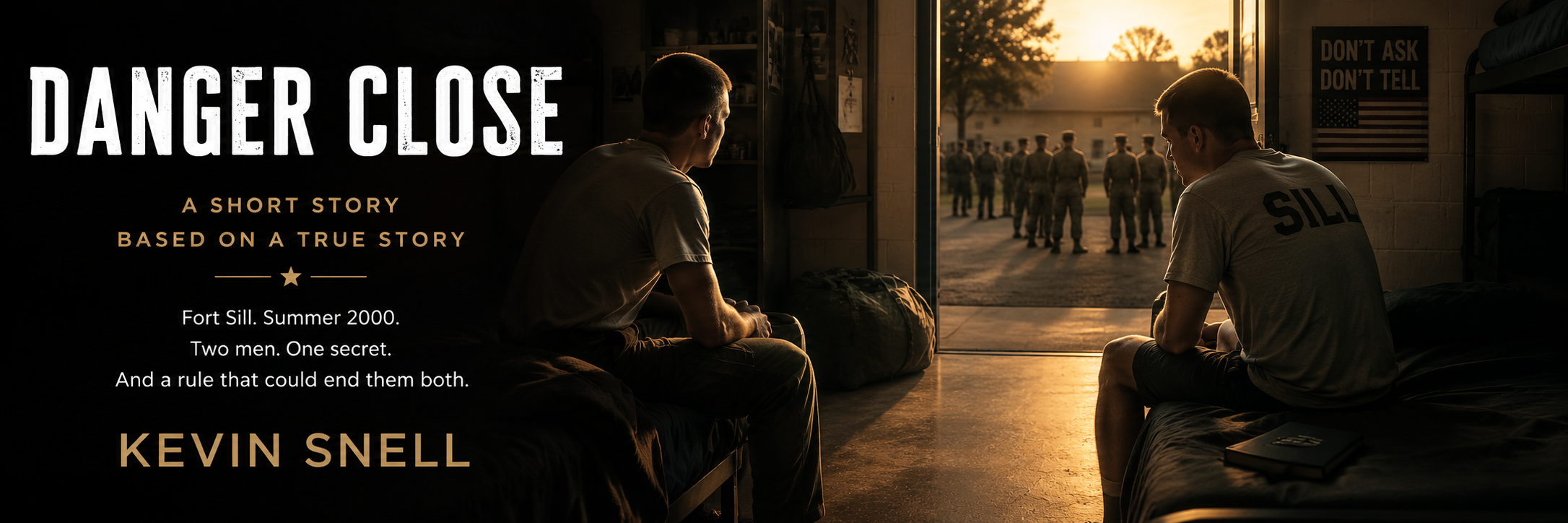
Danger Close

A NOTE ON THIS STORY
This one is true.
It happened the way I’ve told it, in the summer of 2000, at Fort Sill, when I was twenty-two and certain that what I was could end me—because I had already watched it end someone I loved. I’ve changed the names and a few small details, and I’ve fictionalized the man I’ve called Tanner past the point where anyone could find him, because he was real, he never asked to be written about, and what we were to each other for one summer belongs to him as much as to me. Everything that matters is exactly as it happened.
The story ends at the buses. The rest belongs to me.
I stayed in. I served two tours in Afghanistan with the 82nd Airborne. Somewhere in those years I stopped being alone with it—I found a family inside my own unit, men who knew exactly what I was and decided it cost them nothing, who had my back in the way I’d been warned, by someone who paid for the lesson, that no one ever would. They were wrong about that, and I have never been more grateful to be wrong about anything in my life. I left the Army a staff sergeant, honorably discharged. The word on my paperwork was the right one after all.
I wrote it down so it would exist somewhere, and so the next twenty-two-year-old lying awake in a bunk somewhere might know it was survivable.
It was.
—KS
Reception
I was twenty-two the year I learned you could want a person so bad it felt like a security clearance you’d lose. That was the word that kept coming to me for it, all that summer, lying in my bunk in Oklahoma with my heart going. A liability. Like the thing I was carrying around inside my own chest was the kind of thing they’d pull a man’s access over.
I came in late. Most of the kids at reception were eighteen, nineteen, fresh out of some high school, and I was twenty-two with two years of community college I never finished and a job at a tire place behind me, which in that crowd made me an old man. I’d enlisted in the spring of 2000 for reasons I told everybody and one reason I told nobody, which was that I needed to be somewhere with rules so loud I couldn’t hear myself. I had a good idea by then what I was. I’d had it confirmed in the worst possible way, back home, and I’ll get to that. The short version is I came to Fort Sill already knowing exactly what I had to keep buried, and exactly what it cost when you didn’t.
I’d come to Fort Sill out of basic, like everybody does. I’d done mine up at Fort Leonard Wood, in Missouri, the whole screaming boot-camp machine of it, and I’d survived it the same as I survived most things, by going somewhere behind my own eyes and waiting it out. I was good at going somewhere behind my own eyes. I’d been practicing my whole life. AIT was supposed to be a different animal and it was. You’d already been broken down and built back by the time you got there, so the cadre eased off. They were sergeants now, instructors, the men who’d teach us the actual job, and they ran a tighter ship than any civilian would believe and a looser one than basic by a country mile. You got treated a notch more like a soldier and a notch less like a problem. You got a little of your own self handed back to you. Which, for me, turned out to be exactly the wrong gift, because the self they handed back was the one I’d enlisted to get shut of.
They bused us over to the AIT company our first day in, a busload of us hauling duffels, a long brick building with the company guidon out front and a sergeant named Hicks on the steps with a clipboard, not screaming, watching us unload, which after ten weeks of being screamed at felt like a different army. Inside it was two-man rooms off a long center hallway, no doors on any of them, just open doorways, gray tile, gray walls, a latrine and a shower bay at one end. Hicks read names and room assignments off the clipboard and you grabbed your stuff and went. I was standing there with my duffel cutting into my shoulder when he read off my name and then read off the name that was going to wreck my life, except of course I didn’t know that yet. It was just a name. Some kid from West Virginia.
Tanner came down the hall toward me with his duffel up on one shoulder like it weighed nothing, and he stuck his hand out before he even got to me, which nobody did, and said his name in an accent so thick it took me a second, and grinned like we’d already gotten away with something. He was twenty. He looked younger. He had that lean farm-kid build, all rope and angle, a jaw that hadn’t quite finished, ears the buzz cut had left too big, and a way of looking right at you that I wasn’t at all ready for. I shook his hand and told him my name and went somewhere behind my eyes and locked the door, hard, a reflex I’d drilled into myself, because the first thing I felt looking at Tanner was the thing I’d come two thousand miles to a place with very loud rules specifically so I would never feel again.
Here is what I knew, standing in that hallway. I knew there was a regulation, and the regulation had a name everybody said as a joke, Don’t Ask Don’t Tell, and underneath the joke it meant that what I was could end me. Not get me in trouble. End me. Pull me out by the roots and write a word on my paperwork that would follow me into every job I ever applied for after. I knew it because it had already happened, that spring, to the one other person on earth who’d known about me, and I knew exactly what his face looked like the day they did it. So I shook the West Virginia kid’s hand and I thought, very clearly, like an order to myself, not him. Not this. Not here. You came here to disappear. Disappear.
We carried our bags into the room. Two beds, one against each wall, two wall lockers between them, a window that looked out on the PT field and past it the brown hills that everything at Sill happened in the shadow of. Tanner threw his duffel on the bed by the window and claimed it without asking and then turned around and asked me if that was all right, which I would learn was the whole of him in one motion, taking the thing he wanted and then checking your face about it after. I said it was fine. He stuck out his hand again, even though we’d already shaken.
“Well, looks like we’re stuck together,” he said, and grinned.
And I stood there in a gray room in Oklahoma with my whole life riding on never letting anybody see me, shaking a stranger’s hand for the second time in five minutes, already in more trouble than I had the sense to know.
Battle Buddy
The Army doesn’t let you be alone, and that turned out to be the cruelest thing it ever did to me, though it took a while to feel like cruelty.
They assign you a battle buddy, your battle, everybody just said in AIT, and your battle is supposed to be with you basically always. You don’t go to the latrine alone, you don’t go to sick call alone, you don’t walk to the PX alone. The idea is that two soldiers keep each other out of trouble, and the deeper idea, the one nobody says, is that two soldiers are easier to control than one. My battle was also my roommate, the kid from West Virginia, and so from the first day on I was almost never more than ten feet from Tanner, and the wanting I’d come there to kill got fed three meals a day and a bed five feet across the room from mine.
He was the easiest person I ever met. I don’t know how else to say it. People liked him without thinking about it, without it costing them anything. By the end of the first week he knew everybody’s name in the platoon and half their hometowns. He talked the whole time, low, under his breath in formation, a running commentary on everything, the sergeants, the food, the heat, his girl back home, and I was the one he aimed most of it at because I was the one tied to him. He had a girl back home named Mandy and he mentioned her with no weight on it at all, a fact about himself he set down between us so I’d have it. I took it and filed it where I filed everything that was going to keep me alive. There. That’s the wall. He’s got a girl. Good. Get behind it.
The thing about Tanner, though, the thing I couldn’t account for, was that he was kind in a way that didn’t seem to be working any angle. He noticed things. He noticed I didn’t talk much and instead of deciding I was stuck up, which is what the eighteen-year-olds did, he decided it was interesting, and he started trying to get me to talk just to see if he could, like I was a puzzle worth the time. He’d ask me real questions. Where in Illinois? What my mom did? Why I’d waited till twenty-two? And I’d give him the short answers, the safe ones, and he’d take them and ask the next one, patient, never pushing past where I shut it down, but always coming back the next day to try again. Nobody had been curious about me in a long time. I’d made sure of it. And here was this kid from a holler I couldn’t have found on a map, deciding I was worth being curious about, and I felt the wall I’d built start to do a thing walls aren’t supposed to do, which is want to come down.
We were good at the same things, which helped. We’d both tested into 13F, Forward Observer, the guys who go out front and find the targets and call the artillery down on them, and it turned out we both had the head for it, the math and the map sense, where a lot of guys struggled. So we got paired up in the field too, not just in the room, and that’s where it really started, though I’d have denied it under oath at the time, even to myself, especially to myself.
Nights were the worst. The lights went out at 2100 and I’d lie there with five feet of gray tile between our two beds, one against each wall, close enough to hear every breath he took and too far to cross, too close and too far at the same time, and not sleep. He talked in the dark sometimes, low, half asleep, telling me about home, the dirt road, his daddy’s truck, the river, Mandy, and I’d lie there and answer in one or two words and want, just want, in the plain hopeless way you want something you have already decided you can’t have, and across the room from me Tanner would finally go quiet and drop off to sleep like a kid, easy, nothing riding him, and I’d be awake in the dark for another hour with the thing in my chest that the Army would have called a liability, doing my arithmetic, the same arithmetic Cole had done and lost. Keep it in your pants. Keep your head down. Disappear. I was so bad at it already and we were two weeks in.
The Last Stall
There’s no privacy in the Army and there’s nowhere to hide a body, and for a man trying to keep a secret the size of mine, the shower bay was a daily test I kept failing in small ways nobody could see.
It was an open bay with stalls down one wall, the cheap kind, shoulder-high dividers and a shower curtain that never quite closed, and in the morning forty of us cycled through it fast, no time, a sergeant counting, everybody too tired and too rushed to be anything but bodies. I learned to look at the wall. The grout, the rust stain, a fixed point I could put my eyes on and keep them on while I washed, because the alternative was to look at Tanner one stall over, soaped and dripping and grinning at me about something, and I couldn’t afford what looking did to me. So I kept my eyes on the grout and did my arithmetic and got out fast.
Everybody knew about the last stall. You figure these things out by the second week, same as you figure out which sergeant means it and which one’s putting on a show. The last stall, the one at the end farthest from the door, was where guys went at night, after lights, when the bay was empty, to take care of themselves, because it was the one place in the whole building you could be alone for four minutes. Nobody said it out loud. It was understood. You’d hear the water come on at 2200 and you knew, and you gave the man his privacy, and in the morning nobody knew anything. It was the only mercy the building had in it, and the whole platoon protected it without ever once discussing it, eighteen-year-old boys a thousand miles from anyone who’d ever touched them, keeping each other’s one secret by pretending none of us had it.
I used it like everybody else and I hated how much of my mind it took up. Because the problem wasn’t the four minutes alone. The problem was who I was alone with, in my head, in the last stall, with the water running, and how it was always the same person now, across the room, asleep, easy, breathing, and how I’d come back to the room after and lie down five feet from the actual him with the shame of it still wet on me and tell myself tomorrow I’d think about Mandy instead, or about nobody, about the grout, the rust stain, anything.
It came to a head, the first time, over nothing. We’d had a long field day, land nav in the heat, and we’d come back filthy and dead on our feet, and it was late, near lights out, and the bay had mostly cleared. I was at a stall washing the day off and Tanner came in behind me still talking, about a point we’d missed and how the azimuth had been off, and he took the stall next to mine, and I put my eyes on the wall. And he kept talking. And then he wasn’t talking. And I felt him looking at me. You can feel it, when somebody’s looking, it’s a real thing, it lands on your skin. I kept them there and my heart started going and I thought, very clearly, do not turn your head, do not turn your head, and the water ran and the steam came up and for a long few seconds neither of us said anything and the whole bay was the two of us and the water and the thing I wasn’t turning my head to look at. Then somebody banged through the door at the far end, a third guy, and Tanner went back to talking about the azimuth like nothing, and I got out fast, and lay in the dark doing my arithmetic with my hands shaking, and understood that I was in real trouble now, the kind Cole had warned me about, the kind with a name on the paperwork, and that I wasn’t, when it came to it, going to be able to keep looking at the wall.
Land Nav
The first honest conversation I ever had with Tanner happened on the side of a mountain at oh-dark-thirty with a busted flashlight, looking for a point that turned out to be two hundred meters from where we thought it was, and I think about it more than I think about almost anything.
Night land nav is its own kind of lonely even with a partner. They drop you at a start point with a map and a compass and a list of grid coordinates, and you shoot your azimuth and count your pace and walk off into the dark to find an orange-and-white marker nailed to a stake, and then the next one, and the next, against a clock, and if you’re off by a couple degrees over a long enough distance you end up nowhere, on the wrong hill, burning time you don’t have. Tanner and I were good at it together. He had the better pace count and I had the better head for the map, and we’d worked out a rhythm where I navigated and he counted and we’d find them, one after another, while half the platoon got lost in the rocks.
That night we’d found four and we were hunting the fifth and we had gotten turned around, off behind a ridge where the lights of the cantonment area didn’t reach, real dark, the kind you don’t get where there are towns. We sat down on a rock to re-shoot the azimuth and check the map under a red lens, and Tanner’s flashlight died, and we sat there a minute in the dark waiting for our eyes, and it was the quiet you only get out there, no trucks, no sergeants, no forty other guys, only the wind and the two of us and a sky with more stars in it than I’d ever seen in my life in Illinois.
And he asked me the real question. Not Mandy, not home, not why I waited. He laid it down careful in the dark, real quiet, not his usual run-on.
“You ever feel like you came in here to get away from something?”
And I sat there with my heart going because it was so close to the true thing, closer than anybody had come, and I could have given him the safe answer, the short version, and I almost did. But it was dark, and we were behind a ridge where nobody could see us, and there’s something about real dark and being tired down to the bone that gets the truth up out of you whether you want it or not.
“Yeah,” I said. Just yeah.
And he was quiet a second.
“Me too,” he said, and didn’t say from what, and didn’t ask me from what.
And we sat there on that rock in the dark with our two yeahs hanging in the air between us, and it was the most naked I’d been with another person in years and we hadn’t touched and we hadn’t said a single thing that could end us.
Then I found the fifth point off the back of the ridge, plotted it again clean and shot a new azimuth, and we got up and counted our pace into the dark and found it, the marker on its stake, right where the math said it’d be, and we punched our card and walked back in toward the lights, and somewhere in the dark on the way Tanner’s shoulder came up against mine and stayed there a half-step longer than the walking needed, and I let it, and neither of us said anything, and I knew, the way you know weather coming, that the wall was already gone and I’d been standing in the open for a while without admitting it.
Fire Guard
They put us on fire guard together, which felt at the time like the Army doing me a favor and was really the Army handing me the rope.
Fire guard is the overnight watch. The barracks always has somebody awake, walking the hallway, checking the rooms, making sure nobody burns the place down or walks off in the night, and they run it in shifts, two soldiers at a time, an hour or two each, the whole platoon cycling through so everybody loses the same sleep. They posted the roster on the wall and Tanner and I had the same shift, 0200 to 0400, the dead middle of the night, the worst shift, the one where your body doesn’t know what it’s for. The two of us, awake, in a dark hallway, with forty guys asleep in the rooms on either side and nobody else up in the whole building.
There’s a particular tired that lives at three in the morning on fire guard, a floaty scraped-out tired where the building ticks and settles around you and the whole world shrinks down to one dark hallway and whatever’s in it. We kept awake on coffee out of the big steel urn in the dayroom, the bad Army coffee, bitter and stewed down to tar, and we’d walk the hall slow past the rows of open doorways with the index card slid in the slot beside each one for the two names inside, and just inside every doorway the platoon would be dead asleep, forty guys breathing in the dark, and it would be only us, awake, in the one lit place in the building. There is no privacy in the Army except the kind the middle of the night hands you by accident. And that summer the middle of the night handed us a lot of it.
The first hour we walked the hall and checked the fire extinguishers and didn’t say much, both of us stupid with sleep. Then we ended up sitting on the floor at the end of the hall by the latrine, backs against the cold cinderblock, shoulders together because it was cold and because we always ended up with our shoulders together by then, and we talked low so we wouldn’t wake anybody, and the talking-low did the thing the dark on the mountain had done, turned everything we said into something said closer than it was. He told me real things. About his daddy, who hit. About why twenty wasn’t too young to leave, in his house. I told him a couple real things back, careful ones, the edges of true. And the longer we sat there the more I was aware of every place we touched, shoulder to shoulder, knee falling against knee, the warmth of him down the whole side of me in that cold hallway, and I knew he was aware of it too, because the talking had gone quiet and slow and kept stopping, and in the stops you could hear both of us breathing.
And then he stopped talking in the middle of something and turned his head and looked at me, close, in the dark, and I looked back, and there was a long second where the whole rest of my life was balanced on a wire, and I thought about Cole and the word on his paperwork and the regulation and the forty guys asleep ten feet away, and then I thought about nothing at all, which is the only way these things ever actually happen, and I leaned the last two inches and kissed him.
He kissed me back. That’s the part I still can’t get over, all these years on. There was no second of him deciding whether to. He kissed me back like he’d been waiting on me to get there, his hand coming up to the side of my neck, and for about ten seconds the Army and the regulation and Cole and the whole brown state of Oklahoma fell off the edge of the earth and there was just Tanner’s mouth on mine in a dark hallway, warm, certain, tasting like the cheap coffee we’d been keeping ourselves awake with. Then a floorboard creaked somewhere down the hall, just the building settling, but it could’ve been anything, it could’ve been the end of everything, and we came apart fast and sat there with our hearts slamming, a foot of cold air between us where there hadn’t been any, listening, and nothing happened, nobody came out, and after a minute Tanner let out a long shaky breath and laughed, almost silent, and bumped his shoulder back against mine, and I sat in that hallway at three in the morning more scared and more alive than I’d ever been in my life, and didn’t say a word, because there weren’t any words that wouldn’t end us, and because I didn’t trust mine not to say the thing you can never take back.
Smoke and Mirrors
We didn’t talk about it. There was no talking about it. The next morning the lights came on at 0500 and we were back to being battles in front of forty guys and a couple of sergeants, and the genius and the horror of the closet is that you get very, very good at acting like nothing happened, even to the one person it happened with.
But it had happened, and we both knew it had, and now there was a second conversation running under the first one all day long, in the field, in formation, in the chow line, a thing that lived in how long we’d hold a look before one of us broke it, in him finding reasons to put a hand on my shoulder, on my back, steering me, the kind of contact two guys could do in plain sight that meant nothing to anybody watching and everything to us. Tanner turned out to be braver than me, or maybe just younger, less scared, not carrying a Cole around in his chest. He pushed. Little things. A knee against mine at chow held too long. His voice dropping when it was just us. He’d look at me across the bay while he was talking to somebody else and let me see him do it.
I got an education that week in how much two people can say without saying one word out loud, how a whole second language can run underneath the first one, built out of nothing but the length of a look and where a hand landed and how long it stayed there. We’d stand in the chow line six inches apart talking about absolutely nothing, the food, the schedule, the weather, and the real conversation would be happening in the quarter inch where his arm wasn’t quite touching mine, both of us fluent in it, nobody else in the line able to hear a thing. I have never since been as good at anything as I got that summer at running two conversations at once, the loud one for the room and the quiet one for him, and holding my face still through both of them.
And I pulled back, the first couple of days, hard, scared, because the kiss had made it real and real was the thing that got you a word on your paperwork. I went cold on him, gave him the wall, the short answers, and watched it land on his face, this confusion, this hurt he was too proud to show all the way, and I hated myself for it and did it anyway, because I had a picture in my head, I always had it, of Cole’s face the day they walked him out, and I couldn’t stop seeing it laid over Tanner’s. I’d come two thousand miles to disappear and I’d lasted three weeks before I kissed a man in a government hallway, and now the smart thing, the Cole-was-right thing, was to kill it before it killed us both.
But you can’t go cold on Tanner. I want that understood. He didn’t push when I went cold, exactly. He just refused to go away. He kept being warm at me, easy, undeterred, like he could outlast it, like he knew something I didn’t, and on the third day, in the latrine when it was just us, he caught my eye in the mirror while we were shaving and he didn’t say anything for a second, and then he said it, low, real even.
“You can do the thing where it didn’t happen if you want, I’ll let you, but I’m not going to pretend I don’t know what I know.”
And I stood there with the razor in my hand and my whole life telling me to go cold one more time, and I couldn’t do it. I just couldn’t. So I didn’t say anything, which was its own answer, and he saw it land, and the corner of his mouth went up, careful, and he went back to shaving, and I understood that I’d already chosen, days ago, on a mountain, in a hallway, and that all the pulling back in the world was just me being scared in the general direction of a decision I’d already made.
The Last Stall, II
It happened the first time in the shower, which I think both of us always knew it would, because the last stall was the one place the building had ever given anybody to be a person in.
It was a Thursday night near lights out and the bay had cleared and I was in the last stall, the end one, washing off a field day, telling myself that’s all I was doing, and I heard the curtain and it was Tanner, of course it was Tanner, stepping in behind me into a stall built for one, and there wasn’t any pretending about it this time, no azimuth to talk about, no wall to look at, just the two of us crammed into four feet of steam with the water running and the bay empty and a curtain that didn’t quite close between us and the end of our careers. He put his hand flat on my chest and turned me around and looked at me, checking, the same as he always did, and I nodded, and he kissed me, and this time nobody came through the door.
We were quiet about it. We had to be. That was the whole architecture of it, that the worst thing we could do was make a sound, and so everything got pushed down into how we touched instead. He got a hand on me and I was already hard, stupid hard, weeks of it with nowhere to go, and the second another person’s hand was on my cock instead of my own I had to bite down on a sound that would’ve carried down the whole bay. He worked me slow and watched my face the whole time in the steam, his forehead down against mine, water running off both of us, and I got a hand around his cock and felt how hard he was too, how much he’d been carrying it the same as me, and we stood there in the last stall jerking each other off with our foreheads together and our breath shaking and not making a sound, two guys who’d have died before they let anybody hear, and it was the filthiest and the most tender thing that had ever happened to me at the same time, and I didn’t know a thing could be both until him.
He came first, into my hand, with his teeth set in his own bottom lip to kill it, his whole body going tight against me, and feeling him come apart silent like that was what finished me, and I came a few seconds after with my face shoved into his neck and his free hand spread flat on my back holding me up, both of us shaking, the water taking it down the drain, the bay still empty, nobody the wiser, the regulation still intact on paper and broken all to hell in a steel stall at the end of a hallway in Oklahoma. He held onto me after for a second longer than he needed to. That was the part that got me. Not the hand. The second after, the holding, his mouth against my temple, breathing. Then we cleaned up fast and got out one at a time, him first, me a minute behind, and I walked back to our room with my heart going and lay down five feet from the actual him, both of us pretending to sleep, both of us wide awake in the dark, and for the first time since I’d gotten to Fort Sill I wasn’t doing my arithmetic. I was lying there in the dark, terrified and wrecked and happier than I’d been in years, listening to him breathe, knowing he was listening to me.
Adjust Fire
After that it was a thing we were doing, and the doing of it took over my whole life in the quiet way a secret does, running underneath everything, costing more attention than the training did.
We got careful and we got reckless at the same time, which I’ve since learned is just what it’s like. Careful in the daylight, in front of people, better actors than ever, two battles, nothing to see. And reckless in the cracks, the last stall on the nights the bay cleared, the back of a deuce-and-a-half on a long ride out to the range, once in a stairwell during a fire drill that wasn’t a drill for us. We learned each other in pieces, in the four-minute windows the Army left lying around, and every piece made the daylight harder, because now I knew things about him, how he sounded when he was trying not to make a sound, the face he made, how he said my name when there was nobody to hear it, and I had to carry all of that around in formation and not let it show on me.
What nobody tells you about a secret is how much room it takes up, how it crowds everything else out to the edges of the day. I’d be down in the prone on some hill with the binos up and the radio handset against my jaw, calling a mission for real now and not a drill, reading the grid and the target description off the map and waiting on the round, fire mission, over, and the whole time some back third of my head would be running its own mission underneath the real one. Where Tanner was. Who was watching us. How long we’d held a look at chow. Whether Hicks had clocked anything. The arithmetic, always the arithmetic, running under the actual job the Army was paying me to learn. And here’s the thing, I got good at the job anyway. That’s what being good at hiding does to you. It makes you good at doing two things at once, the true thing and the cover, and I did them both well enough that nobody ever looked at me twice, and I’ve wondered plenty since what it cost me, getting that good that young at not being seen.
And the training went on around us, indifferent to all of it. It always is. We ran in the mornings in the cool dark before the heat came up, the whole platoon in formation, calling cadence, and Tanner ran next to me because we always ran next to each other now. We did land nav until we could’ve found those points blind. We learned to call for fire, which is the whole reason a Forward Observer exists, the radio drill of it, the words in their fixed order, the grid and the description and the method, fire mission, over, and I loved it, honestly, the cleanness of it, how there was a right answer and you either had it or you didn’t. We sat in the bleachers in the heat and watched the rounds come in downrange on the impact area and felt the ground move under us, this enormous indifferent power we were learning to reach out and pull down out of the sky onto a spot on a map, and I’d sit there next to Tanner with our shoulders not touching because we were in formation and I’d think about how the most dangerous thing in my life by a mile wasn’t the artillery. It was the kid next to me, and how much I’d started to need him, and how I’d stopped, somewhere in there, being able to imagine the rest of the cycle without him in it.
Weekend Pass
We got our first real weekend pass in the back half of the cycle, once we’d phased up and earned some rope, and Tanner and I did what half the platoon did, which was get off post as fast as humanly possible, and what no one else in the platoon did, which was get a motel room with two beds and only use one.
It wasn’t about what it turned into, not at the start. That’s the thing I want to get right. A weekend pass meant civilian clothes and off post and a night that belonged to us, and after a summer of belonging to the Army that was the whole prize by itself. We caught a cab into the town outside the gate, the strip of pawn shops and tattoo parlors and bars that exists outside every post in America to take a soldier’s money, and we did young-guy stuff, we drank cold beer nobody carded us too hard over, we shot bad pool, we fed a jukebox, we talked to nobody but each other and didn’t even notice we were doing it. It was the first time since reception either one of us had gotten to be a person instead of a number, and neither of us wanted the night to end and put us back in the bay under the fluorescent lights waiting on an 0500 that belonged to somebody else. So when it got late, we didn’t head back to post.
We got a room at one of the cheap motels on the strip, the kind with the AC unit roaring under the window and a bedspread you didn’t want to think about and two double beds with a nightstand between them. And when the door shut behind us and the deadbolt went over, that sound, the bolt, I felt something in my chest let go that had been clenched since reception. A door that locked. A door that locked from the inside, between us and the entire United States Army, for one whole night.
There were two beds. I want to be clear about that because it mattered, it mattered then and it mattered every time I’ve thought about it since. We didn’t have to share. There was a whole second bed, made up, three feet away. And we didn’t even talk about it. Tanner sat down on the one bed and I sat down next to him and we didn’t talk about the other one, the empty one, because the empty one was the whole point, the empty one was the thing we were saying without saying it, that this wasn’t the four minutes in the last stall, this wasn’t grabbing what you could in the cracks. We had a bed we didn’t have to share and we were going to share it anyway, all night, on purpose, like it meant something, because it did.
And here’s the thing I’ve never told anybody. It didn’t start as anything. We were tired and a couple beers in and it was late, and we turned off the light and got into the one bed without talking about it, stripped down to our shorts to sleep, and we said goodnight, and for a while we honestly tried to. Two guys in one bed with a careful stripe of sheet between them, both lying there in the dark wide awake and pretending not to be. That’s the truth about how these things actually go. There’s no decision in it. There’s just two people in the dark, each one waiting to find out what the other is going to do, each one able to call the whole thing an accident in the morning if it went wrong, and the not-deciding is its own kind of held breath, and it can go on for an hour.
He moved first, or I decided afterward that he had, so I could tell myself he had. His arm came over my waist in the dark, heavy and slow, and settled there, and we both held still and kept up the fiction that we were asleep, that an arm had just landed where an arm lands, that it didn’t mean the thing we both knew it meant. I lay there with his arm over me and my heart slamming and didn’t move for the longest time, because moving meant admitting I was awake, and admitting I was awake meant admitting I wanted it, and wanting it out loud was the one thing a whole summer of Cole’s warning had trained me never to do. So I did the cowardly brave thing instead. I scooted back. An inch, and then more, slow, pretending it was nothing but a man turning over in his sleep, until my back was full against his chest and there was no gap left anywhere, his front to my back, the whole warm length of him, and I felt him hard against me, against my ass, felt him grow there while neither of us said a word or admitted a thing, both of us still playing asleep with his cock pressed up against me and my own breath gone ragged in the dark.
And then I couldn’t do the asleep thing anymore. Neither of us could. I rolled over inside his arm, in the dark, until we were face to face with an inch of air between us, close enough that I could feel his breath and he could feel mine, both of us finally done pretending, and I kissed him, and that was the end of the fiction and the start of everything else.
I’d never done the whole thing with anybody. I need to say that, because it’s part of what that night was. I’d had the furtive stuff, the scared stuff, the cracks, with Cole once, before, and a stranger one time I don’t like to think about. But I’d never had a person and a locked door and a whole night and somebody who looked at me like Tanner looked at me, and I was nervous in a way I hadn’t been since I was a kid, and Tanner felt it, because he felt everything, and he slowed us back down. He kissed me slow and long until I stopped shaking, and we got the rest of it off, our shorts, the dog tags, everything the Army leaves you in, until there was nothing between us at all. We took our time because for the first time we had it, no water running to hide under, no curtain that didn’t close, no listening for a door. And then he reached over to the duffel for the bottle of lotion off the sink because that’s what you used, that’s what there was, and he asked me, right up against my ear, real quiet, he asked me how I wanted it, and I told him the truth, which was that I wanted him, that I wanted all of it, that I’d wanted it since the hallway.
So he opened me up with his fingers, slow, patient, his mouth on my neck, his other hand laced through mine on the pillow, while I shook apart under him and tried to stay quiet out of pure habit, and he told me I didn’t have to be quiet, not here, not tonight, the door was locked.
“Let me hear you.”
And when he finally pushed his cock into me it was slow and deep and it hurt and then it didn’t, and I held onto him and made every sound I’d been swallowing all summer right into his shoulder, and he fucked me slow in a cheap motel bed with the AC roaring and his name in my mouth and mine in his, and it wasn’t the four minutes anymore, it wasn’t stolen, it was given, it was the most given thing of my whole life. He came inside me with his face dropped down against mine and my name coming out of him broken, and I came between us a second later with his hand on me and his eyes on me, and then he didn’t pull away. That’s the thing about that night. He didn’t get up, didn’t clean up fast, didn’t go to the other bed. He stayed. He pulled the questionable blanket up over both of us and got an arm under me and we lay there in the roar of the AC, sweaty and wrecked and ours, and the empty bed three feet away stayed empty all night long, and that, more than anything we did with our bodies, was the thing I knew I’d never get over.
Call for Fire
The letter from Cole came on a Tuesday in the back half of the cycle, after the pass, when I was already in so deep I’d stopped being able to see the edges of it, and it landed in my chest like a round coming in.
Mail call was a thing the sergeants ran in the evening, calling out names, tossing letters, and I’d gotten the usual, a card from my mom, and then one more, a cheap envelope with handwriting I knew, postmarked from back home, and I took it back to the room and sat on my bunk and opened it while Tanner was down at the latrine, and it was Cole, who I hadn’t heard from since the spring, since the day they walked him out. It wasn’t long. Cole was never one for a lot of words. The letter said:
Wes. Made it home okay, more or less. It’s bad here but I’m getting by. I’m only going to say this one time and then I’ll never bring it up again, I swear. Whatever you do out there, keep your head down and keep it in your pants. Don’t trust anybody with it. Not anybody, not even the one you most want to trust, especially not him. They will take everything you have and call it doing the unit a favor. I’m not telling you what to be. You know I’d never. I’m telling you what they do to it once they know. Don’t do what I did. Be smarter than me. — Cole
I read it twice and then I sat there on my bunk holding it, and the AC of the whole summer seemed to go quiet around me. Because here was the one person on earth who loved me enough to have lost everything rather than lie about what we both were, writing to me from the wreckage of it, telling me the exact, precise, true thing, the thing I’d come two thousand miles to obey, and the timing of it, God, the timing. He didn’t know. He couldn’t have known. He thought he was writing to me before, to the scared kid at reception. He didn’t know the letter was landing on a man who had a locked-door night three days behind him and a face he loved five feet across the room and his head all the way down in exactly the thing Cole had paid for. Don’t trust anybody with it, especially not him. And I’d already trusted him with all of it. There wasn’t any of it left untrusted.
Tanner came back from the latrine and saw my face and asked what was wrong, and I almost didn’t tell him, almost gave him the short answers out of pure reflex, and then I didn’t, because the wall was gone, it’d been gone since the mountain. I handed him the letter. I let him read it. I watched him read the part about him, especially not him, and I watched it land, and he sat down next to me on the bunk, close, our knees together, and didn’t say anything for a long time. And here is the thing I keep coming back to, all these years on. He didn’t tell me Cole was wrong. He was too honest for that, even at twenty. He knew Cole was right. We both knew Cole was right, about the risk, about the word on the paperwork, about what they’d do to it if they ever found it. And then Tanner said it, finally, real low, folding the letter back along its creases and handing it back to me careful like it was something that could break.
“Your friend’s right about all of it. And I’m not going anywhere.”
And I understood that he was telling me to choose with my eyes open, the same as he already had, knowing the whole cost, not pretending it away. And God help me, I chose him. I put Cole’s letter in my wall locker under my civvies where I’d see it every day, and I kept it the rest of my life, and I chose Tanner anyway, eyes open, the warning read and understood and set aside, because some things you decide you’d rather have and pay for than not have and stay safe, and he was the first thing I ever wanted enough to pay.
Danger Close
In the call for fire there’s a thing you say when the rounds you’re bringing in are close to your own people, close enough that they could kill you too, and you say it so the gun crews know to be exact, because the margin’s gone. You say danger close. I’ve thought my whole life that what we did the last week of that cycle was me calling it on myself, danger close, knowing the margin was gone, and bringing it in anyway.
We’d gotten reckless. Not in the daylight, never in the daylight, we were too good by then, but in the cracks the recklessness had grown teeth. The last stall wasn’t enough anymore. The four minutes weren’t enough. After the motel we knew what the whole thing was and we couldn’t go back to grabbing pieces of it, and that’s a dangerous way to feel in a place like that, where the only safe amount of want is none. We had a couple weeks left. Orders were coming. We both knew we were about to get scattered to opposite ends of the country, and I think that’s what did it, that’s what made us stupid at the end, the clock. You get careful for a future. We were running out of future. So we stopped being careful in exactly the proportion that we ran out of it.
It was a fire guard night, our shift again, 0200 to 0400, the dead middle, the whole platoon asleep in the open rooms down the long hallway and nobody else in the building awake but us. We’d walked the hall and checked the rooms and ended up where we always ended up, at the dark end by the latrine, and we started kissing, quiet, careful, the same as we had a dozen times on that shift, and it should have stayed that, it always stayed that, we always kept it to that on fire guard because fire guard was the one place the risk was total, open doorways on both sides, forty sleeping men, any one of them up to piss at any second. But that night it didn’t stay that.
That night the clock was too loud and we were too far gone and Tanner had me up against the cinderblock with his hand down the front of my PT shorts and I had no business letting it go past kissing and I let it go way past kissing, and then it was happening, right there, in the hallway, in the open, in plain view of every open doorway, him behind me with my shorts shoved down and his cock pushing into me and his hand clamped over my mouth to keep me quiet, the cold cinderblock against my hands.
I know how insane that sounds. I knew it then too. That’s the part I need you to understand.
You, reading this.
We weren’t careless because we thought we were safe or indestructible. We were careless because we knew we weren’t. Every open doorway in that hallway was a possible ending. Every sleeping soldier was a witness we’d been lucky enough to not wake up. The danger wasn’t outside the thing. By then, the danger was part of the thing.
It was rough and it was fast and it was reckless past anything we’d done, the open hallway and the open doorways and the total no-margin insanity of it ran in my blood right alongside how much I wanted him, the two things wound together so tight I couldn’t have told you where one stopped. It was pure wanting, spit, and recklessness.
He had a hand clamped over my mouth and his other arm banded around my chest holding me up and he fucked me against the wall in the dark with forty men asleep ten feet away on either side, and I bit down on his palm to keep silent and he pressed his mouth to the back of my neck to keep himself silent and we did the most dangerous thing two soldiers could do in the year 2000, right out in the open, where anyone, anyone who lifted his head in any one of those open doorways, could have ended both of us, the word on the paperwork, the whole thing, gone, and we did it anyway because we were twenty and twenty-two and in something neither of us had a name for and out of time. He came in my ass with his teeth set in my shoulder and his hand crushed over my mouth, and I came against the cinderblock with no hand on me at all, just him, just the whole insane danger of it, and then we froze there, joined, shaking, his hand still over my mouth, both of us listening to the hallway, to the open doorways, to forty men breathing in their sleep, waiting to find out if we’d thrown our lives away.
Nobody made a sound, no one woke. That’s the part I still can’t believe. We got away with it. We pulled apart and got our PTs right with our hands shaking and a minute later we were just two soldiers walking a hallway on fire guard again, checking the rooms, getting ready to wax the floors, and at 0400 we acknowledged our relief and lay down in our own two beds five feet apart and didn’t say a word.
In the morning the lights came on and we ran PT in the cool dark and nobody ever knew. But I knew. I knew we’d called it danger close on ourselves and the rounds had come in inside the margin and missed us by luck, by nothing, by the grace of nobody needing to piss at two in the morning, and I lay awake the rest of that night more scared than I’d ever been. More sure than I’d ever been, both at once, because I finally understood what I’d been refusing to understand all summer, which was that I’d have paid the price. If someone had stepped out into the hall. If it had all come crashing down. I’d have paid the price, the word on the paperwork, Cole’s whole nightmare, all of it, and I wouldn’t have been sorry, because some things are worth the rounds coming in close, and he was the first one I ever found that was.
END OF MISSION
Orders came down the last week, indifferent, a sheet of paper on a clipboard, and the Army did what the Army does, which was to take the one thing I couldn’t stand to lose and send it to the far side of the country with a straight face.
I was going to Airborne school at Fort Benning, down in Georgia, jump school, three weeks of learning to throw myself out of perfectly good airplanes, and then on to a unit from there. Tanner was going to his first real assignment, a unit up at Fort Drum, New York, the top edge of the country, snow country, about as far from Georgia as you could get and still be in the same army. We found out the same morning, standing at the board with the orders posted, and we read each other’s and didn’t say anything for a second, and then Tanner did the bravest thing I ever saw him do, which was grin at me, easy, like always, and say it.
“Well. New York and Georgia.”
He kept his voice level and his face right because there were people around, and only I could see what it cost him, and only because I knew his face better than I knew my own by then.
We had a few days left and we spent them the way you spend the end of something, pretending it isn’t ending right up until it does. We didn’t get another pass. The last stall a couple more times, careful now, the recklessness burned out of us by how close we’d come in the hallway. Mostly we stayed near each other, battles to the last, our shoulders together in formation, and talked, low, in the dark, about everything except the thing that was a week out and then was three days out and then was the morning the buses came.
I’m not going to make the last morning into more than it was, because part of what it was, was that we couldn’t make it into anything. There were buses and duffel bags and a hundred guys and a couple of sergeants, and Tanner and I shook hands, because that’s all two soldiers could do in the open in the year 2000, we shook hands like we had the first day in the hallway, and he held on a half-second too long, the same half-second his hand had stayed at the small of my back on the ranges, his shoulder against mine on the mountain, a half-second that nobody else would ever have clocked and that I have carried for over twenty years.
“Take care of yourself, Wes,” he said, and I said it back.
And that was it. That was all we got to say. He got on the bus to the airport and the snow and his unit and I got on mine to Georgia and the airplanes, and I watched his bus pull out through the smeared window of mine, and I went somewhere behind my eyes and waited it out, what I’d done my whole life, except this time there was something back there with me that hadn’t been there before.
We stayed friends. I want that on the record, because it’s true and because it’s the part nobody expects. We wrote, back when people wrote, and then we emailed, and we’d call, and over the years it got to be the once-or-twice-a-year thing that old friends have, the thing that doesn’t need much to stay real. He got out after his enlistment and went home to West Virginia. He married Mandy, the girl from back home he’d mentioned the first week like the weather, and they’ve got two kids now, a boy and a girl, and he sends me a picture every Christmas, the four of them in front of a tree, and he looks happy, he really does, settled and sunburnt and happy, and I’m glad, I’m genuinely glad, because I love him, in the worn-down once-a-year way you go on loving the people who were the realest thing that ever happened to you a long time ago.
Cole was right. I’ve thought about that letter a thousand times and he was right about every single thing in it, the risk, the cost, what they do to it once they know. He was right, and I read it, and I understood it, and I did it anyway, and the one place he was wrong, the only place, was the last line. Be smarter than me, he wrote. Don’t do what I did. But Cole didn’t do anything wrong. Cole loved somebody and got caught and paid for it, and the only mistake in any of it was theirs, the regulation’s, the word on the paperwork, and not his and not mine.
I wasn’t smarter than Cole. I just got lucky. That everyone stayed asleep that night, and the rounds came in close and missed. That’s the whole difference between us, luck, and I’ve never once been able to call what I did a mistake.
I had a summer in Oklahoma when I was twenty-two, in the most remembered place on earth to me, with a kid from West Virginia who kissed me back in a dark hallway like he’d been waiting for me. We found the nav points and called fire and shared the bed we didn’t have to share, and got away with it, and went our separate ways into our separate lives, and it was the realest thing I ever did.
Danger close.
The margin gone.
I’d bring it in again exactly the same.
Every time.